
Loading, please wait...
LOT 0223
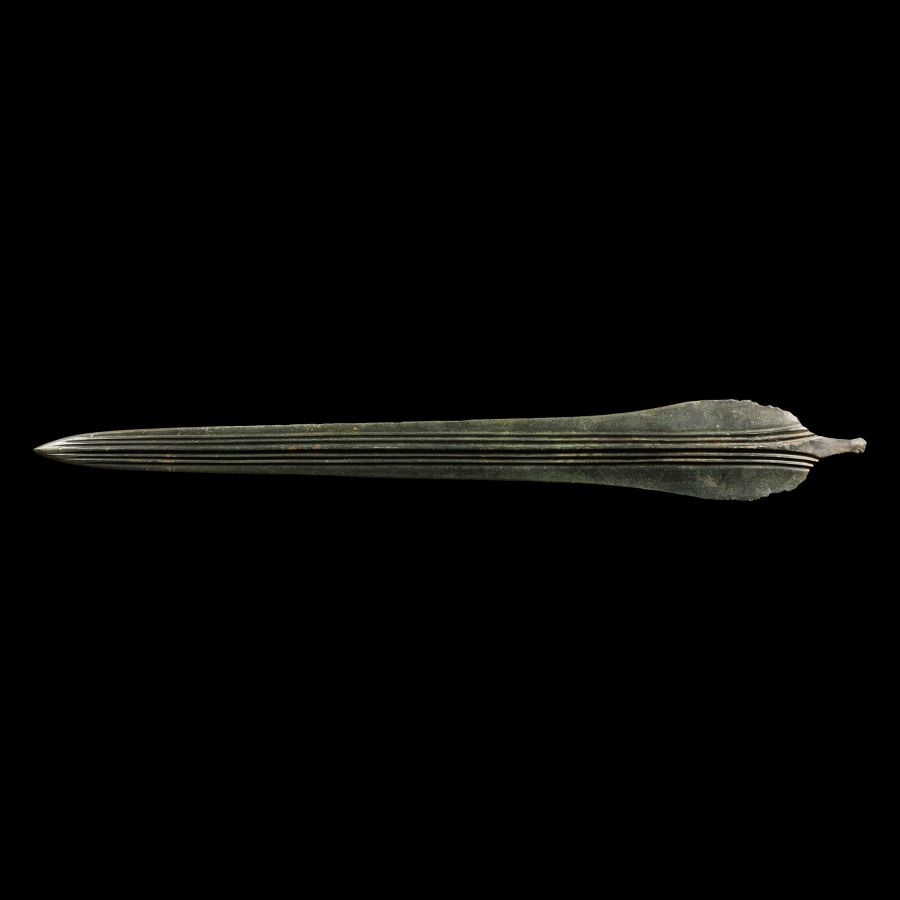
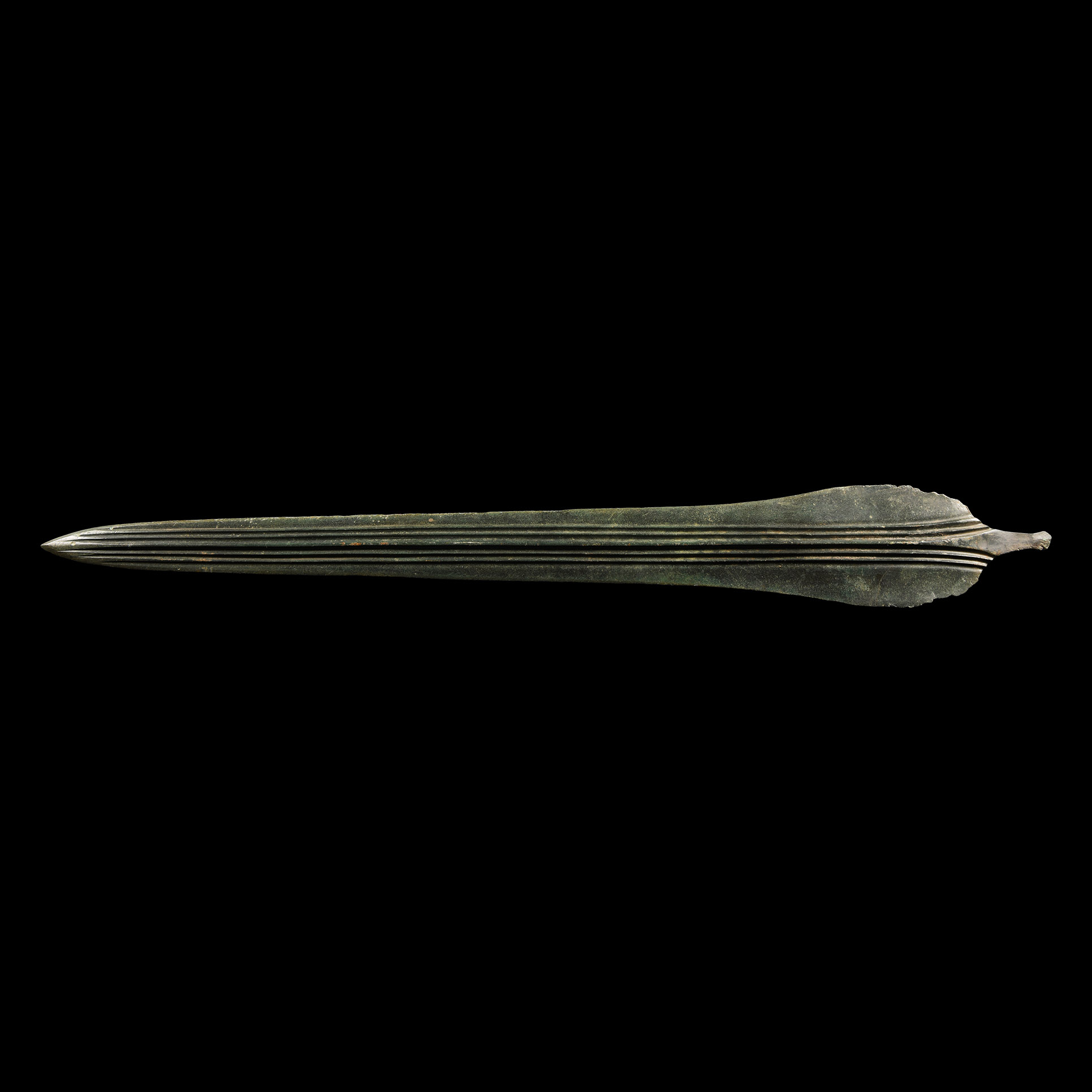
Luristan Sword with Blood Channels
LATE 2ND-EARLY 1ST MILLENNIUM B.C.
16 1/2 in. (295 grams, 42 cm).
A tanged bronze sword of triangular shape with multiple fullers tapering to a pointed tip, the tang forming an extension of the thick ridged midrib.
Provenancewith John Hewitt.
Ex Maurice Braham, acquired from the above.
Lord Alistair McAlpine collection.
Cf. Moorey, P.R.S., Catalogue of the Ancient Persian Bronzes in the Ashmolean Museum, Oxford, 1971, p.78, no.57, for similar; see also Christie's, The Axel Guttmann Collection of Ancient Arms and Armour, part 1, London, 2002, p.26, no.24.
FootnotesThe blade belongs to a sword probably made in a Luristan workshop, once fitted with a conical pommel and a crescentic guard. The metalworking techniques used in making bronze weapons in Luristan were very complex. Surfaces were often finished in repoussé work, and some of the weapons were chased, others engraved.
CONDITIONTimeLine Auctions follows a vetting process to ensure the authenticity and legality of all items, reinforcing our commitment to integrity and responsible trading. Each antiquity, antique, and coin lot undergoes thorough examination by a vetting committee of at least ten external specialists, professional trade association members, scientists, and archaeologists: Our Vetting Process
AUCTIONS:
TimeLine is a leading auction house specialising in antiquities, ancient art, collectables, natural history, coins, medals, and books. Our auctions offer museums, collectors, historians, and enthusiasts the opportunity to acquire unique and historically significant pieces.
LOT 0223
Luristan Sword with Blood Channels
Estimate £1,000 - 1,400€1,160 - 1,620 (for guidance only)$1,350 - 1,890 (for guidance only)
-
Viking Age Sword with Five-Lobed Pommel
10th century A.D.Sold for (Inc. bp): £12,350
A double-edged sword of Petersen Type L or S variant with straight tapering blade, light traces of pattern-welding and battle-nicks along the blade, tapering fullers and a sturdy long tang; boat-shaped lower guard curving gently towards the blade, decorated with punched ring-and-dot ornament along the edges; the upper guard with Trewhiddle Style ornament, surmounted by an elegant five-lobed pommel decorated with geometric patterns in the same style; cleaned and conserved. 755 grams, 89 cm
Acquired 1971-1972. From the collection of the vendor's father. Property of a London, UK, collector. Accompanied by an academic report by Dr Raffaele D’Amato. This lot has been checked against the Interpol Database of stolen works of art and is accompanied by searcher certificate no.11574-198855. -
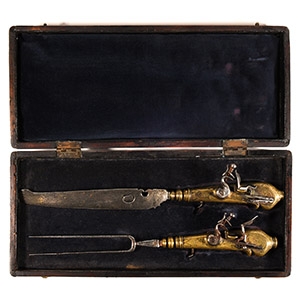
Cased Flintlock 'Knife and Fork' Gun Pair
19th century A.D.Sold for (Inc. bp): £4,160
A pair of smooth-bore flintlock pistols of about 5mm bore formed as a knife and fork (two tines) set; with steel blades (the knife with a profile bust maker's mark) with the pistols contained within the brass foliate engraved handles, firing to the rear; each fitted with finely made steel single action flintlock mechanism to sides; contained in the original velvet-lined mahogany case with hinged lid and brass catches; actions in working order. 1.31 kg total, case 30 x 13 cm
Acquired Peter Wilson Auction, 2020, lot 13. Property of a Kent collector. Accompanied by lot ticket.
Sold as an exempt item under Section 58 (2) of the Firearms Act, 1968, to be held as a curiosity or ornament. No license required but buyer must be over 18 years of age. -
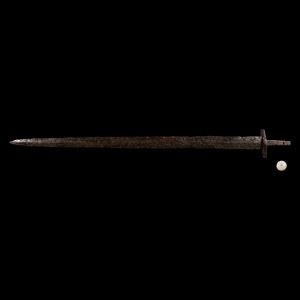
Migration Period Spatha Sword Blade with Sword Bead
Circa 4th-5th century A.D.Sold for (Inc. bp): £572
A double-edged spatha with a lentoid section parallel-sided iron blade with pointed tip; battle nicks to both cutting edges; rhomboid-section cross-guard; a fastening nail on the upper tang; accompanied by a sword bead. 921 grams total, 2.7- 86.5 cm
cleaned and conserved.
Acquired 1971-1972. From the collection of the vendor's father. Property of a London, UK, collector. Accompanied by an academic report by Dr Raffaele D’Amato.
A Migration Period sword, originating from Central Asia, often used by nomadic populations and particularly by the Huns, defined as a Nomadic-Asiatic sword by Menghin, or as a sword with plate guard. The long and thin blade, with a lenticular or lozenge section, was equipped with a guard composed of an iron plate inserted into the tang. Little is known about the scabbard of these swords but it is known that they usually had disc-shaped pommels, and stones hanging from the pommel or hilt. This typology was widespread in Central Europe by the Huns and there are also specimens attested in Gaul in the 5th century.
