
Loading, please wait...
LOT 0222
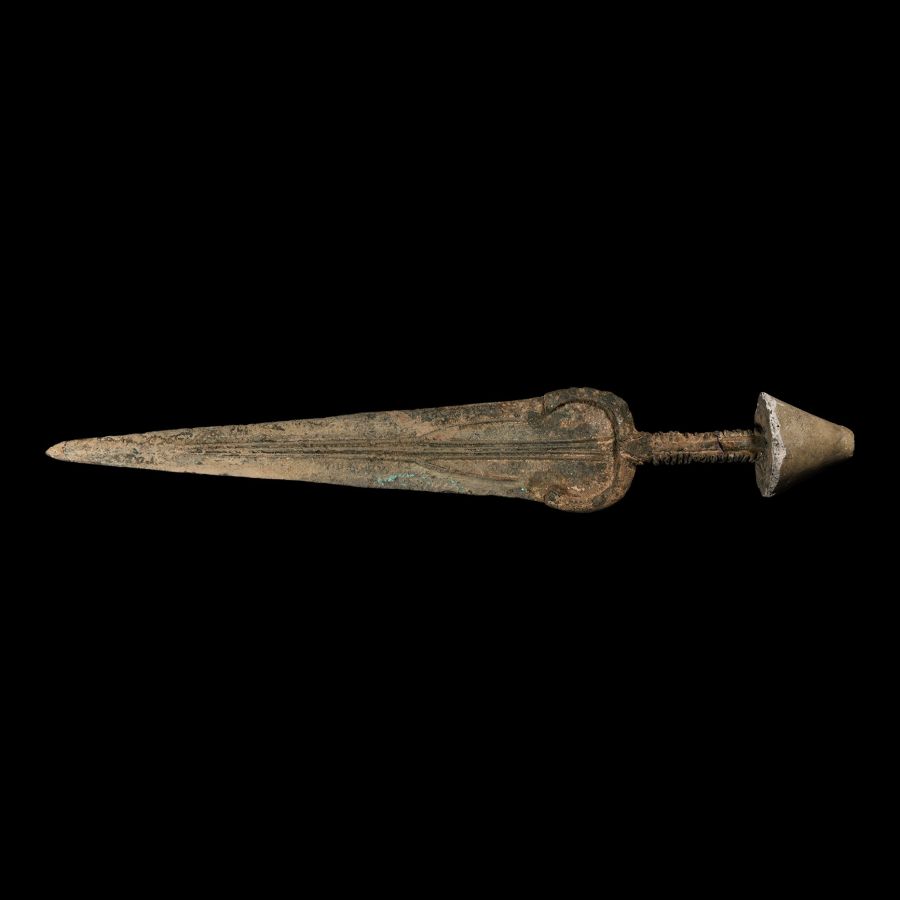
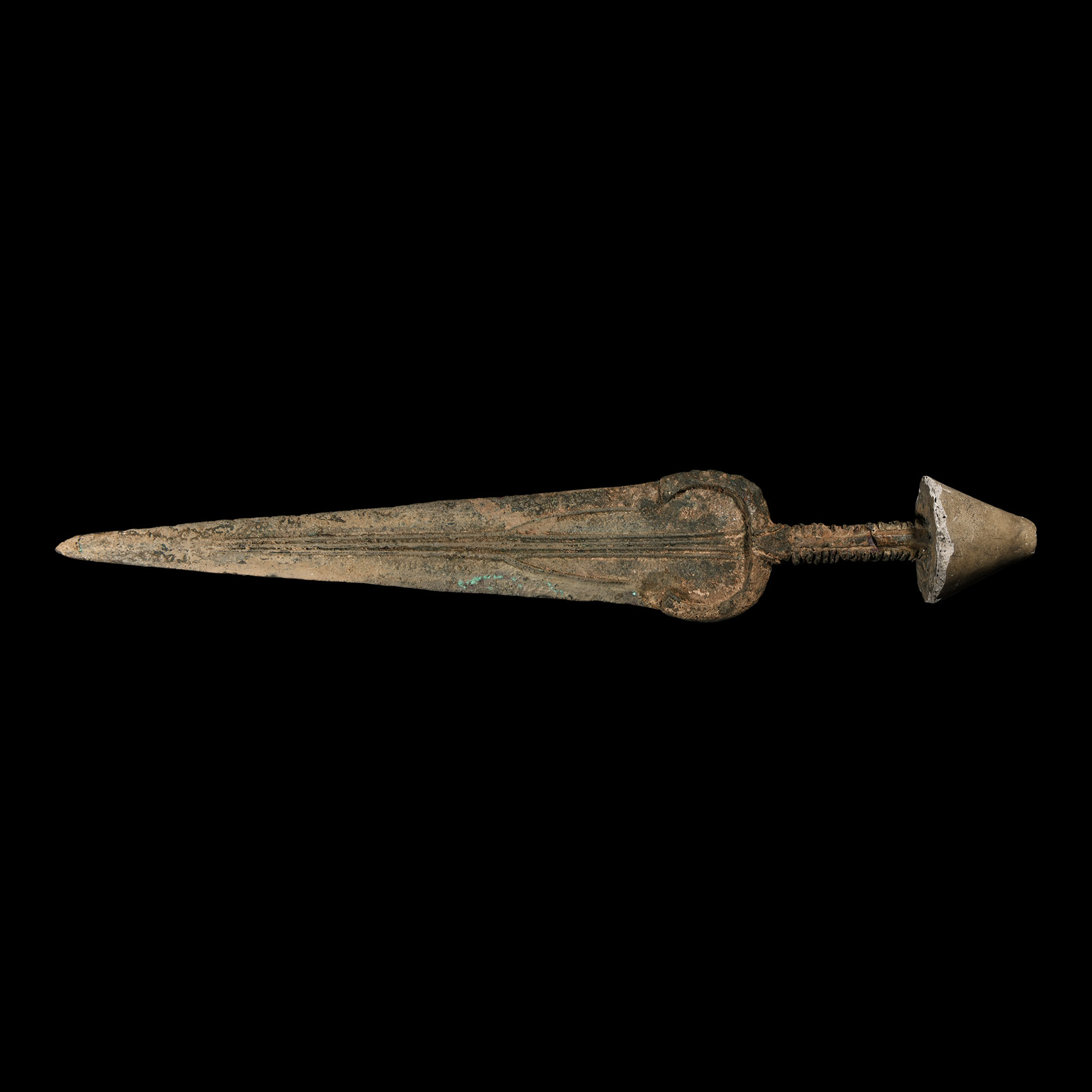
Luristan Sword Blade
LATE 2ND MILLENNIUM B.C.
22 in. (876 grams, 56 cm).
A bronze sword with solid cast hilt with penannular guard and a horizontally ribbed grip; a conical stone mushroom pommel and a multi-fullered blade tapering to a sharp tip; handle repaired.
ProvenanceAcquired 1980-2015.
Ex Abelita family collection.
Cf. Khorasani, M. M., Arms and Armor from Iran: The Bronze Age to the End of the Qajar Period, Tübingen, 2006, pp.394-5, for type.
FootnotesAccording to Moorey, such category of swords were distributed in the Northern Iran area, as proved by the Amarlu finds. Based on the example from the Ashmolean Museum, he dated them to the end of the 2nd millennium B.C., more precisely to a period between 1400-1200 B.C.
CONDITIONTimeLine Auctions follows a vetting process to ensure the authenticity and legality of all items, reinforcing our commitment to integrity and responsible trading. Each antiquity, antique, and coin lot undergoes thorough examination by a vetting committee of at least ten external specialists, professional trade association members, scientists, and archaeologists: Our Vetting Process
AUCTIONS:
TimeLine is a leading auction house specialising in antiquities, ancient art, collectables, natural history, coins, medals, and books. Our auctions offer museums, collectors, historians, and enthusiasts the opportunity to acquire unique and historically significant pieces.
-
Migration Period Sword Blade with Agate Pommel
Circa 5th-6th century A.D.Sold for (Inc. bp): £975
A two-edged parallel-sided iron blade with broad pointed tip, battle nicks to both cutting edges; accompanied by a discoid agate pommel. 823 grams total, 3.5-83 cm
cleaned and conserved
Acquired 1971-1972. From the collection of the vendor's father. Property of a London, UK, collector. Accompanied by an academic report by Dr Raffaele D’Amato. -
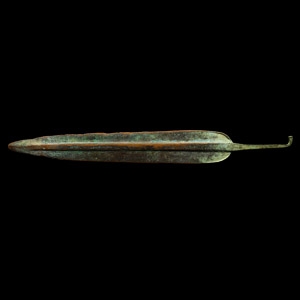
Marlik Spearhead with Pronounced Ridge
14th-10th century B.C.Sold for (Inc. bp): £114
A heavy bronze spearhead comprising an oval blade with gently curved shoulders and strong midrib, flat rectangular-section tang tapering to a curved end. 432 grams, 45.8 cm
Fine condition.
Ex Abelita family collection, 1980-2015.
The spearhead belongs to the type V of the heavy spearheads, similar to the ones excavated by Dr. Negahban in Tomb 47 (Trench XXIIE) of the Marlik necropolis. The heavy spearheads, cast in one piece, usually have an oval blade with rounded gently curved shoulders and a rounded midrib near the tang. -
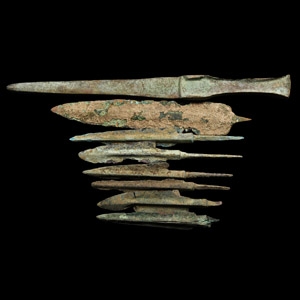
Luristan Mixed Blade Group
2nd-1st millennium B.C. and laterSold for (Inc. bp): £169
A mixed group of bronze bladed weapons including arrowheads; dagger believed to be a reproduction. 374 grams total, 11.4-26.5 cm
Acquired 1970s-1990s. Ex Rabi Gallery, Mayfair, London, U.K. From a specialist collection of pottery.
