
Loading, please wait...


LOT 1353
Luristan Stag Statuette
2ND-1ST MILLENNIUM B.C.
4 1/8 in. (91.31 grams, 10.56 mm).
Modelled in the round on a waisted rectangular base, head turned.
ProvenanceEx Abelita family collection, 1980s-2000s.
CONDITIONTimeLine Auctions follows a vetting process to ensure the authenticity and legality of all items, reinforcing our commitment to integrity and responsible trading. Each antiquity, antique, and coin lot undergoes thorough examination by a vetting committee of at least ten external specialists, professional trade association members, scientists, and archaeologists: Our Vetting Process
AUCTIONS:
TimeLine is a leading auction house specialising in antiquities, ancient art, collectables, natural history, coins, medals, and books. Our auctions offer museums, collectors, historians, and enthusiasts the opportunity to acquire unique and historically significant pieces.
-
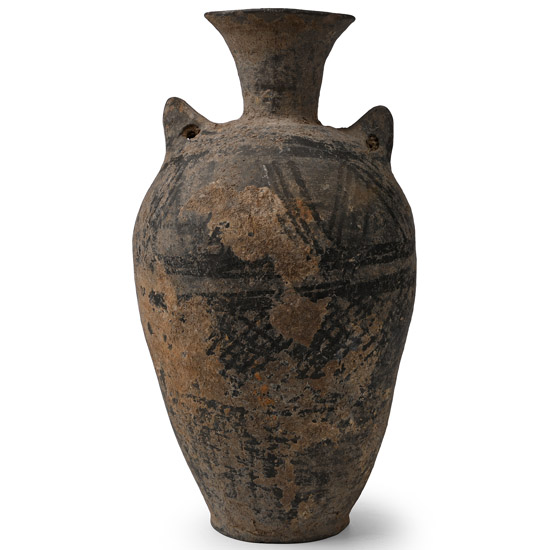
Amlash Terracotta Net-Painted Handled Vase
1st millennium B.C.Sold for (Inc. bp): £182
Piriform body and a funicular neck, two pierced lug handles above the shoulder, a circumferential band of dense net decoration on the body, and the shoulder decorated with a band of concentric triangles. 584 grams, 22 cm
Ex Abelita collection, 1990s. -
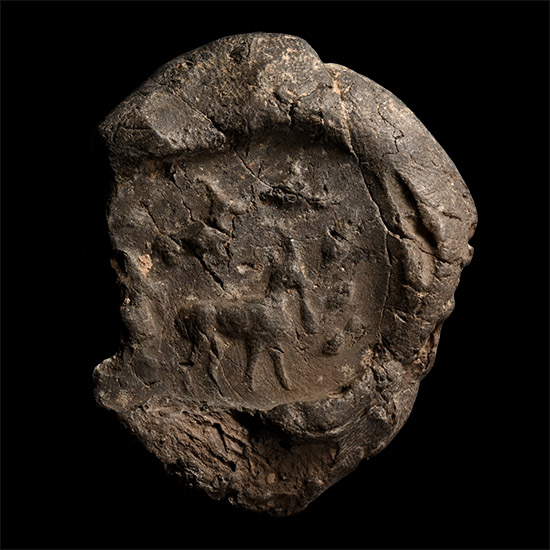
Large Sasanian Terracotta Bulla with Animals
Circa 400-600 A.D.Sold for (Inc. bp): £20
A large fragment of a bulla showing a standing ibex and other animals. 21.6 grams, 45 mm
From the private collection of a European gentleman (1942-2024), formed since the 1970s. -

Large West Central Asian Bronze Seal Matrix with Cross of Trees
Circa 2300-2000 B.C.Sold for (Inc. bp): £98
Openwork seal matrix with a loop on the reverse, accompanied by an old scholarly note, typed and signed by W.G. Lambert, late Professor of Assyriology, University of Birmingham, 1970-1993, which states: 'Stamp Seal of Bronze, 40 x 40 x 14 mm. This is round, with flat face and flat back, on which is mounted a handle of inverted U-shape. The design consists of a central oblong joined to the outer rim with struts. From the centre of each side of the oblong is a short strut joining two crescent shaped lines creating the impression of a tree, and between each such combination is a single straight strut from oblong to edge. This comes from west central Asia and dates to c. 2300-2000 B.C. The metal is in very good condition, and the whole seal is also in fine state of preservation.' 15.2 grams, 40 mm
Acquired in the late 1980s-early 1990s. Ex property of a West London businessman. Academically researched and catalogued by the late Professor Lambert in the early 1990s. Accompanied by a copy of a scholarly report, numbered N-11, typed and signed by Professor Wilfrid George Lambert.
