
Loading, please wait...
LOT 1099
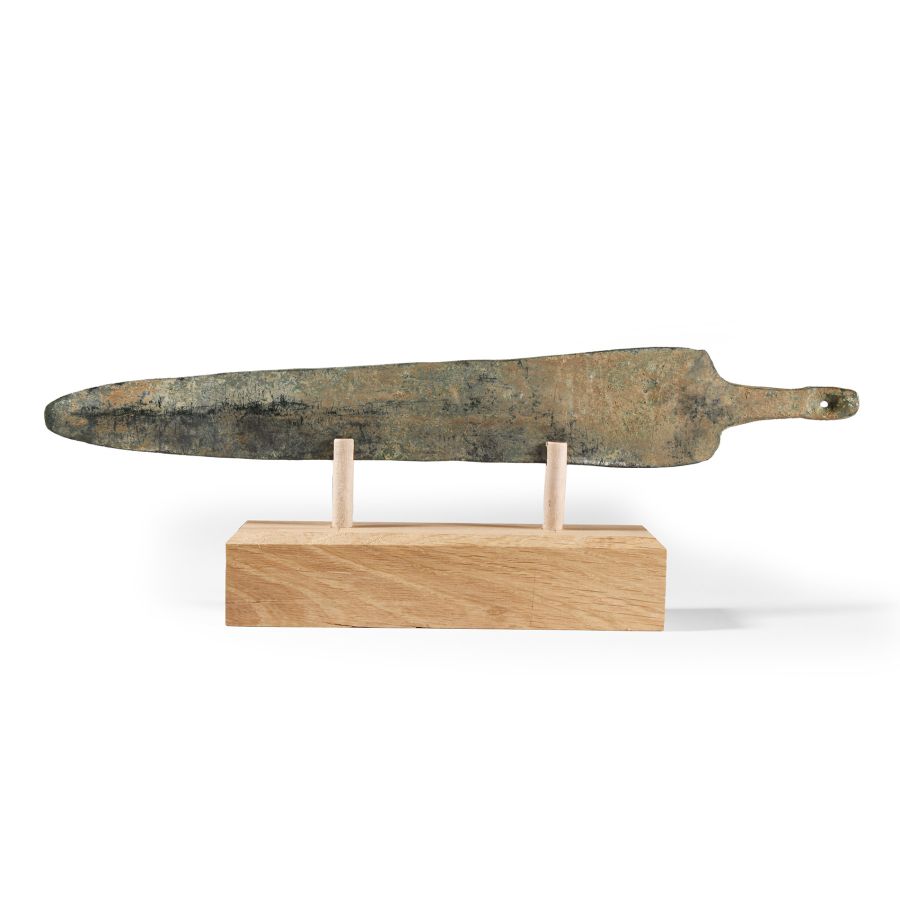
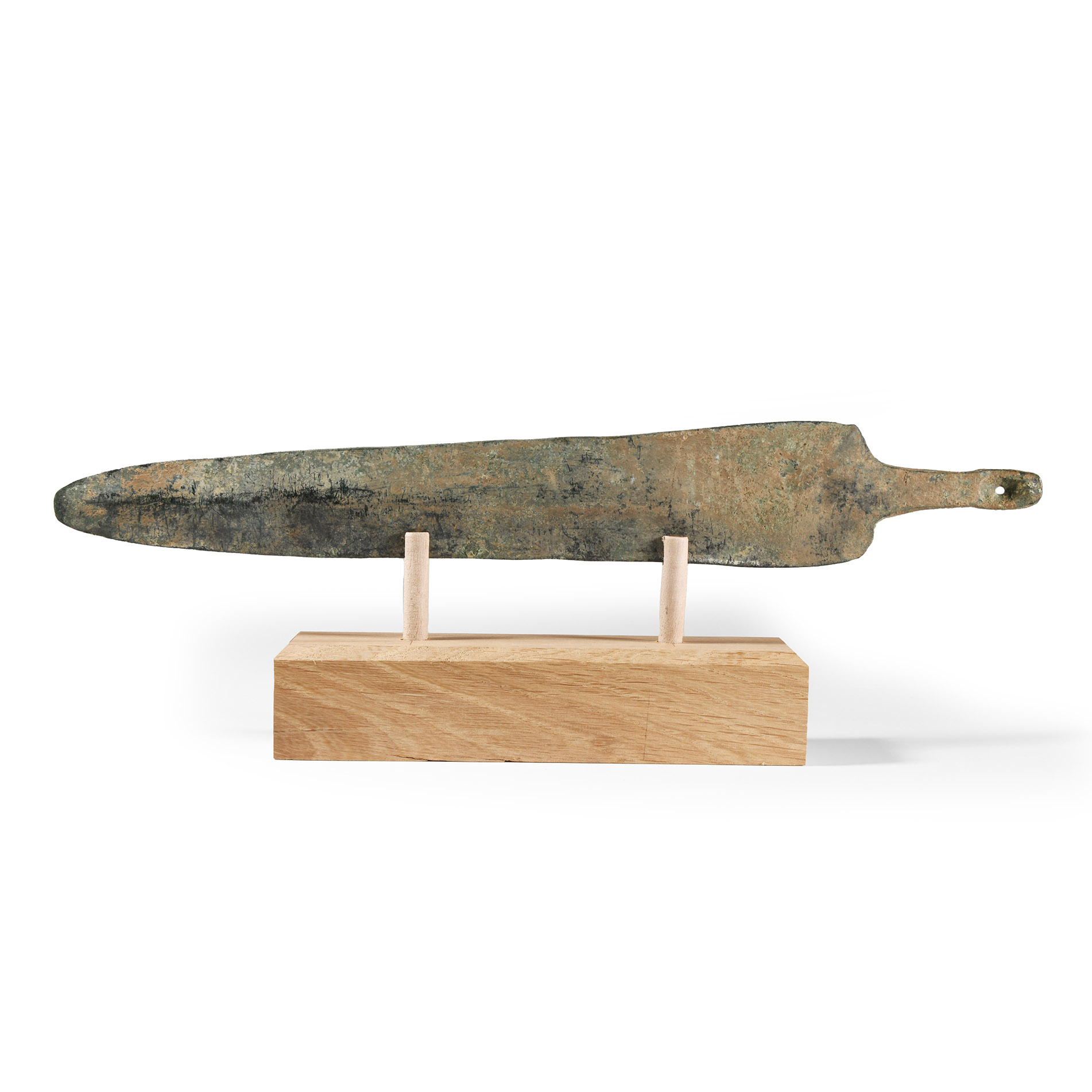
Luristan Short Sword Blade
CIRCA 13TH-6TH CENTURY B.C.
15 in. (880 grams total, 38 cm wide including stand).
With a broad, lentoid-section blade and wide raised flange down centre, rounded tip, straight sides, well marked shoulders with narrow tang, one hole for rivet to attach an organic hilt; mounted on a custom-made stand. [No Reserve]
ProvenanceAcquired 1980-1990s.
From the private collection of H.N., Milton Keynes, Bedfordshire, UK.
See Maxwell-Hyslop, R., Daggers and swords in Western Asia: a Study from Prehistoric Times to 600BC, in Iraq, Volume 8, 1946, pp.1-65, pl.II, type 12.
FootnotesThis kind of weapon was used in the early 2nd millennium B.C. in Mesopotamia and in Syria and as late as the mid-first millennium in Luristan.
CONDITIONTimeLine Auctions follows a vetting process to ensure the authenticity and legality of all items, reinforcing our commitment to integrity and responsible trading. Each antiquity, antique, and coin lot undergoes thorough examination by a vetting committee of at least ten external specialists, professional trade association members, scientists, and archaeologists: Our Vetting Process
AUCTIONS:
TimeLine is a leading auction house specialising in antiquities, ancient art, collectables, natural history, coins, medals, and books. Our auctions offer museums, collectors, historians, and enthusiasts the opportunity to acquire unique and historically significant pieces.
-
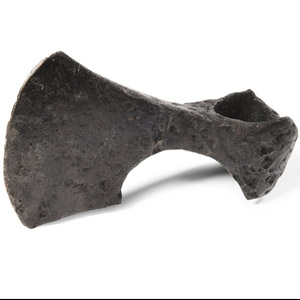
Viking Age Iron Bearded Axehead
9th century A.D.Sold for (Inc. bp): £338
Hand-forged with triangular-section narrow blade widening to a broad bevelled edge with square chin, socket with lateral flanges and rounded panel to the rear. 359 grams, 12.4 cm
From the private collection of a London gentleman, from his grandfather's collection formed before the early 1970s.
The axe seems to belong to the typology of Viking side axes of Wheeler type B (Wheeler III / Rygh 559). Usually these bearded axeheads (skeggöks) had a longer edge, designed to split tree trunks into planks and beams, or heads in two parts. Some of the bearded axes were known as halfÞynna öx, the neck on such 'half thin axe' was thinly forged, to make it lighter. -
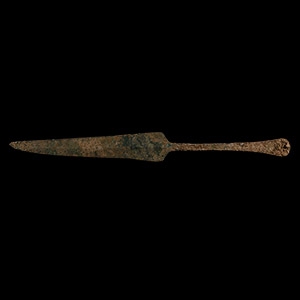
North-Western Persian Type Bronze Blade
Early 1st millennium B.C.Estimate: £100 - 140 (+bp*)
Opening Bid: £50
With tapering triangular blade, having straight shoulders, flat midrib and tapering square-sectioned tang ending with a rounded pommel. 99 grams, 33 cm
Acquired 1980-2015. Ex Abelita family collection.
Moorey, Gordon and Khorasani created a classification of bladed weapons, according to which daggers are edged weapons not greater than 36cm in length, dirks (short swords) are between 36cm and 50cm in length, and swords are edged weapons greater than 50cm in length. -
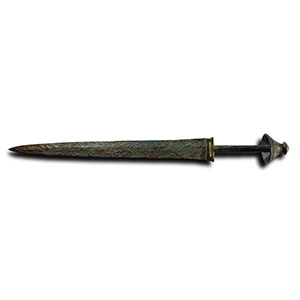
Amarlu Bronze Dagger with Bell-shaped Pommel
Late 2nd millennium B.C.Sold for (Inc. bp): £715
With solid cast hilt, straight horizontal guard with turquoise inlay; plain narrow grip with conical hollow cast mushroom pommel decorated with dots and lines; wide shallow midrib on the blade tapering to a sharp tip. 505 grams, 52 cm
Ex old English collection. London art market, pre 2000. Property of a London, UK, gentleman.
Moorey and Khorasani dated swords with mushroom pommels to the end of the second millennium B.C. The weapon belongs to Category IX of the Khorasani classification, the ones with a mushroom or bell-shaped pommel. A similar example is in the National Museum of Iran, Tehran.
