
Loading, please wait...
LOT 0939
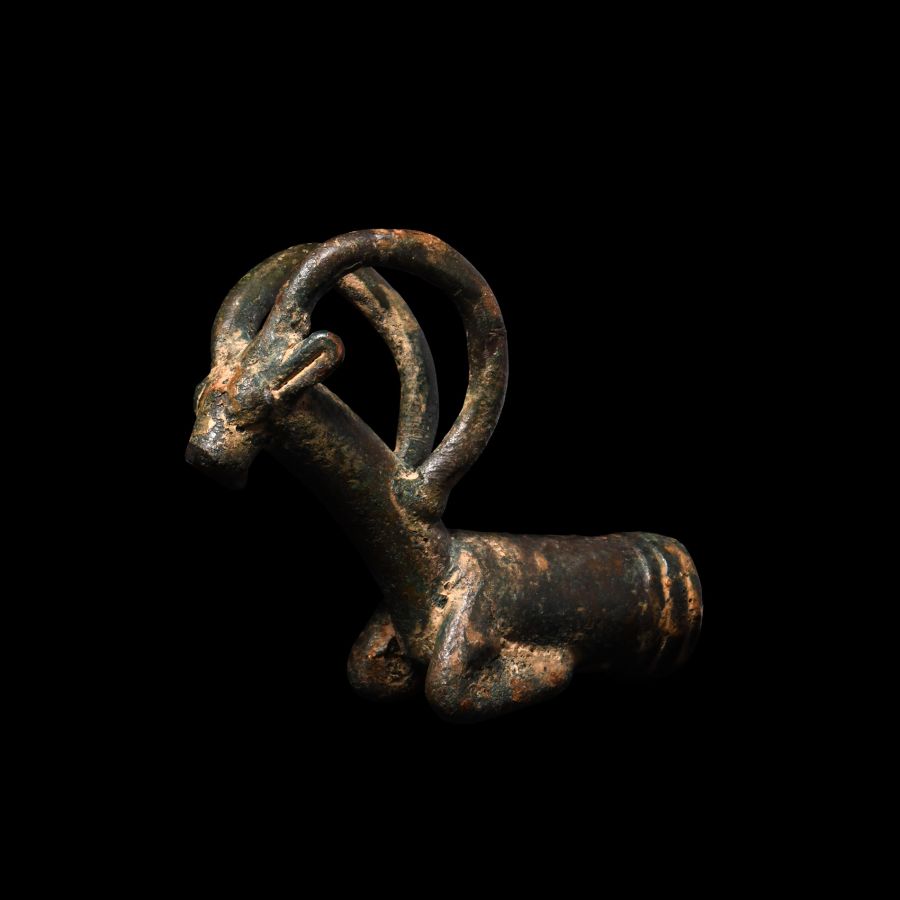
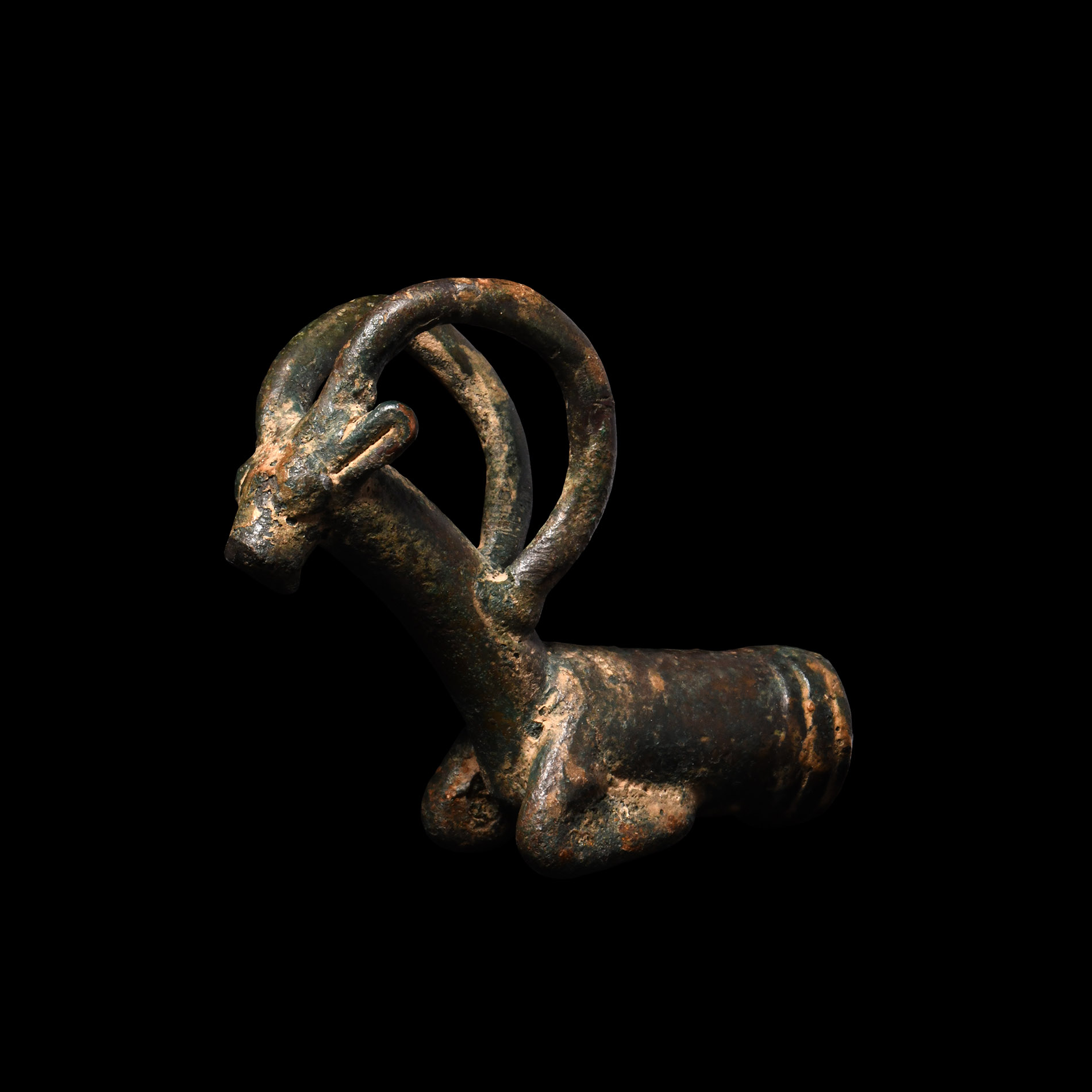
Luristan Mouflon Whetstone Terminal
13TH-7TH CENTURY B.C.
2 1/2 in. (64 grams, 63 mm wide).
A copper-alloy whetstone terminal in the form of the head and forequarters of a mouflon, with a cylindrical body, legs tucked beneath its chest, large curved horns creating two closed loops, large pricked ears and stylised facial features.
ProvenanceAcquired 1990s.
From an important Paris gallery, France.
Ex Parisian collection.
TimeLine Auctions follows a vetting process to ensure the authenticity and legality of all items, reinforcing our commitment to integrity and responsible trading. Each antiquity, antique, and coin lot undergoes thorough examination by a vetting committee of at least ten external specialists, professional trade association members, scientists, and archaeologists: Our Vetting Process
AUCTIONS:
TimeLine is a leading auction house specialising in antiquities, ancient art, collectables, natural history, coins, medals, and books. Our auctions offer museums, collectors, historians, and enthusiasts the opportunity to acquire unique and historically significant pieces.
-
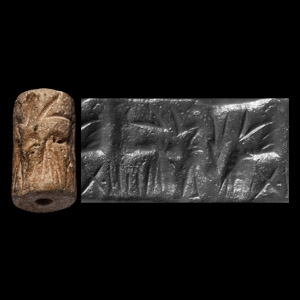
Sumerian Cylinder Seal with Banqueting Scene
26th-24th century B.C.Sold for (Inc. bp): £191
A chalk cylinder seal with frieze; accompanied by an old scholarly note, handwritten and signed by W.G. Lambert, late Professor of Assyriology, University of Birmingham, 1970-1993, which states: 'Cylinder seal of white stone, 28x17 mm. Two facing seated drinkers, wearing long robes and holding up cups. Standing servant in short clothes between them. Vessel with pointed base and two straws in it. Mesopotamian, c.2600-2400 B.C.. Top of seal damaged, but design deep and clear.' In a different hand beneath 'Sumerian seal; early Dynastic Period III. Banquet scene. Manuscript of Prof. W.G. Lambert' and further notation to the reverse; accompanied by a museum-quality impression. 7.2 grams, 28 mm
Fine condition.
From the private collection of Emilio Bacarani, Valbonne, France, 1950-1988. Acquired in 1988. From the collection of G.M.R.H., London, UK. Accompanied by an original handwritten unsigned scholarly note by Professor Wilfrid George Lambert FBA. -
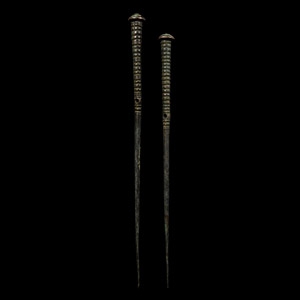
Luristan Decorated Pin Pair
13th-6th century B.C.Sold for (Inc. bp): £59
A pair of bronze pins composed of tapering round-section stems with ribbed upper bodies and domed heads; pierced. 111 grams total, 22-23.5 cm
UK private collection before 2000. UK art market. Property of a London gentleman. -
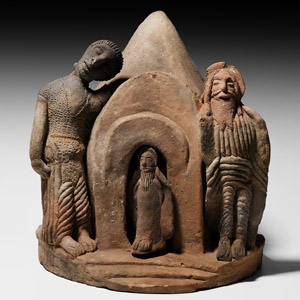
Western Asiatic Terracotta House with Inhabitants
20th century A.D.Sold for (Inc. bp): £91
A terracotta diorama comprising a Middle Eastern conical hut or dwelling with arched frame around the D-shaped entrance; two figures placed beside the doorway: to the left a tall slender with luxuriant curls male wearing a textured shirt (mailcoat?) and ruched trousers, barefoot, resting his head on the frame; to the right a shorter bearded male waring a cloak and quilted tunic and trousers. 9.1 kg, 27 cm
Acquired 1970-1999. Ex collection of deceased Mayfair gentleman.
