
Loading, please wait...
_900x900.jpg "Luristan 'Mistress of Animals' Bridle Bit")
_200x200.jpg "Luristan 'Mistress of Animals' Bridle Bit")
.jpg "Luristan 'Mistress of Animals' Bridle Bit")
LOT 0260
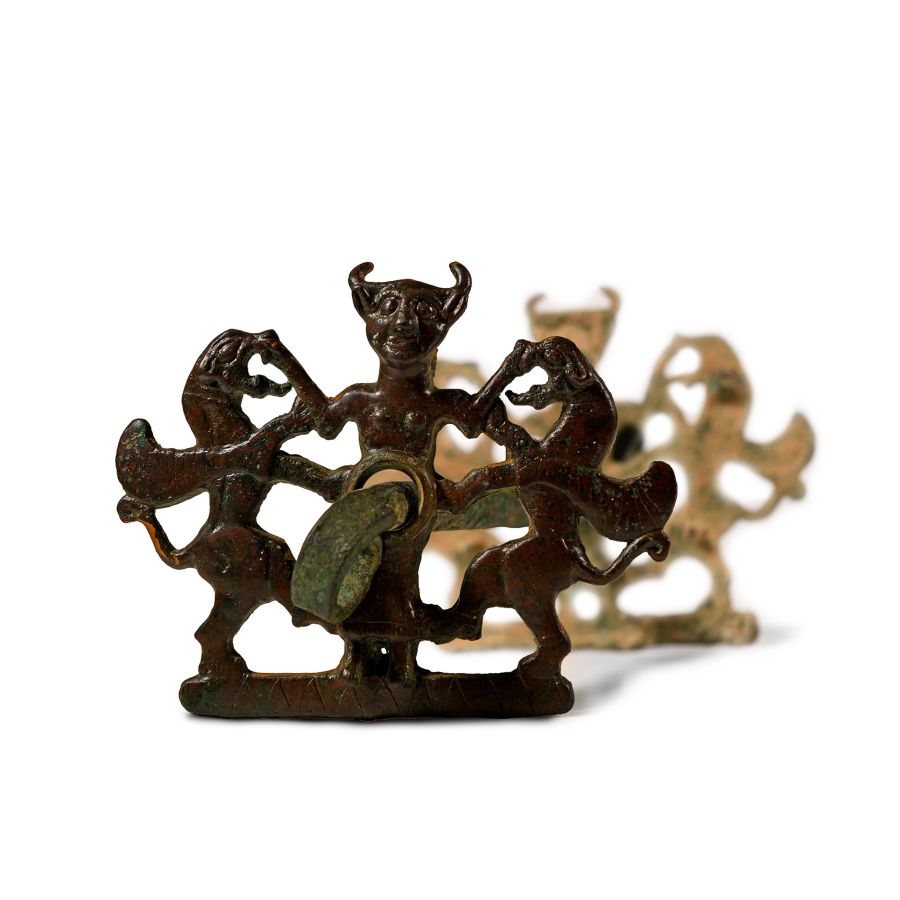
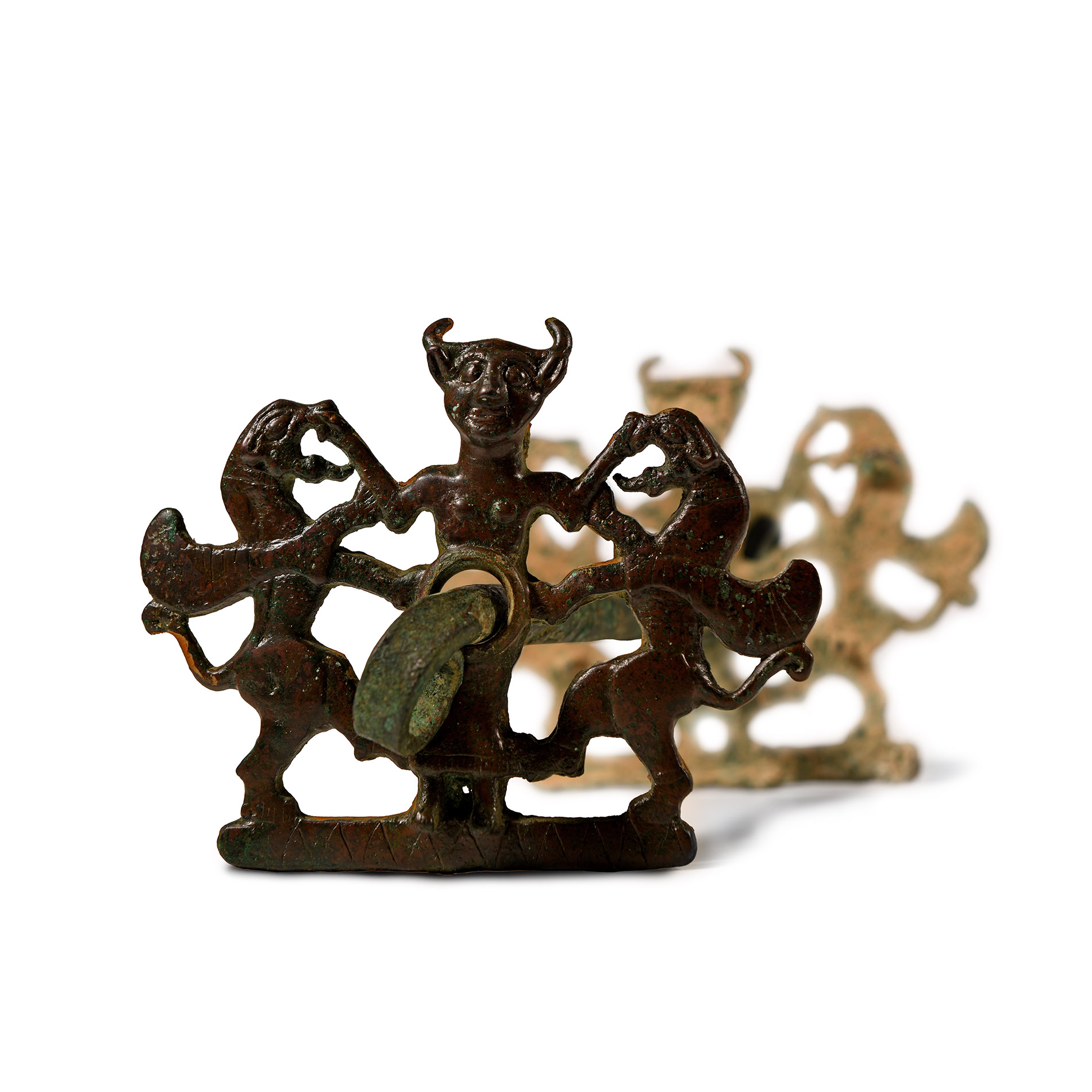
Luristan 'Mistress of Animals' Bridle Bit
CIRCA 9TH-7TH CENTURY B.C.
9 5/8 in. (1.03 kg, 24.5 cm).
Each cheekpiece comprising the figure of a goddess on a rectangular base, standing in a long fringed robe and tiara with horns emerging from his head, grasping an attacking rampant winged griffin or winged lion in each hand, three loops to the reverse, perforated through the body through which the long mouthpiece passes.
ProvenanceAcquired on the London art market, 1995.
Ex Christie's London, 2nd April 2014, no.32.
From the private collection of a North West London, UK, gentleman.
Accompanied by a previous collection photograph and copies of the relevant Christie's catalogue pages.
Accompanied by an academic report by Dr Raffaele D'Amato.
This lot has been checked against the Interpol Database of stolen works of art and is accompanied by a search certificate number no.12049-217395.
Cf. Legrain, L., Luristan Bronzes in the University Museum, Philadelphia, 1934, pl.XVI, for the bit; Godard, F., The Art of Iran, London, 1965, item 16; Moorey, P.R.S., Ancient Bronzes from Luristan, London, 1974, plate V (A), for the bronze harness bit, and VIIB, for a complete similar bronze bit; Moorey, P.R.S., ‘ The Art of Ancient Iran’ in Ancient Bronzes, Ceramics and Seals, Los Angeles, 1981, item 43; Musée Cernuschi, Bronzes du Luristan, Enigmes de l’Iran Ancien, IIIe-Ier Millenaire av.J.C., Paris, 2008, no.87, p.123, for a similar bit with a male Master of Animals.
FootnotesThe image of a deity holding two animals is ancient and found in many cultures and can depict either a male or female divinity. The goddess was known by the Greek as Potnia Theron, or "Lady of the Animals", a term first used by Homer in the Iliad.
CONDITIONTimeLine Auctions follows a vetting process to ensure the authenticity and legality of all items, reinforcing our commitment to integrity and responsible trading. Each antiquity, antique, and coin lot undergoes thorough examination by a vetting committee of at least ten external specialists, professional trade association members, scientists, and archaeologists: Our Vetting Process
AUCTIONS:
TimeLine is a leading auction house specialising in antiquities, ancient art, collectables, natural history, coins, medals, and books. Our auctions offer museums, collectors, historians, and enthusiasts the opportunity to acquire unique and historically significant pieces.
LOT 0260
Luristan 'Mistress of Animals' Bridle Bit
Estimate £3,000 - 4,000€3,480 - 4,640 (for guidance only)$4,050 - 5,400 (for guidance only)
-
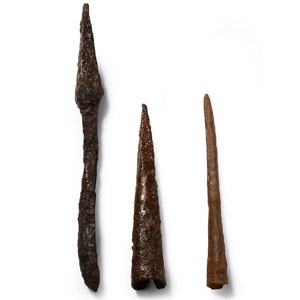
Roman Iron Ferrules and Javelin Head Group
3rd century A.D.Sold for (Inc. bp): £78
Comprising: square-section missile head with short neck; conical ferrule with square-section finial; conical ferrule socket with long square-section finial. 64 grams total, 8.2-12.8 cm
Found S.E. England, UK. Acquired from Allan Cherry, Bournemouth, UK, circa 2004. Ian Wilkinson collection, Nottinghamshire, UK.
The usual form of the butt of the spears in this period was a cone shape, sometimes split down one side, but more often forged into a complete circle. The butt was fastened to the wooden shaft by one or more rivets. The butt or ferrule of the Roman spears essentially had two functions. Firstly it acted as a counterweight to the blade of the spear/javelin, ensuring that the weapon was balanced and therefore effective. Secondly, it kept the wooden shaft out of contact with the ground if the spear was grounded and thus avoiding damage to it. -
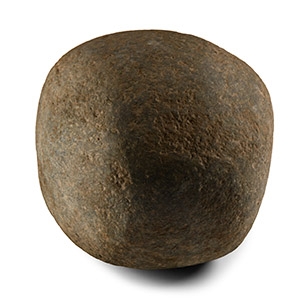
Stone Ballista Catapult Shot
Roman, 1st-3rd century A.D. or laterSold for (Inc. bp): £26
Roughly spherical stone cobble with impact scar. 973 grams, 81 mm
From a collection acquired on the UK art market from various auction houses and collections mostly before 2000. From an important Cambridgeshire estate; thence by descent.
The operation of the onager (Latin for 'wild ass') is first mentioned in 353 A.D. by Ammianus Marcellinus in his Res Gestae and more fully in Vegetius's Epitoma Rei Militaris probably written in the reign of Emperor Theodosius I (378-395 A.D.). -
.jpg)
Medieval Bronze Archer's Thumb Ring
13th-15th century A.D.Sold for (Inc. bp): £72
With geometric design on a hatched background and discoid pad to rear. 7.31 grams, 26.60 mm overall, 22.48 mm internal diameter (approximate size British X 1/2 , USA 11 3/4, Europe 26.92, Japan 25)
Acquired in the 1990s. Ex Private collection, Suffolk, UK. Property of a Kent lady collector.
