
Loading, please wait...
LOT 1060
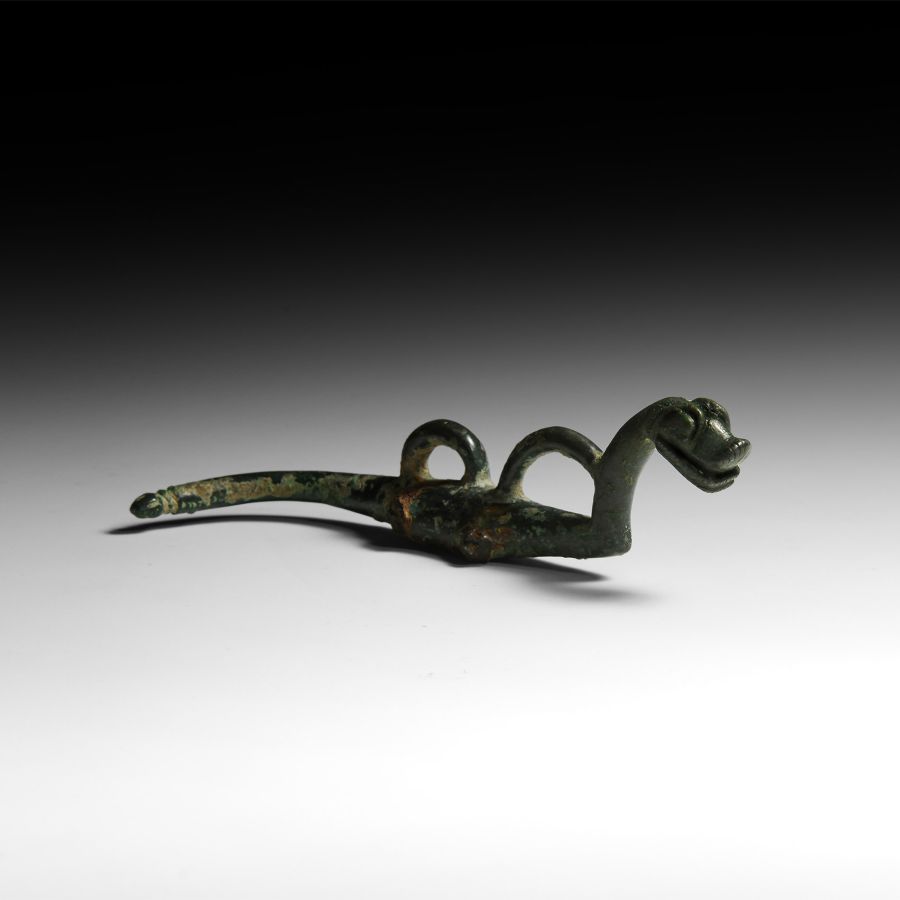
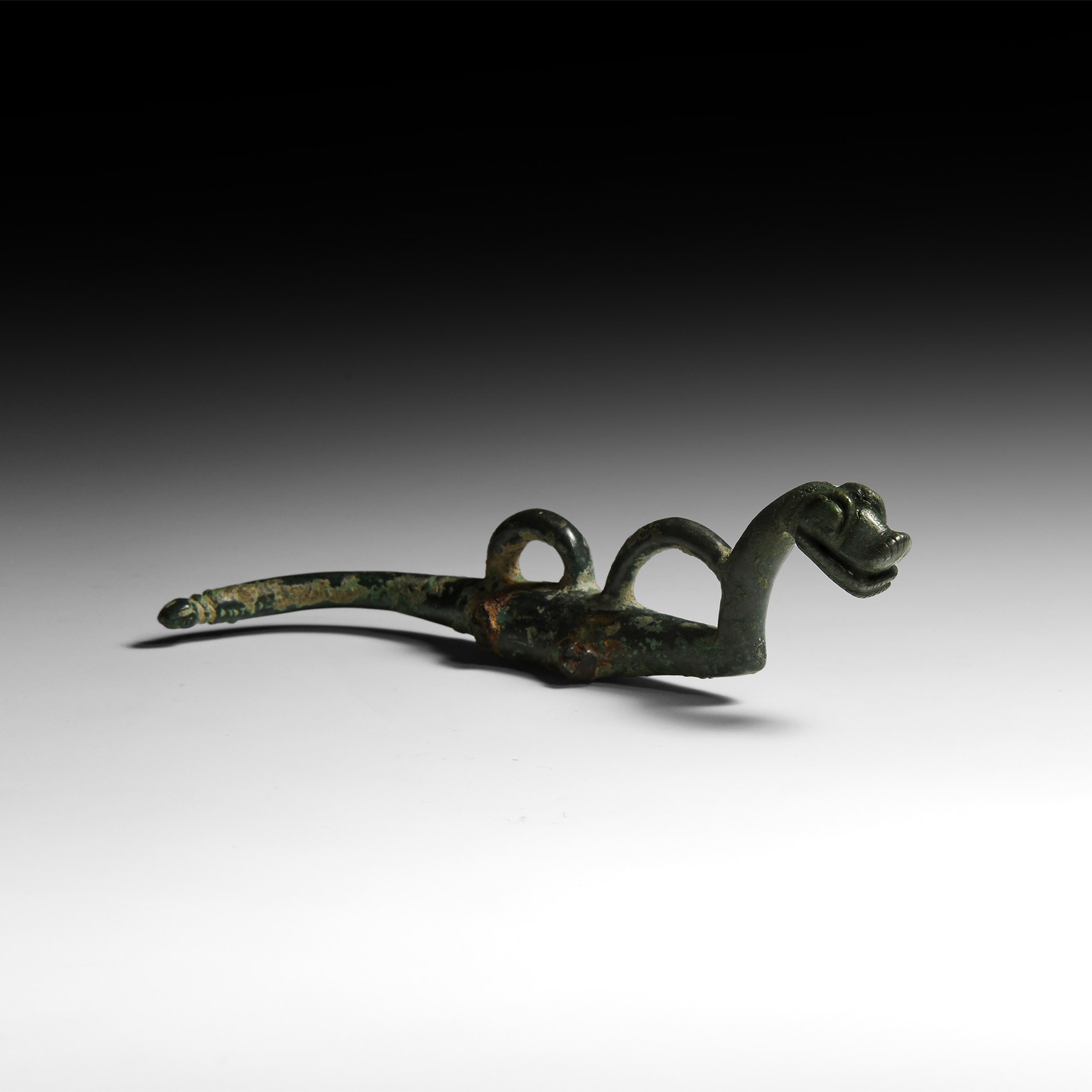
Luristan Horse Harness Cheekpiece
11TH-8TH CENTURY B.C.
5 1/4 in. (130 grams, 13.5 cm wide).
A bronze cheek-piece element in the form of a righthand side bar, surmounted by two loops for additional straps, ending in a lion's head at the front, the other extremity bending outwards and ending with a conical tip, remains of the iron bar visible on the sides; once belonging to an articulate bit.
ProvenanceAcquired mid 1980s to early 1990s.
Private family collection formed in London, UK.
Cf. Musee' Cernuschi, Bronzes de Luristan, enigmes de l'Iran Ancien, IIIe-Ier millenaire av. J.C., Paris, 2008, p.107, no.62, for similar types.
FootnotesThe association of Psalia in the shape of a bar and with an articulated bit is documented in Assyria, in Media and in central Iran starting from the 10th century B.C., but the zoomorphic elements of this specimen suggest that it was produced in Luristan. The use of articulated bits, which moved inside the horse's mouth, exerting a minimal pressure on the reins, allowed for better control of the mount.
CONDITIONTimeLine Auctions follows a vetting process to ensure the authenticity and legality of all items, reinforcing our commitment to integrity and responsible trading. Each antiquity, antique, and coin lot undergoes thorough examination by a vetting committee of at least ten external specialists, professional trade association members, scientists, and archaeologists: Our Vetting Process
AUCTIONS:
TimeLine is a leading auction house specialising in antiquities, ancient art, collectables, natural history, coins, medals, and books. Our auctions offer museums, collectors, historians, and enthusiasts the opportunity to acquire unique and historically significant pieces.
LOT 1060
Luristan Horse Harness Cheekpiece
Estimate £400 - 600€460 - 700 (for guidance only)$540 - 810 (for guidance only)
-
Luristan Dirk with Cuneiform Inscription
1125-1104 B.C.Estimate: £8,000 - 10,000 (+bp*)
Opening Bid: £4,000
A bronze dirk or dagger with raised flanges to the grip, possibly to accept organic inserts, cuneiform script over two lines inscribed to the blade below the grip on both faces; blade repaired. 188 grams, 40 cm
with a London, UK gallery 1971-early 2000s. Accompanied by an academic report by Dr Raffaele D'Amato. This lot has been checked against the Interpol Database of stolen works of art and is accompanied by search certificate number no.11591-199676.
This is a dagger with an inscription of King Nebuchadnezzar I of Babylon, 1125-1104 B.C. The inscription is identical to those on four other bronze daggers (reportedly from Luristan), three of which are in the Foroughi collection and one in the Iran Bastan museum (National Museum of Iran, inventory no.626/1626). The Type IIIa bronze dirk of the Medveskaya classification belongs to a series of weapons bearing the same engraved inscription in Babylonian cuneiform script which reads: 'It belongs to Nabu, the King of Kiohatti, the King of Babylon, King of Sumer and Akkad'. It was cast in one piece (hilt and blade) and probably formed an endowment to the royal guard. -
Luristan Sara Gorz Macehead
13th-7th century B.C.Estimate: £450 - 650 (+bp*)
Opening Bid: £250
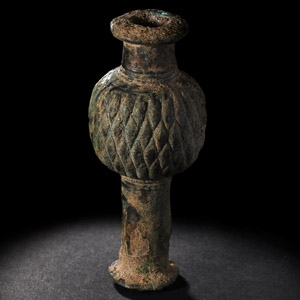
A bronze mace head with cylindrical shaft extended over the top, rounded knobs around the swollen head, flanked by horizontal grooved bands. 272 grams, 12.5 cm high
Fine condition.
Acquired mid 1980s to early 1990s. Private family collection formed in London, UK. -
Luristan Sword with Decorated Hilt
10th century B.C.Sold for (Inc. bp): £1,300
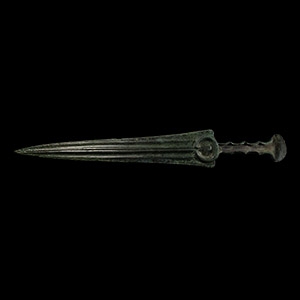
A bronze short sword or dirk with tapering blade and square shoulders, flanged hilt with crenellated grip, widening slightly to a fan-shaped pommel, strong midrib and penannular guard. 464 grams, 44 cm
Ex S. Motamed collection. with Bellman's Auctions, 20th-26th June 2015, lot 2482. Property of a London gentleman.
According to Khorasani and Moorey, this type of dirk probably originated from the north and appeared in Western Iran towards the end of the Late Bronze Age, remaining in use alongside with the early examples of iron dirks. Medveskaya stated that usually this type of daggers and dirks were cast in one piece, meaning the penannular grip was cast on later to the dagger or dirk.
