
Loading, please wait...
LOT 1048
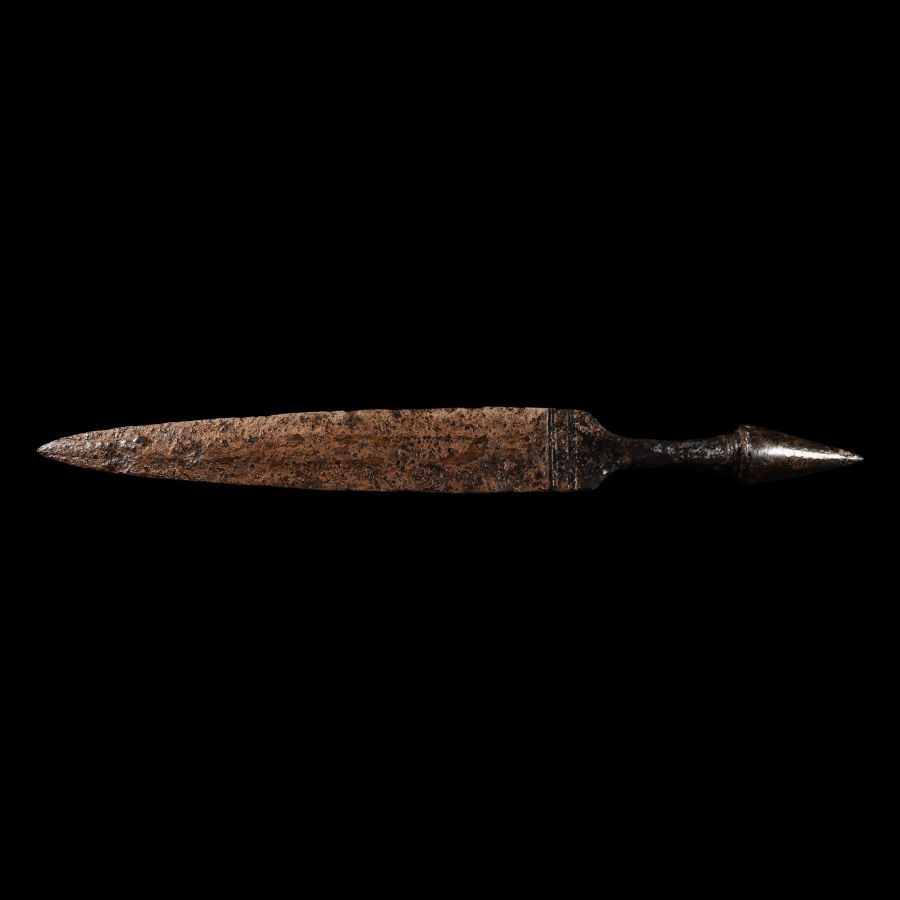
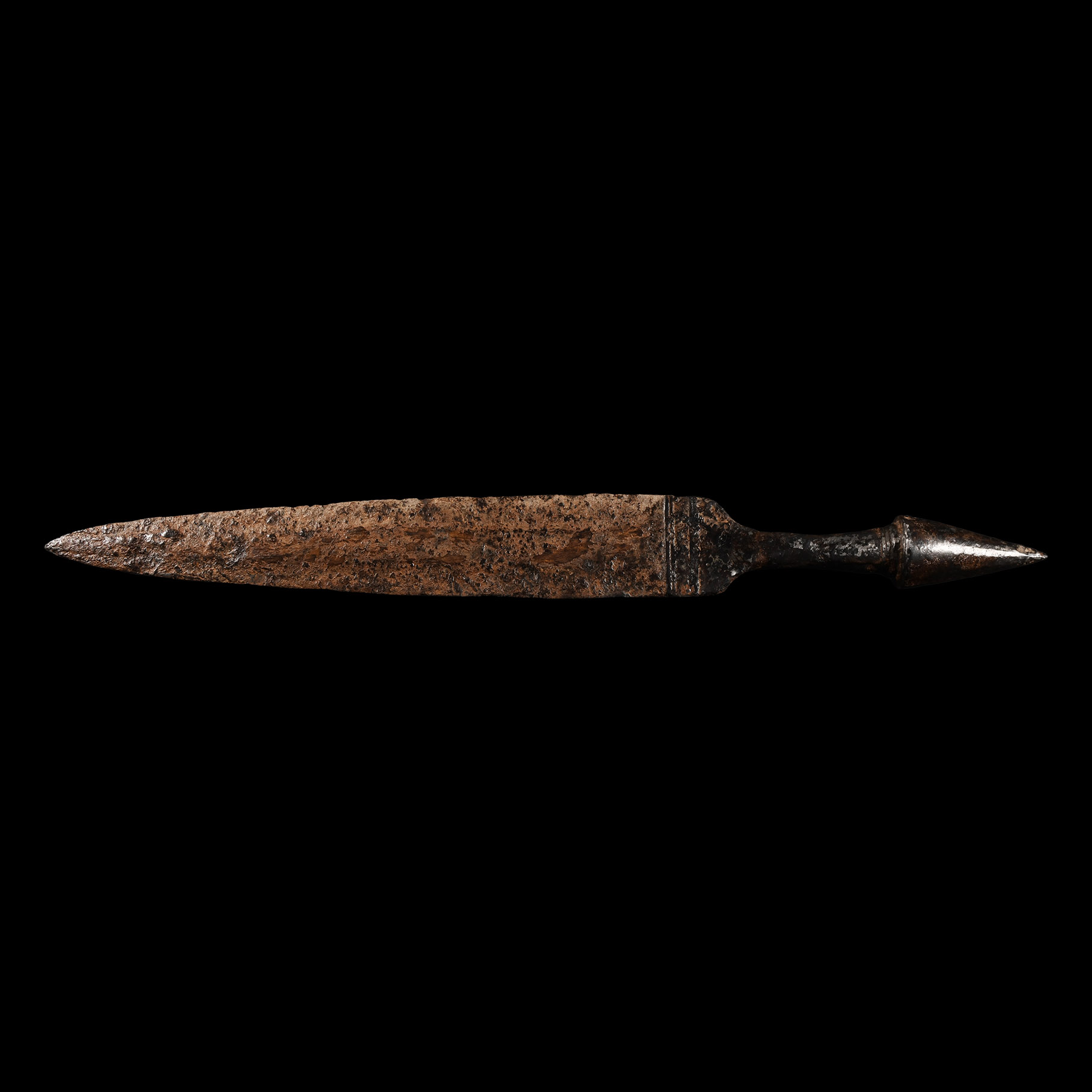
Luristan Dagger with Mushroom Pommel
13TH CENTURY B.C.
16 1/8 in. (491 grams, 41 cm).
A bronze short dagger with double-edged blade, central rib to both sides, a slender fullered handle with a high conical pommel.
ProvenanceUK private collection before 2000.
UK art market.
Property of a London gentleman.
Cf. Khorasani, M.M., Arms and Armour from Iran - The Bronze Age to the End of the Qajar Period, Tübingen, 2006, p.393, cat.31, for similar type.
FootnotesThe sword has a solid cast hilt with a straight horizontal guard. However, its main characteristic is the exaggerated mushroom pommel, which resembles the type dated by Moorey to the end of the 2nd millennium B.C. According to some authors, these swords were produced in Northern Iran and dated between 1400-1200 B.C.
CONDITIONTimeLine Auctions follows a vetting process to ensure the authenticity and legality of all items, reinforcing our commitment to integrity and responsible trading. Each antiquity, antique, and coin lot undergoes thorough examination by a vetting committee of at least ten external specialists, professional trade association members, scientists, and archaeologists: Our Vetting Process
AUCTIONS:
TimeLine is a leading auction house specialising in antiquities, ancient art, collectables, natural history, coins, medals, and books. Our auctions offer museums, collectors, historians, and enthusiasts the opportunity to acquire unique and historically significant pieces.
LOT 1048
Luristan Dagger with Mushroom Pommel
Estimate £400 - 600€460 - 700 (for guidance only)$540 - 810 (for guidance only)
-
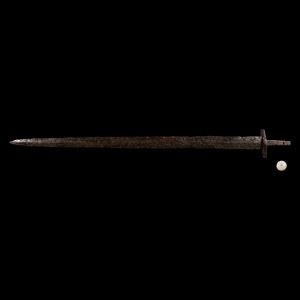
Migration Period Spatha Sword Blade with Sword Bead
Circa 4th-5th century A.D.Sold for (Inc. bp): £572
A double-edged spatha with a lentoid section parallel-sided iron blade with pointed tip; battle nicks to both cutting edges; rhomboid-section cross-guard; a fastening nail on the upper tang; accompanied by a sword bead. 921 grams total, 2.7- 86.5 cm
cleaned and conserved.
Acquired 1971-1972. From the collection of the vendor's father. Property of a London, UK, collector. Accompanied by an academic report by Dr Raffaele D’Amato.
A Migration Period sword, originating from Central Asia, often used by nomadic populations and particularly by the Huns, defined as a Nomadic-Asiatic sword by Menghin, or as a sword with plate guard. The long and thin blade, with a lenticular or lozenge section, was equipped with a guard composed of an iron plate inserted into the tang. Little is known about the scabbard of these swords but it is known that they usually had disc-shaped pommels, and stones hanging from the pommel or hilt. This typology was widespread in Central Europe by the Huns and there are also specimens attested in Gaul in the 5th century. -
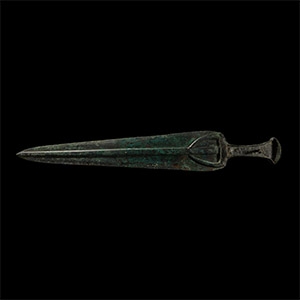
Marlik Sword with Decorated Hilt
14th-10th century B.C.Sold for (Inc. bp): £1,040
A bronze sword with flanged hilt, penannular guard and strong midrib running to the pointed tip, hilt and pommel open to accept inlays, bronze fastening nail still visible in the pommel. 477 grams, 39 cm
Ex S. Motamed collection. with Bellman's Auctions, 20th-26th June 2015, lot 2482. Property of a London gentleman.
According to Khorasani and Negahban, blade and grip of this kind of swords were cast in one-piece mould. The penannular guard was later added to the blade. -
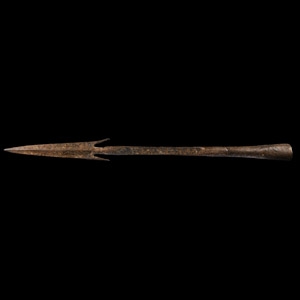
Medieval Socketted Catapult Dart
14th-16th century A.D.Sold for (Inc. bp): £143
An iron catapult dart formed with a tapering cylindrical socket, square-section neck and barbed triangular head with full-length medial rib to both faces. 109 grams, 27 cm
Acquired before 2000. From the collection of a European gentleman living in the UK.
