
Loading, please wait...
LOT 1095
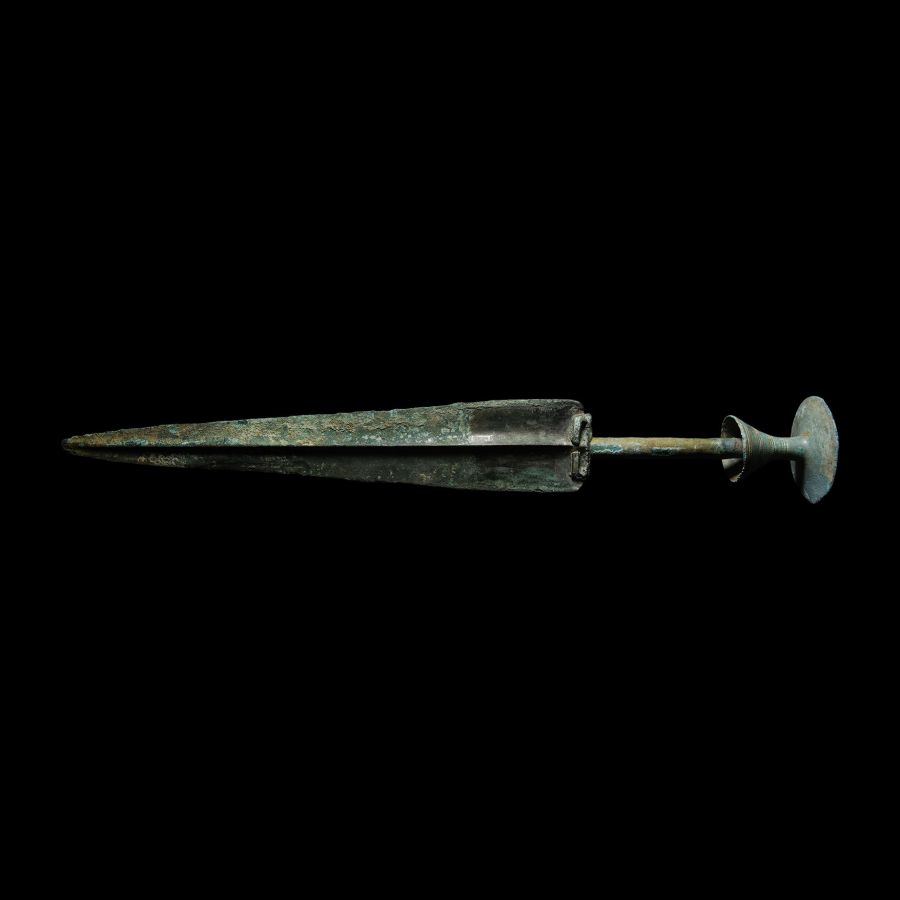
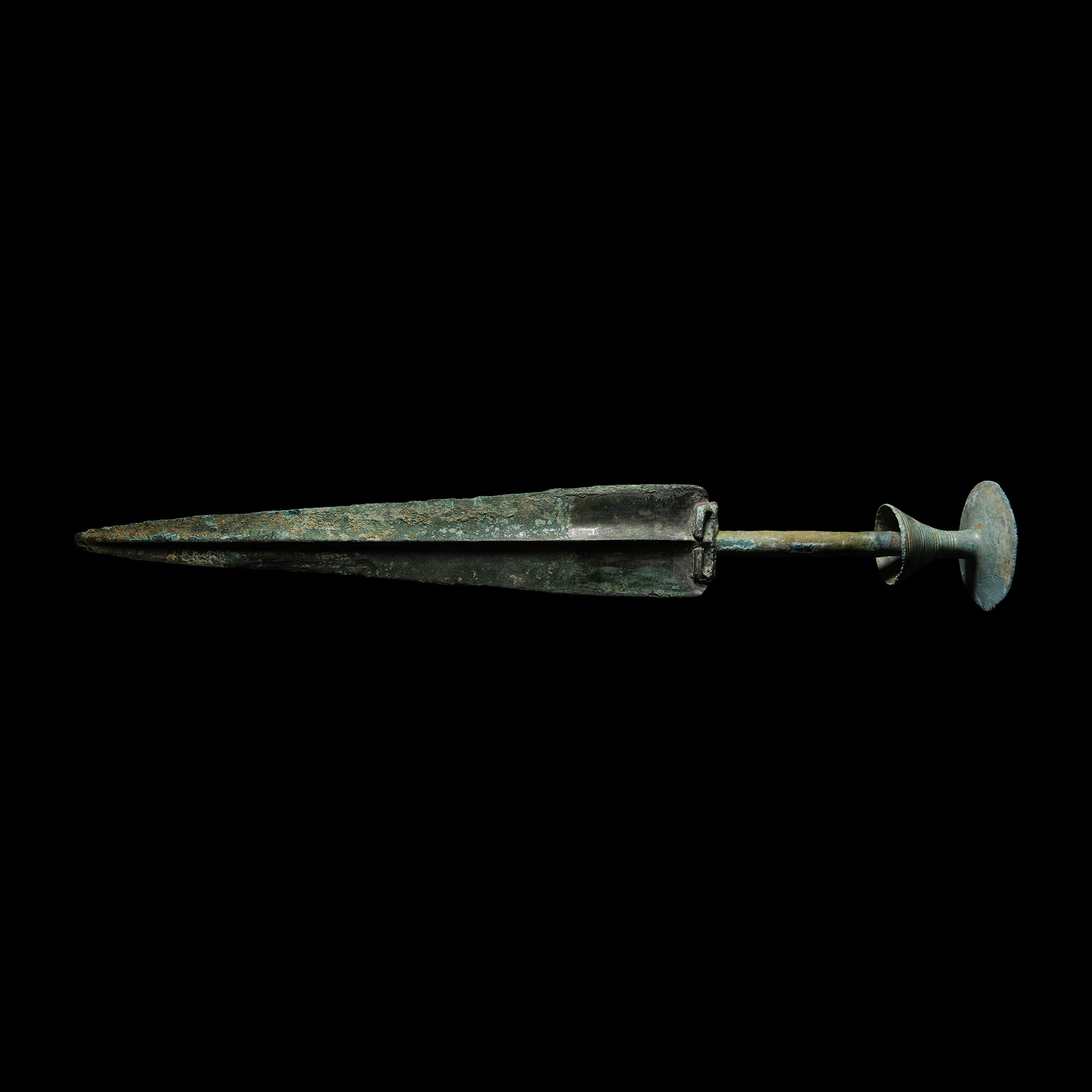
Luristan 'Cotton Reel' Pommel Sword
13TH-6TH CENTURY B.C.
20 in. (725 grams, 51 cm).
A bronze sword with a broad double-edged blade with a central ridge on both sides, square bronze hilt with goblet-shaped pommel surmounted by a disc.
ProvenanceAcquired 1980-2015.
Ex Abelita family collection.
Cf. Vahdati, A.A., 'Marlik and Toul-E Talish: a dating problem' in Iranica Antiqua, vol.XLII, 2007, pp.125-138, figs.2, 6, 9, 10.
FootnotesBimetallic swords (some examples are entirely cast in iron and others entirely cast in bronze) with disc pommel, slender cylindrical grip and tapering blades of this type are among the most common types of daggers / swords in Northern Iranian graveyards. This type has occasionally been referred to as the 'cotton reel' pommel, as below the flat circular pommel there is a second, a rather wide disc, and a plain or incised cylindrical grip in between.
CONDITIONTimeLine Auctions follows a vetting process to ensure the authenticity and legality of all items, reinforcing our commitment to integrity and responsible trading. Each antiquity, antique, and coin lot undergoes thorough examination by a vetting committee of at least ten external specialists, professional trade association members, scientists, and archaeologists: Our Vetting Process
AUCTIONS:
TimeLine is a leading auction house specialising in antiquities, ancient art, collectables, natural history, coins, medals, and books. Our auctions offer museums, collectors, historians, and enthusiasts the opportunity to acquire unique and historically significant pieces.
-
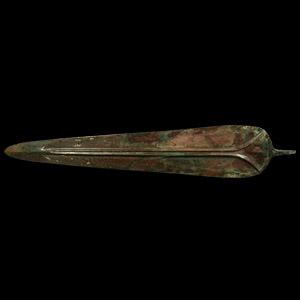
Luristan Sword Blade with Blood Channels
2nd millennium B.C.Sold for (Inc. bp): £229
A substantial bronze leaf-shaped blade with raised midrib extending to a short tang, ribbed fullers with curved ends extending to the shoulders. 422 grams, 41.5 cm
Fine condition.
Acquired in the 1990s. With a London, UK, gallery. Property of a London collector; from her family's private collection.
The metalworking techniques used in making bronze weapons in Luristan were very complex. Surfaces were often finished in repoussé work, and some of the weapons were chased, others engraved. -
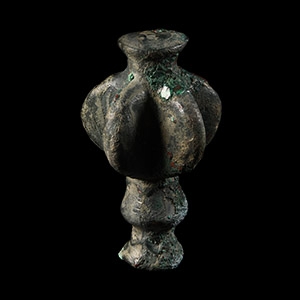
Western Asiatic Flanged Macehead
Late 3rd millennium B.C.Sold for (Inc. bp): £104
A cylindrical bronze macehead with five D-shaped flanges to the circumference; socket to base. 131 grams, 80 mm
Early 1990s London collection. Acquired on the UK art market. From a private collection, Lancashire, UK.
Bronze maces with a long bronze tubular sleeve appeared in Mesopotamia from the last third of the 3rd millennium B.C., apparently being of Palestinian origin. This type of mace was then spread to Elam and from there to India. -
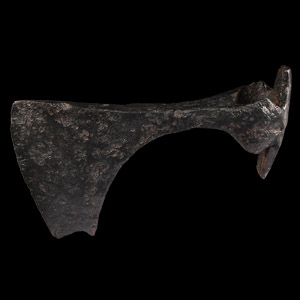
Viking Period Bearded Type Axehead
Circa 9th-11th century A.D.Sold for (Inc. bp): £598
A hand-forged iron skeggöx (bearded axe) with asymmetrical triangular section narrow blade widening to a broad bevelled edge with square chin, curved edge, flared wings to the scooped socket and dorsal bar. 855 grams, 20 cm
Acquired 1971-1972. From the collection of the vendor's father. Property of a London, UK, collector.
Iron axeheads of this typology show a sub-trapezoidal asymmetrical blade, often perforated through the centre. They are characterised by two projections spurs from the top and the bottom of the back of the shaft-hole.
