
Loading, please wait...

LOT 1441
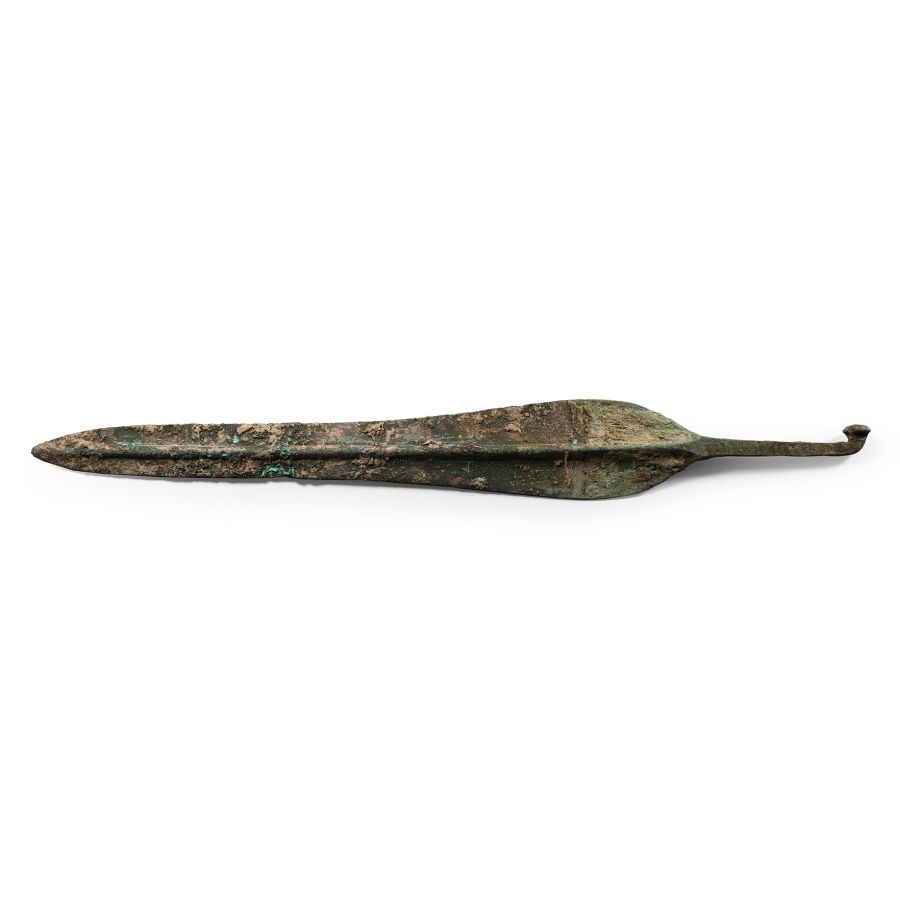
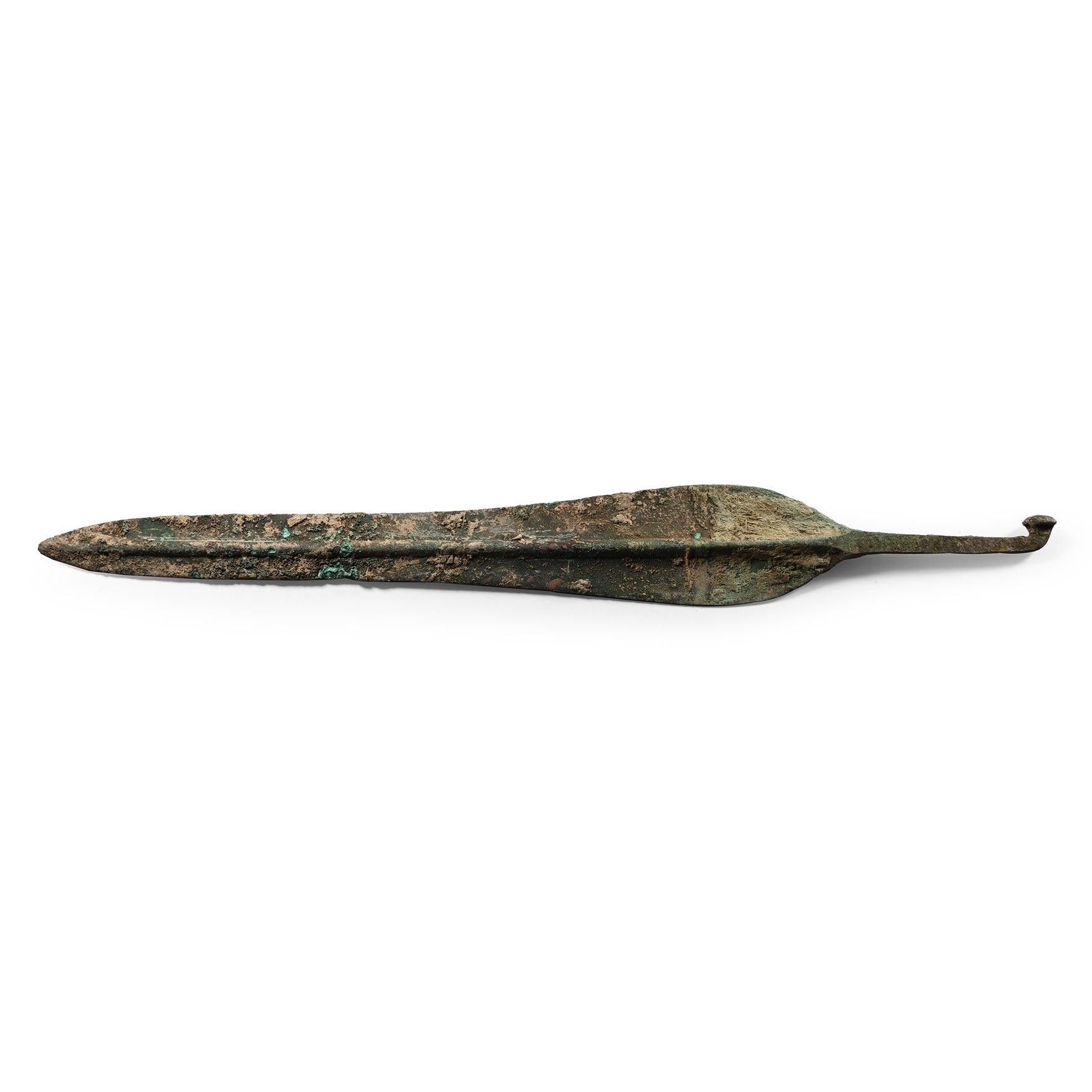
Luristan Bronze Spearhead
EARLY 2ND MILLENNIUM B.C.
16 3/4 in. (412 grams, 42.5 cm).
Having foliate blade with central rib and slender shoulders, short rectangular shaft and tang with a bent end.
ProvenanceAcquired 1980-2015.
Ex Abelita family collection.
Cf. Muscarella, O.W., Bronze and Iron, ancient Near Eastern Artifacts in the Metropolitan Museum of Art, New York, 1988, no.176, for the type.
FootnotesA number of similar blades, some considered to be spearheads and others to be daggers, all with bent tang, derived from Tepe Hissar Culture III. Some of them, like our specimen, have a button terminal, some others have a plain, pointed terminal. The general dating of these specimens is fixed to the early 2nd millennium B.C.
CONDITIONTimeLine Auctions follows a vetting process to ensure the authenticity and legality of all items, reinforcing our commitment to integrity and responsible trading. Each antiquity, antique, and coin lot undergoes thorough examination by a vetting committee of at least ten external specialists, professional trade association members, scientists, and archaeologists: Our Vetting Process
AUCTIONS:
TimeLine is a leading auction house specialising in antiquities, ancient art, collectables, natural history, coins, medals, and books. Our auctions offer museums, collectors, historians, and enthusiasts the opportunity to acquire unique and historically significant pieces.
LOT 1441
Luristan Bronze Spearhead
Estimate £100 - 140€120 - 160 (for guidance only)$140 - 190 (for guidance only)
-
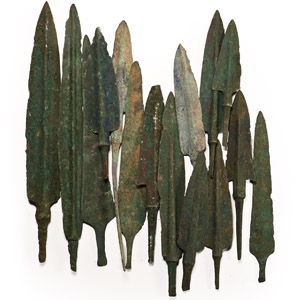
Luristan Bronze Arrow and Blade Group
13th-7th century B.C.Sold for (Inc. bp): £247
Comprising mainly two-edged narrow blades with thick midrib. 431 grams total, 9.5-19.5 cm
Ex London, UK, collection, 1990s. -
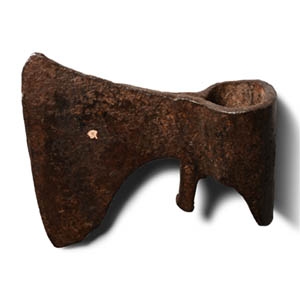
Medieval Iron Broad Axehead
Circa 14th-16th century A.D. or laterSold for (Inc. bp): £59
With D-shaped socket broad edge with chin below and languet. 230 grams, 97 mm
Ex North American collection, 1970s-1990s. -
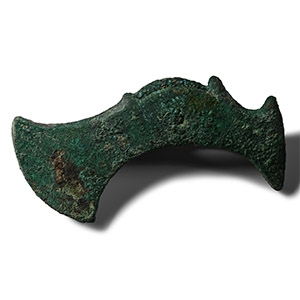
Bactrian Bronze Axehead
3rd-2nd millennium B.C.Estimate: £500 - 700 (‡+bp*)
Opening Bid: £250
With curved flaring cutting edge, characteristic curving shape and narrow socket, blade end squaring off, shaft hole pierced on both sides. 227 grams, 10.6 cm
Acquired in the mid 1980s-1990s. Private collection, Switzerland, thence by descent. Private collection, since the late 1990s.
These collared axes have the specific feature of being equipped with variously shaped rear extensions. The provenance of this typology is clearer than others: these axes came from Margiana and southern Bactria. Gonur Depe and Susa yielded a rather atypical and probably imported example. P. Amiet suggests that they were an adoption of Elamite material, from conceptual and institutional models. They would have developed from the end of the 3rd and the beginning of the 2nd millennium B.C.
