
Loading, please wait...
LOT 1101
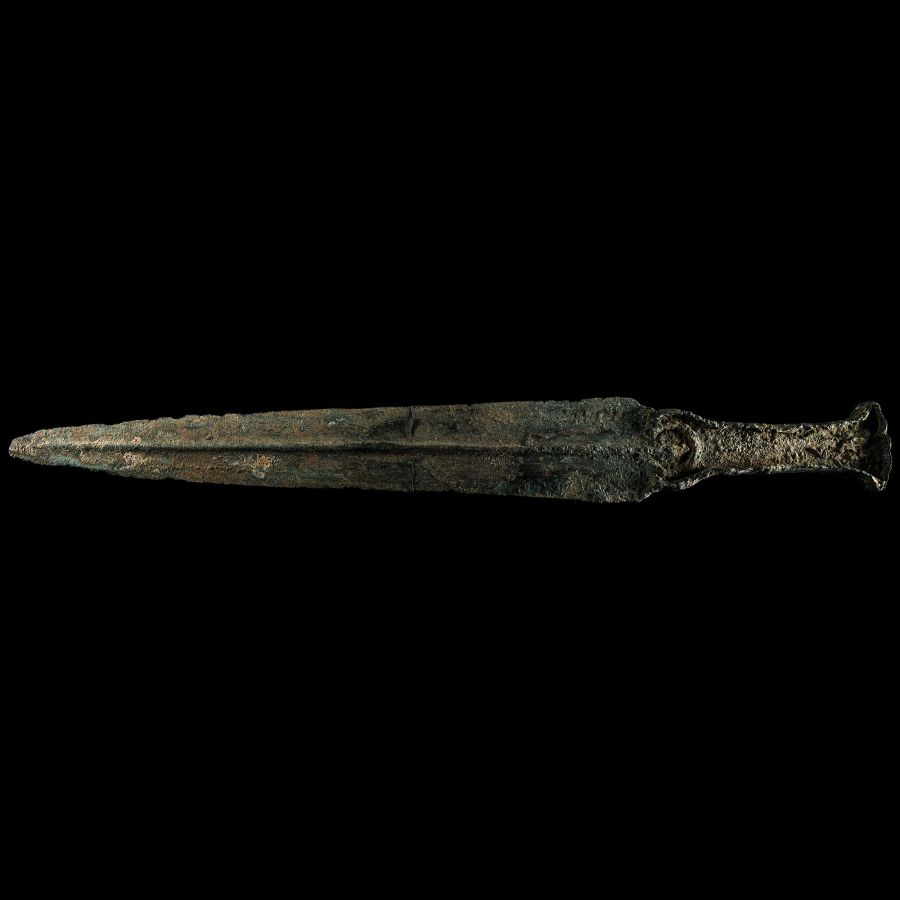
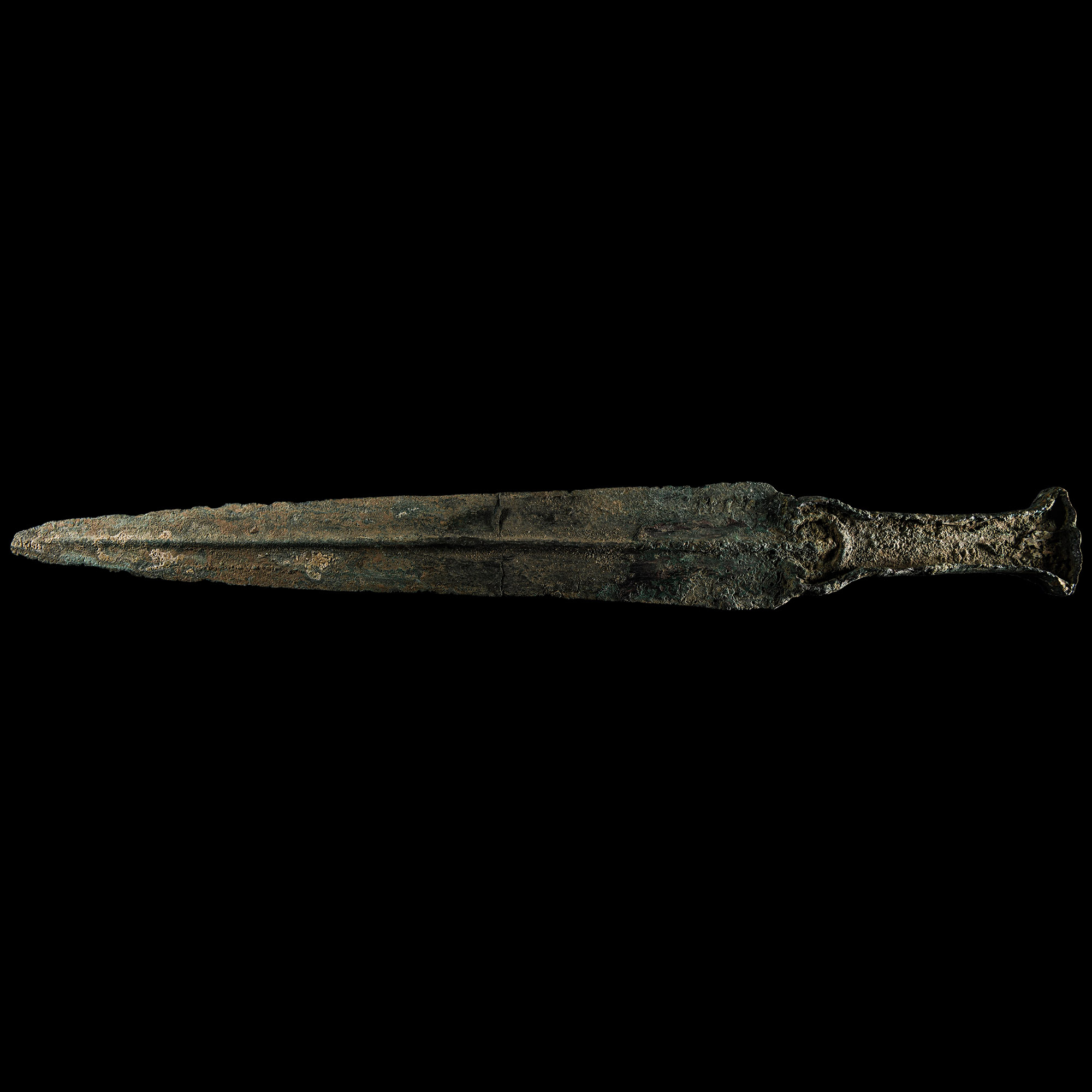
Luristan Bronze Short Sword
CIRCA 1000 B.C.
16 1/2 in. (421 grams, 42 cm).
The blade with a tapering profile, triangular in overall form, with slender shoulders, penannular guard with strong midrib, flanged hilt with crenellated grip, widening slightly into a fan-shaped pommel, cracked.
ProvenanceAcquired 1980-2015.
Ex Abelita family collection.
Cf. similar sword in Khorasani, M.M., Arms and Armour from Iran. The Bronze Age to the End of the Qajar Period, Tübingen, 2006, cat.12, for a similar weapon.
FootnotesThese types of short sword or dirks were usually cast in one piece, and the penannular rib in relief was cast on at the same time with the handle of the blade. In some cases, however, the penannular rib was later cast on the dagger, possibly to strengthen a weak point at the junction of hilt and blade. The flanged hilt was originally inlaid with organic material such as bone.
CONDITIONTimeLine Auctions follows a vetting process to ensure the authenticity and legality of all items, reinforcing our commitment to integrity and responsible trading. Each antiquity, antique, and coin lot undergoes thorough examination by a vetting committee of at least ten external specialists, professional trade association members, scientists, and archaeologists: Our Vetting Process
AUCTIONS:
TimeLine is a leading auction house specialising in antiquities, ancient art, collectables, natural history, coins, medals, and books. Our auctions offer museums, collectors, historians, and enthusiasts the opportunity to acquire unique and historically significant pieces.
-
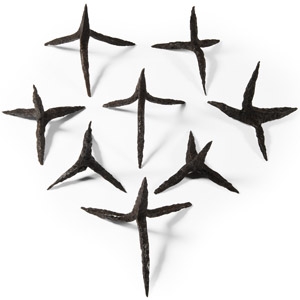
Medieval Iron Anti-Cavalry Caltrop Group
13th-15th century A.D.Sold for (Inc. bp): £221
Comprising eight caltrops, hand-forged with square-section spikes. 398 grams total, 76-95 mm
From the private collection of a London gentleman, from his grandfather's collection formed before the early 1970s. -
.jpg)
Viking Age Iron Sword with Seven-Lobed Pommel
11th-13th century A.D.Estimate: £5,000 - 7,000 (+bp*)
Opening Bid: £2,500
Couronian sword of Petersen Type K with double-edged tapering blade and tapering fullers; bronze cross-guard extending at each end to serpent- or horse-heads, wheeled ornament to both faces; the lower guard with similar motifs; seven-lobed pommel with annulets and pellets. 1.02 kg, 86.5 cm
From the private collection of a London gentleman, from his grandfather's collection formed before the early 1970s. Accompanied by an academic report by Dr Raffaele D’Amato. This lot has been checked against the Interpol Database of stolen works of art and is accompanied by search certificate no.11925-209658.
Couronian swords of this type, with animal-head decoration on the lower guard, were widespread and used in the Eastern Baltic lands from the 10th to 13th century. Such zoomorphic detailing was a clear influence from Germanic art. Regular geometric ornamentation, derived from Romanesque art, was also widespread, with one of the most common ornaments being a cross-in-circle. -
Viking Age Socketted Iron Spearhead
9th-10th century A.D.Sold for (Inc. bp): £195
Type E with leaf-shaped blade with curved edges, socket tending towards a square internal cross-section and decorated with chiselled longitudinal grooves. 126 grams, 28.5 cm
Ex private collection of Mr M.B., Mainz, Germany, since the 1980s. Acquired from the above, 2004.
The spearheads of type E, of which this type is, belongs to the first group of Viking spearheads, i.e. the Frankish spearheads, which appeared between 750 and 950 A.D. These account for one third of the spears found in Viking sites; most of them are pattern forged with herringbone design.
