
Loading, please wait...
LOT 1161
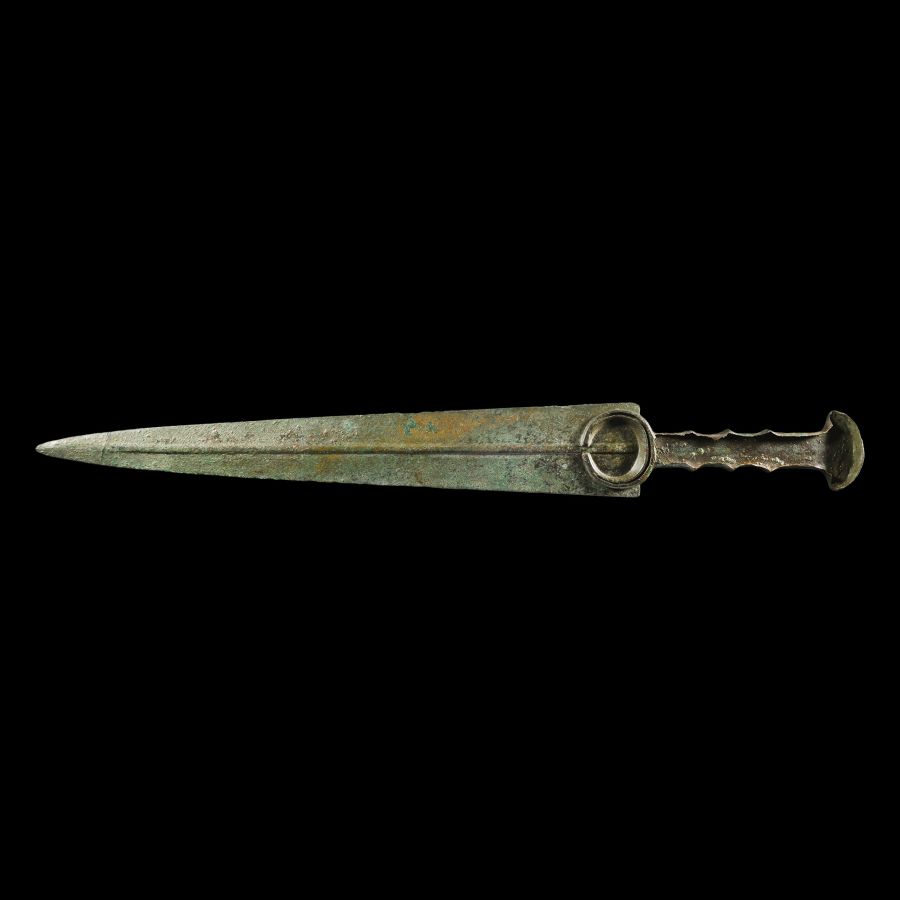
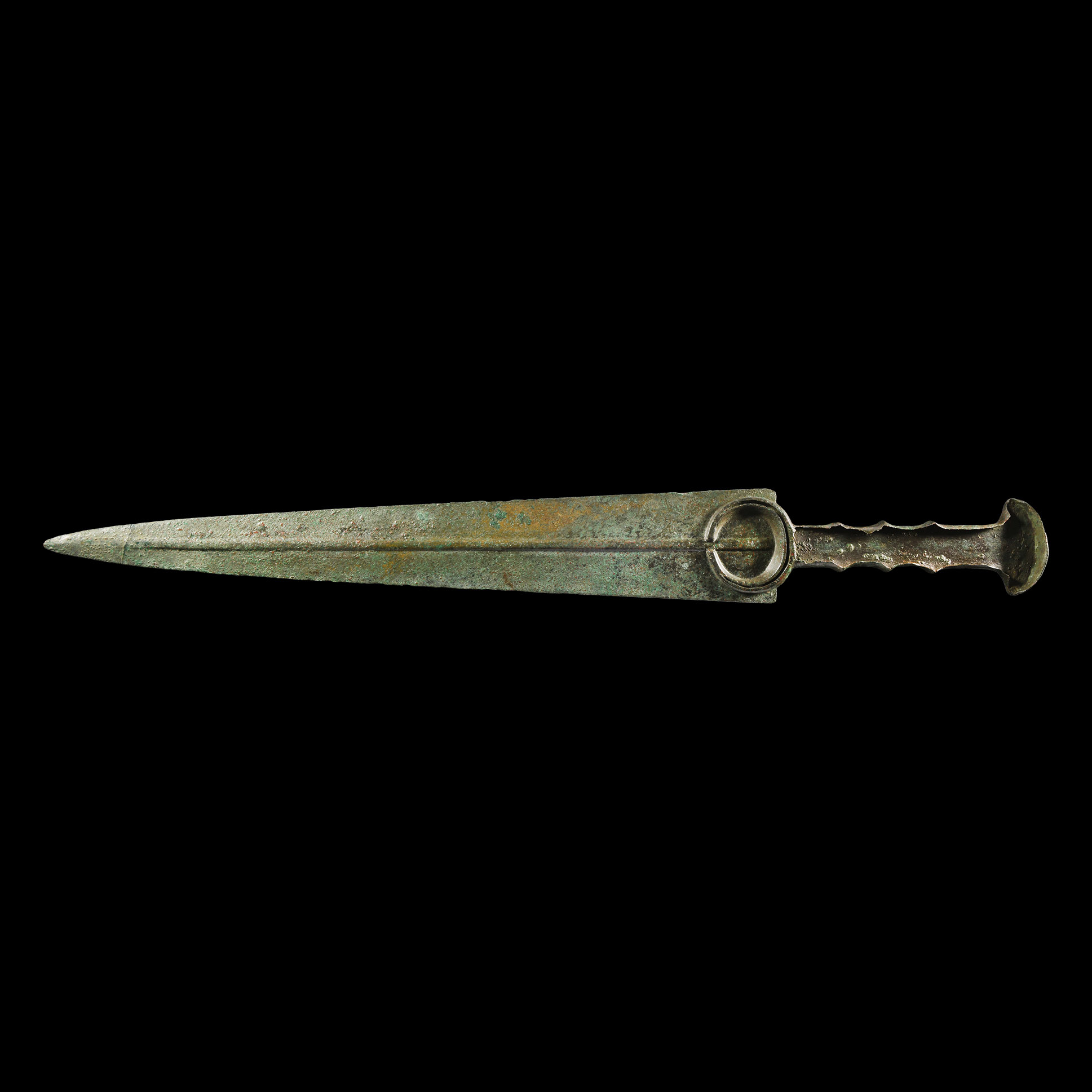
Luristan Bronze Short Sword
CIRCA 1000 B.C.
17 3/8 in. (383 grams, 44 cm long).
The blade with a tapering profile, triangular in overall form, with square shoulders, penannular guard with strong midrib, flanged hilt with crenellated grip, widening slightly into a fan-shaped pommel; tip repaired.
ProvenanceAcquired 1980-2015.
Ex Abelita family collection.
Cf. similar sword in Khorasani, M.M., Arms and Armour of Iran, Germany, 2006, cat.12, for similar example in the National Museum of Iran in Tehran.
FootnotesThese types of short sword or dirks were usually cast in one piece, and the penannular rib in relief was cast on at the same time with the handle of the blade. In some cases, however, the penannular rib was later cast on the dagger, possibly to strengthen a weak point at the junction of hilt and blade. The flanged hilt was originally filled with organic material like bone.
CONDITIONTimeLine Auctions follows a vetting process to ensure the authenticity and legality of all items, reinforcing our commitment to integrity and responsible trading. Each antiquity, antique, and coin lot undergoes thorough examination by a vetting committee of at least ten external specialists, professional trade association members, scientists, and archaeologists: Our Vetting Process
AUCTIONS:
TimeLine is a leading auction house specialising in antiquities, ancient art, collectables, natural history, coins, medals, and books. Our auctions offer museums, collectors, historians, and enthusiasts the opportunity to acquire unique and historically significant pieces.
LOT 1161
Luristan Bronze Short Sword
Estimate £400 - 600€460 - 700 (for guidance only)$540 - 810 (for guidance only)
-
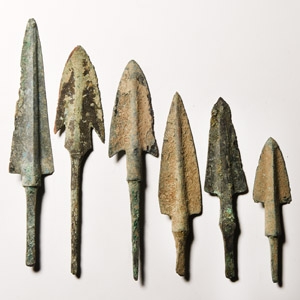
Luristan Bronze Arrowhead Group
12th-10th century B.C.Estimate: £100 - 140 (+bp*)
Opening Bid: £50
Comprising six tanged arrowheads, all with large elongated triangular blades and raised midrib, sharp central groove, cylindrical stem with handle for the shaft; three with barbed shoulders and convex or squared sides, two lanceolate with slightly rounded shoulders, one elongated triangular type. 105 grams total, 6.9-11.7 cm
Acquired 1980-2015. Ex Abelita family collection.
These arrowheads seem to belong to the type V, subcategory types A, B, C and D according to the classification of Khorasani and Negahban. In the four categories of triangular bronze arrowheads from Luristan, Marlik and Northern Iran individuated by Negahban, subtypes C and D of type V are larger arrow or javelin heads, C with barbed shoulders and D with round shoulders. -
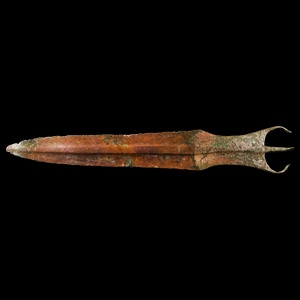
North-West Persian Bronze Dagger with Horns
Circa 1st millennium B.C.Estimate: £300 - 400 (+bp*)
Opening Bid: £150
With curved 'horns' projecting on either side at top of waisted grip, blade with flat mid-rib. 249 grams, 41.5 cm
Acquired 1980-2015. Ex Abelita family collection.
The Luristani people produced a quantity of fine metalwork, which according to Dr Khorasani, could be due to a settled period which arose as a result of the defeat of the Elamites by the Babylonians, leaving the Luristani people in relative peace for a period of time after 1200 B.C. According to Khorasani 'A culture of innovation and experimentation flourished, and the repertoire of the Luristan smiths expanded in the period between 1150-1050 BC.' -
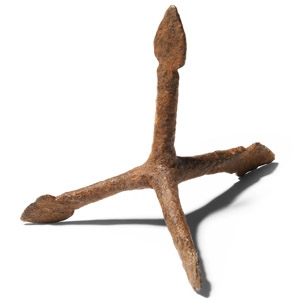
Roman Iron Anti-Cavalry Caltrop
3rd-4th century A.D. or laterSold for (Inc. bp): £221
Composed of four arms tipped with triangular spikes. 24 grams, 73 mm
Acquired on the German art market around 2000s. From the collection of an EU gentleman living in the UK.
Caltrops were scattered on battlefields in an effort to stop or slow advancing enemy cavalry or foot soldiers; regardless of how a caltrop lands, one spike is always facing upwards. Caesar used widely them at Alesia (Caes., BG 7.73; 82): 'Stakes a foot long, with iron hooks attached to them, were entirely sunk in the ground before these, and were planted in every place at small intervals; these they called spurs'.
