
Loading, please wait...
LOT 1543
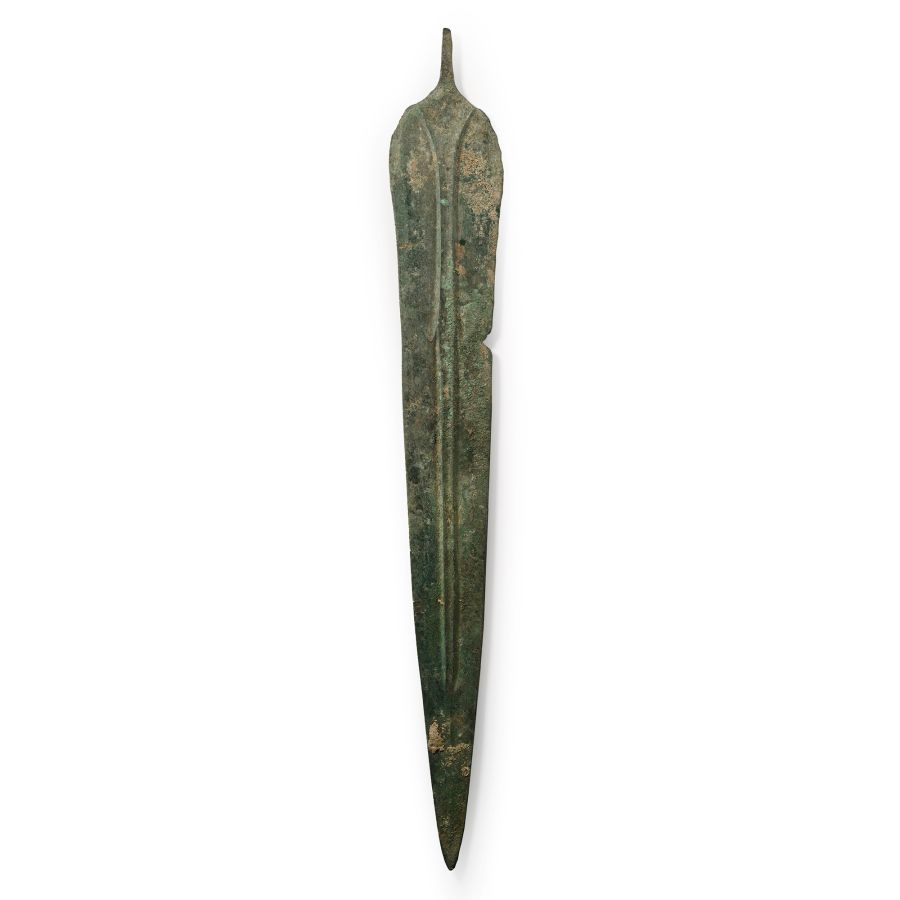
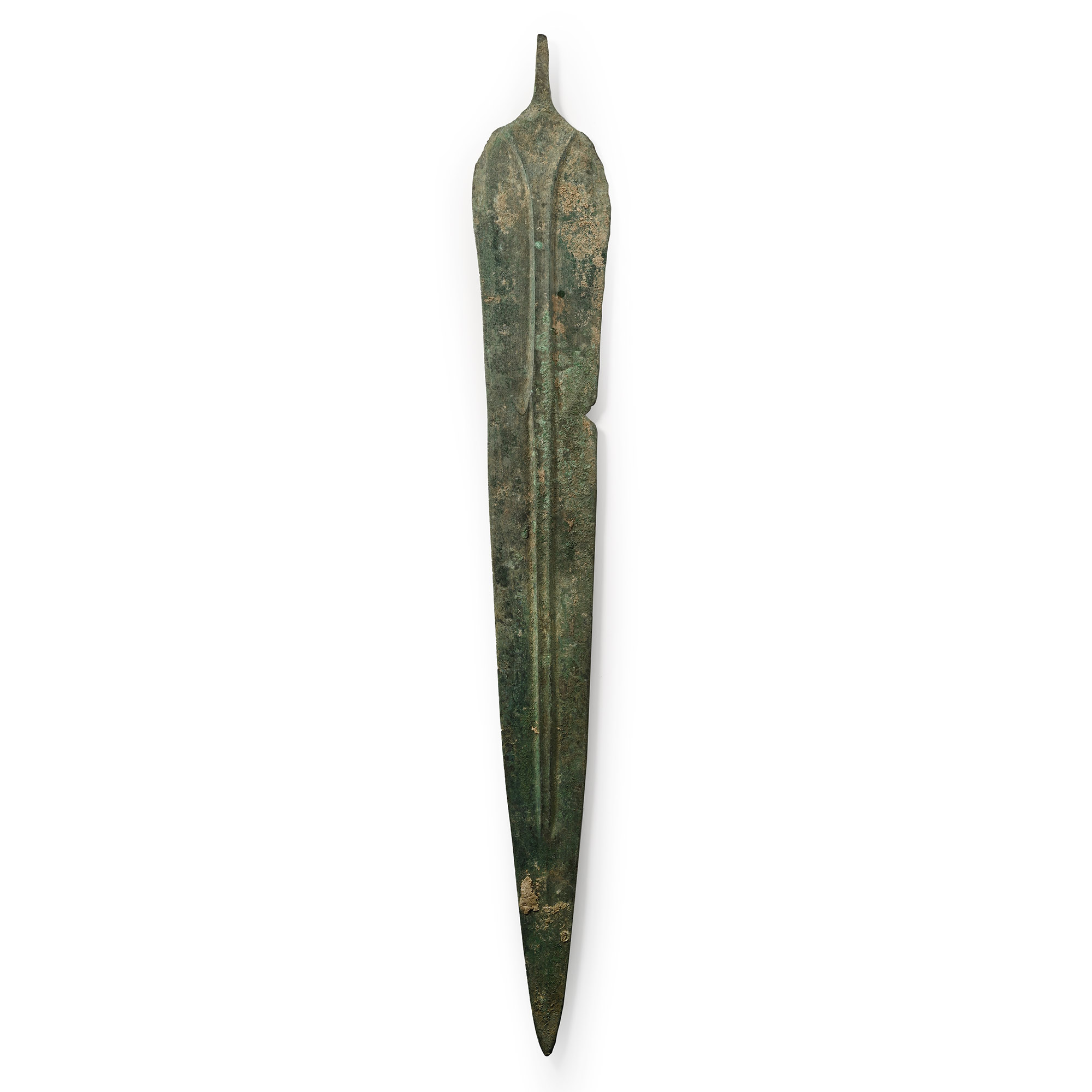
Luristan Bronze Short Sword with Blood Channels
2ND-1ST MILLENNIUM B.C.
18 7/8 in. (342 grams, 48 cm).
A two-edged leaf-shaped blade with short rectangular tang, corrugated midrib extending almost to the tip and flared at the shoulder.
ProvenanceAcquired 1980-2015.
Ex Abelita family collection.
This lot is accompanied by an illustrated lot declaration signed by the Head of the Antiquities Department, Dr Raffaele D’Amato.
Cf. Christie's, The Axel Guttmann Collection of Ancient Arms and Armour, part 2, London, 2004, item 36, p.33.
FootnotesLuristan was hardly an ethnic or political entity, but the people of Luri had relations through warfare and trade with Sumerians, Lullubi, Assyrians, Babylonians and Elamites in a large time period, spanning from the 3rd to the 2nd millennium B.C. The ruling elites of warrior horsemen were buried in the graves with their weapons and horses.
CONDITIONTimeLine Auctions follows a vetting process to ensure the authenticity and legality of all items, reinforcing our commitment to integrity and responsible trading. Each antiquity, antique, and coin lot undergoes thorough examination by a vetting committee of at least ten external specialists, professional trade association members, scientists, and archaeologists: Our Vetting Process
AUCTIONS:
TimeLine is a leading auction house specialising in antiquities, ancient art, collectables, natural history, coins, medals, and books. Our auctions offer museums, collectors, historians, and enthusiasts the opportunity to acquire unique and historically significant pieces.
-
.jpg)
Scythian Chalcidian Helmet with Embossed Stags
3rd-1st century B.C.Sold for (Inc. bp): £24,700
Chalcidian or Illyrian variant (Caucasian type), constructed from two halves with the right side overlapping the left, embossed ram horns on the brow, with a profile image of a stag to both sides; hinged cheek-pieces with regularly disposed holes to the outer edges; some restoration. 696 grams, 31cm high
Acquired on the European art market, mid-1980s. Private collection, Oxford, UK. From the collection of a London doctor. Accompanied by an academic report by Dr Raffaele D’Amato. This lot has been checked against the Interpol Database of stolen works of art and is accompanied by search certificate number no.12339-228100. This lot has been cleared against the Art Loss Register database, and is accompanied by an illustrated lot declaration signed by the Head of the Antiquities Department, Dr Raffaele D’Amato.
The cultural interchange and the military contacts between the Nomads of Kuban and the Hellenic peoples allowed the Sindo-Meothic, Scythian, or Sarmatian noblemen to equip themselves with such beautiful defensive equipment. The helmet finds its closest parallel in a specimen published by A.E. Negin, belonging to the Puskin Fine Arts Museum of Moscow, originally in the collection of S. Karakowskij (Negin, 2010, p.354 no.6; Hixenbaugh H304). Some of the helmets of this type were modified according to the nomadic (Scythian or Sarmatian) taste, being decorated with religious elements, like the deer. -
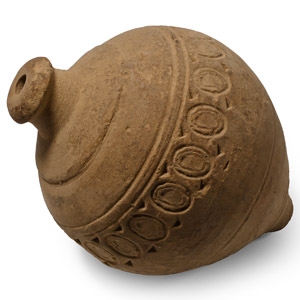
Byzantine 'Greek Fire' Ceramic Fire Bomb or Hand Grenade
9th-11th century A.D.Sold for (Inc. bp): £124
A piriform missile decorated with a band of annulets and chevrons, domed filler hole, intended to be filled with explosive liquid and wick, used as a hand grenade. 406 grams, 12.2 cm
From an important specialist collection, London, UK, 1990s onwards. Accompanied by an academic paper by military specialist Dr Raffaele D'Amato, dated 15 July 2019 and titled 'Eastern Roman Empire - Greek Fire Bomb or Hand Grenade (μεσαίον kακάβιον) 9th-11th century AD'. This lot is accompanied by an illustrated lot declaration signed by the Head of the Antiquities Department, Dr Raffaele D’Amato. -
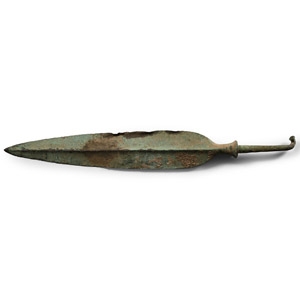
Western Asiatic Bronze Spearhead
2nd millennium B.C.Sold for (Inc. bp): £130
With foliate blade, rhomboidal in section, raised mid-rib, medium length stem widening at its base and forming a small stop, rectangular-section tang with bent terminal. 595 grams, 41.5 cm
Acquired 1980-2015. Ex Abelita family collection. This lot is accompanied by an illustrated lot declaration signed by the Head of the Antiquities Department, Dr Raffaele D’Amato.
The specimen belongs to the category of tripartite spears with long pointed biconvex blade and single bevelled tang. They seem to be a Mesopotamian and Susian (Elamite) variant, and this type also includes decorated blades, like the spear from Tello with the inscription 'King of Kish'. Various specimens have been found in the layers of Tepe Hissar III site.
