
Loading, please wait...
LOT 1200
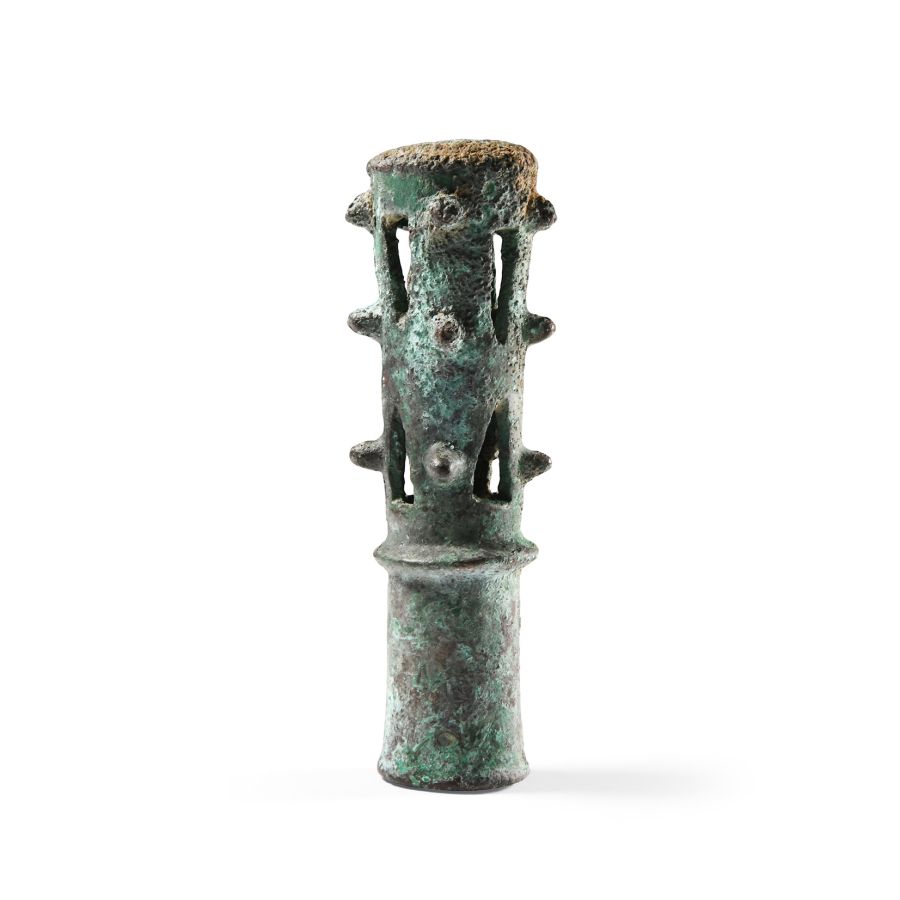
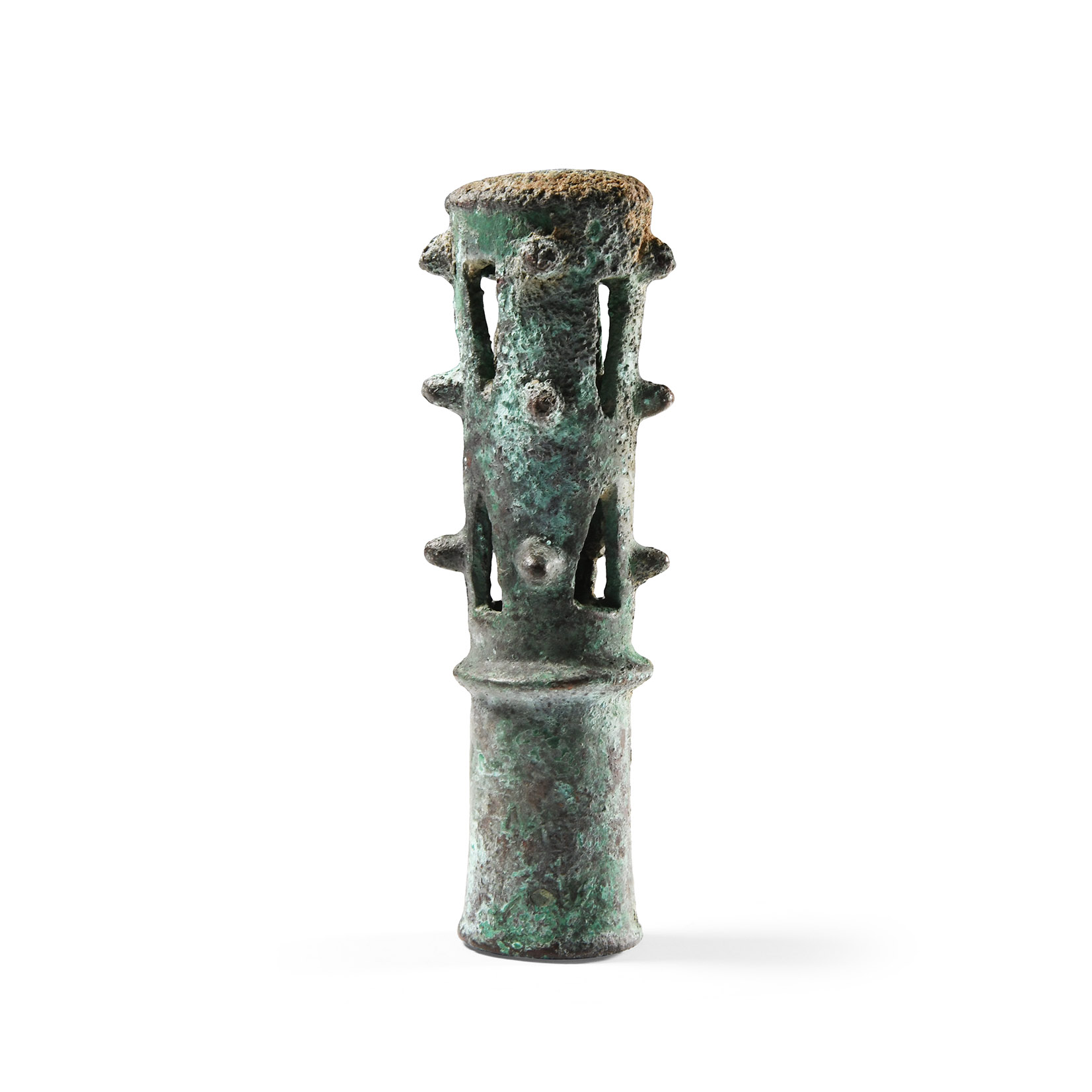
Luristan Bronze Macehead with Points and Fretwork
2600-2400 B.C.
5 3/4 in. (363 grams, 14.5 cm).
Cylindrical in shape, the upper section with alternating holes and vertical rows of three prominent spikes, short cylindrical shaft. [No Reserve]
ProvenanceCollected from 1979-1999.
From the collection of the late Mr S.M., London, UK.
See Godard, A., Les Bronzes du Luristan, Paris, 1931, pl.XIX, no.58, for the type; cf. Gernez, G., L’armament en métal au Proche et Moyen-Orient: des origines a 1750 av. J.C., Paris, 2007, fig.2.79, subtypes M 2.A.b, for the type.
FootnotesThis knopped mace head was probably made using the lost-wax method. It corresponds to the type M 2.A.b of the classification of Gernez: single-cylinder spiked maces. These elements are rare and quite diverse. They consist of a metal cylinder with rows of juxtaposed points. There are between 3 and 8 rows each, comprising 3 to 5 more or less pronounced spikes.
CONDITIONTimeLine Auctions follows a vetting process to ensure the authenticity and legality of all items, reinforcing our commitment to integrity and responsible trading. Each antiquity, antique, and coin lot undergoes thorough examination by a vetting committee of at least ten external specialists, professional trade association members, scientists, and archaeologists: Our Vetting Process
AUCTIONS:
TimeLine is a leading auction house specialising in antiquities, ancient art, collectables, natural history, coins, medals, and books. Our auctions offer museums, collectors, historians, and enthusiasts the opportunity to acquire unique and historically significant pieces.
-
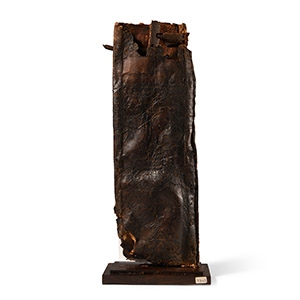
Ilkhanid Decorated Leather Quiver
13th-14th century A.D.Sold for (Inc. bp): £416
Rectangular hide case with saddle-stitched edge, knotted attachment thong to reverse; obverse with panels of low-relief moulded tendril and geometric ornament with decorative stitching; mounted on a custom-made stand. 498 grams total, 39.5 cm high
Ex Yacob's Gallery, London W1, 2000. From a private UK collection. Ex central London gallery. -
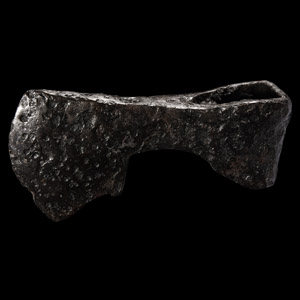
Viking Iron Bearded Axehead
10th-12th century A.D.Sold for (Inc. bp): £208
Featuring a sub-triangular socket, rectangular butt and bearded head with convex cutting edge. 563 grams, 14.6 cm
From the private collection of a London gentleman, from his grandfather's collection formed before the early 1970s. -
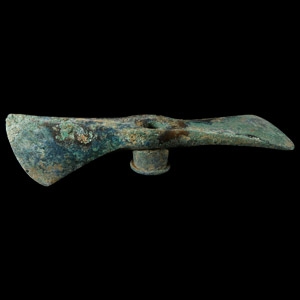
Western Asiatic Bronze Axehead
2nd-1st millennium B.C.Sold for (Inc. bp): £143
With central socket and shaft; cutting blade set vertically at a right-angle; the short pick-adze blade arranged horizontally. 1.3 kg, 26 cm
Acquired 1980-2015. Ex Abelita family collection.
The earliest axe-adzes from the 3rd millennium B.C. were weapons and tools furnished with socket holes. Usually a socket was a more secure way of attaching the object to a wooden haft than having a tang. These weapons developed into a plethora of different forms in the 2nd millennium B.C., and the numerous new forms and were used until at least 800 B.C.
