
Loading, please wait...
LOT 0297
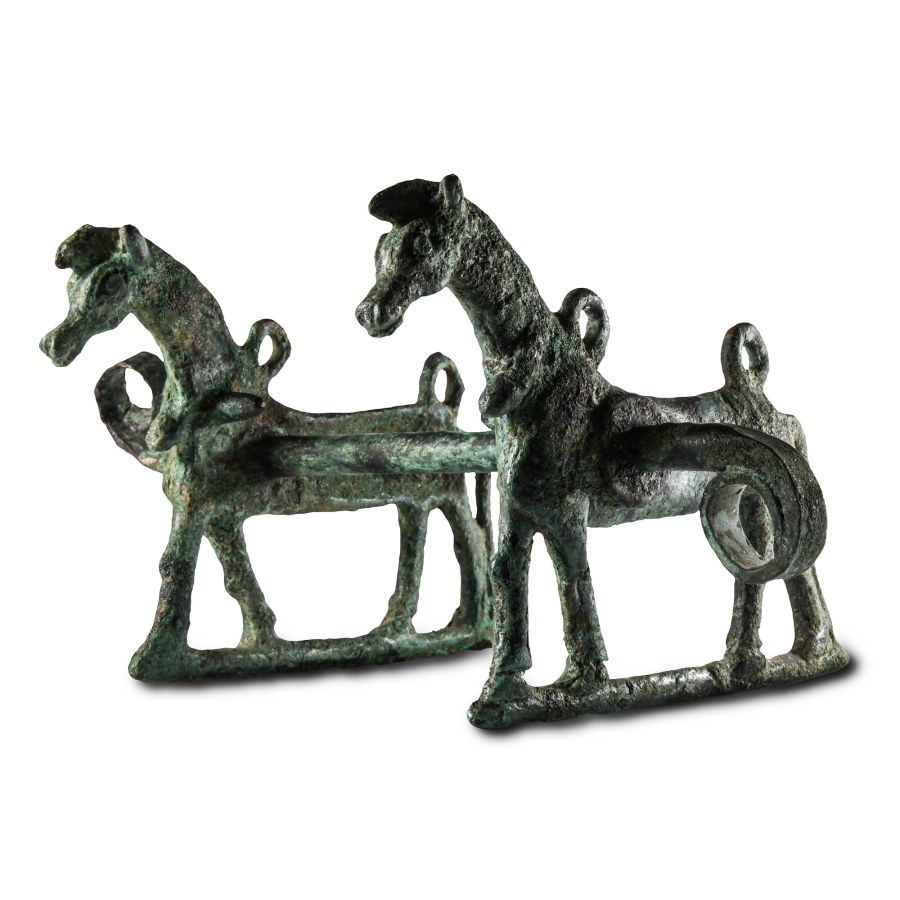
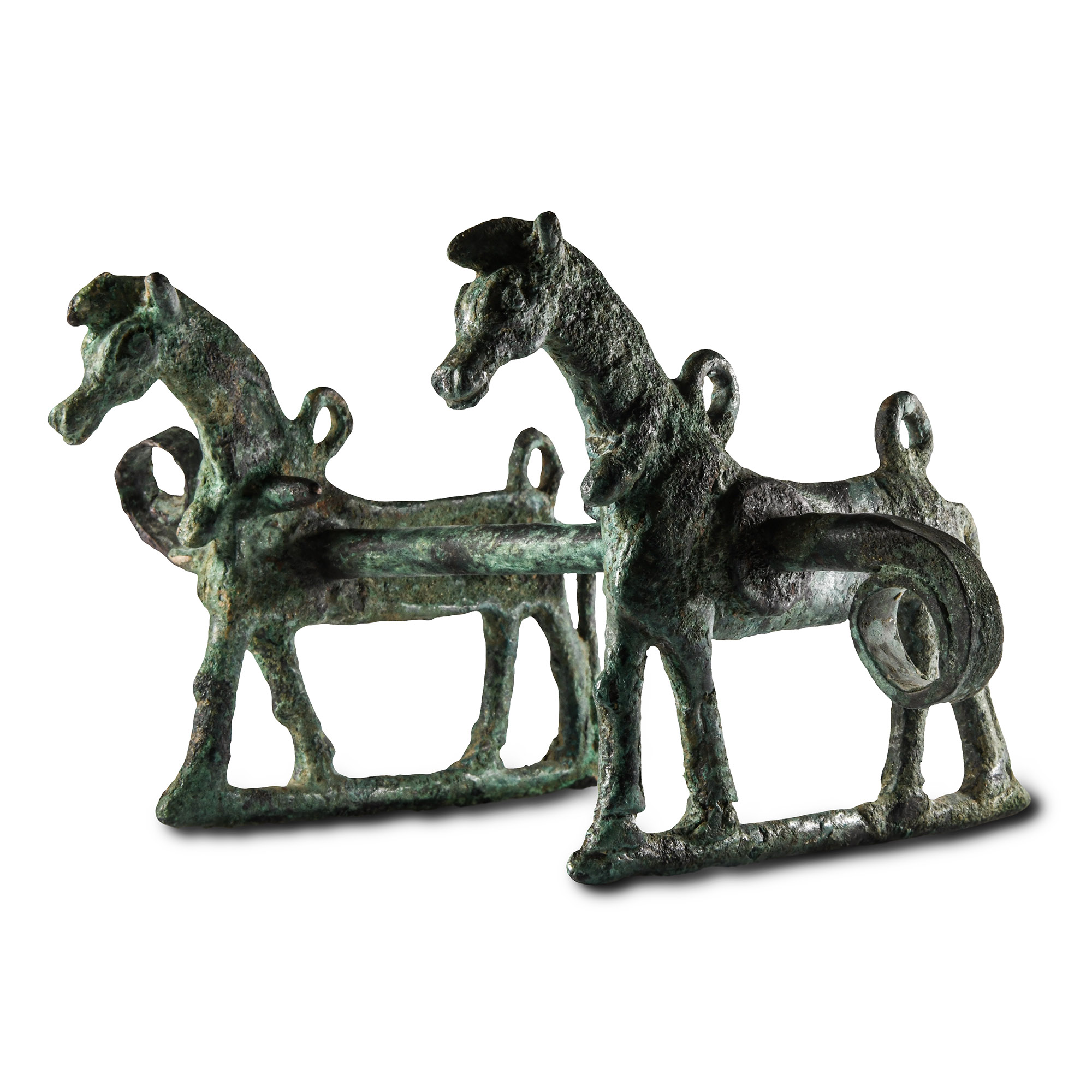
Luristan Bronze Horse Bit with Horses
11TH-8TH CENTURY B.C.
8 1/4 in. (654 grams, 21 cm wide).
The cheekpieces formed as stylised horses with small ears, elongated heads and long tails, a circular opening to the body for the bar to pass through, two loops to the body and two spurs to the reverse.
ProvenanceEx Paris collection.
French gallery, Paris, 1990-2000s.
This lot has been checked against the Interpol Database of stolen works of art and is accompanied by search certificate no.11975-210127
Cf. Legrain, L., Luristan Bronzes in the University Museum, Philadelphia, 1934, pl.XVIII no.52; Musée Cernuschi, Bronzes de Luristan, enigmes de l'Iran Ancien, IIIe-Ier millenaire av. J.C., Paris, 2008, p.111, no.71, 112, nos.72-73, for similar types.
FootnotesIn Luristan, horses were usually buried with a bronze horse-bit in their mouths, as shown by finds from Sarkishti, where the horses’ teeth were stained green.
CONDITIONTimeLine Auctions follows a vetting process to ensure the authenticity and legality of all items, reinforcing our commitment to integrity and responsible trading. Each antiquity, antique, and coin lot undergoes thorough examination by a vetting committee of at least ten external specialists, professional trade association members, scientists, and archaeologists: Our Vetting Process
AUCTIONS:
TimeLine is a leading auction house specialising in antiquities, ancient art, collectables, natural history, coins, medals, and books. Our auctions offer museums, collectors, historians, and enthusiasts the opportunity to acquire unique and historically significant pieces.
-
Western Asiatic Bronze Javelin Head
Late 3rd millennium B.C.Estimate: £300 - 400 (+bp*)
Opening Bid: £150
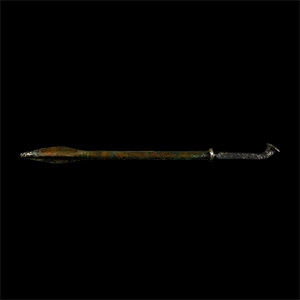
Featuring a tripartite weapon with short, narrow leafy blade, elongated stem decorated by embossed geometric lines and folded tang. 220 grams, 32.3 cm
Acquired 1980-2015. Ex Abelita family collection.
The points within this typology are biconvex or leaf-shaped, not very sharp. These types of spears have been found in the tombs of Palestine from Tell el-'Ajjul (tomb 227) to the sites of the central plains and the banks of Jordan: Yavne, 'Ain Samiya, Jebel Qa'aqir, tombs G 83 and M 13 of Jericho, tombs 2100 and 2111 of Lachish. All are dated to the last two centuries of the 3rd millennium. -
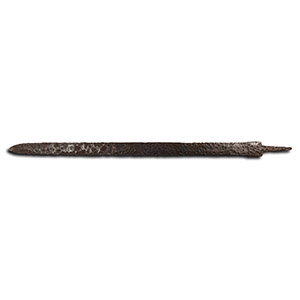
Late Roman Iron Sword of Herulian Type
5th-6th century A.D.Estimate: £3,000 - 4,000 (+bp*)
Opening Bid: £1,500
The double-edged spatha with parallel-sided blade and pointed tip, battle nicks to both cutting edges; the hilt and tang extending over the blade as a tight-fitting sleeve; remains of rivet on the tang. 604 grams, 89 cm
Ex private collection of Mr M.B., Mainz, Germany, since the 1980s. Acquired from the above, 2004. This lot has been checked against the Interpol Database of stolen works of art and is accompanied by search certificate number no. 11939-210916.
This sword belongs to the group of spathae of late Roman typology, widespread among the Germanic and Abkhazian foederati, and garrison troops of the Northern Black Sea and Caucasus. These swords could have been the prototypes of the Eastern Roman spathia, classified in the Strategikon of Pseudo-Mavrikios as Herouliskia (Herulian swords) for their connections with the Germanic mercenaries bearing them in service with the Roman army. -
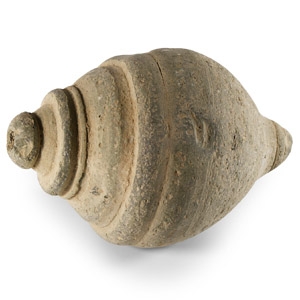
Turco-Mongol Ceramic Fire Bomb or Hand Grenade
14th-15th century A.D.Sold for (Inc. bp): £117
Piriform body with domed filler-hole, raised horizontal flanges to the shoulders; intended to be filled with explosive liquid and wick, used as a hand grenade. 409 grams, 11.7 cm
Acquired 1980-2015. Ex Abelita family collection. Accompanied by an academic paper by military specialist Dr Raffaele D'Amato, dated 15 July 2019 and titled 'Eastern Roman Empire - Greek Fire Bomb or Hand Grenade (μεσαίον kακάβιον) 9th-11th century AD'.
This piece was a sort of ceramic fire grenade, similar to the ones used by the Eastern Romans but of Turco-Mongol type. Apart from the use of manual flame-throwers, special corps of soldiers employed terracotta grenades, in the form of small jars, abundantly evidenced in archaeological excavations.
