
Loading, please wait...
LOT 1090
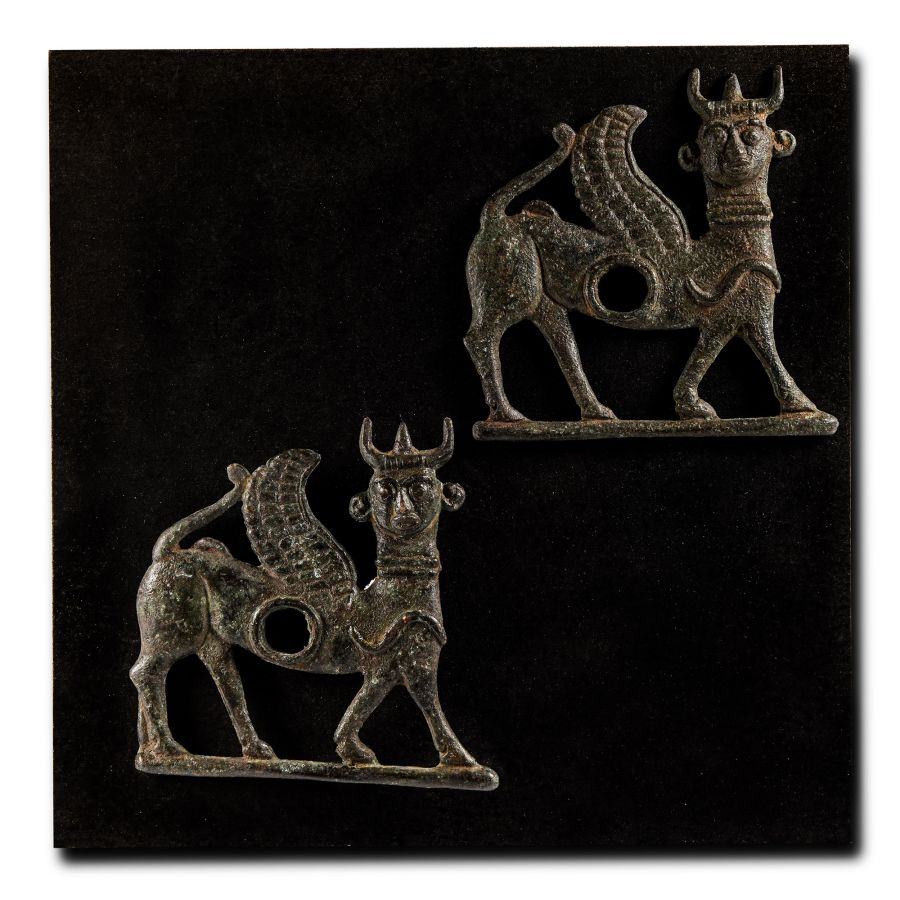
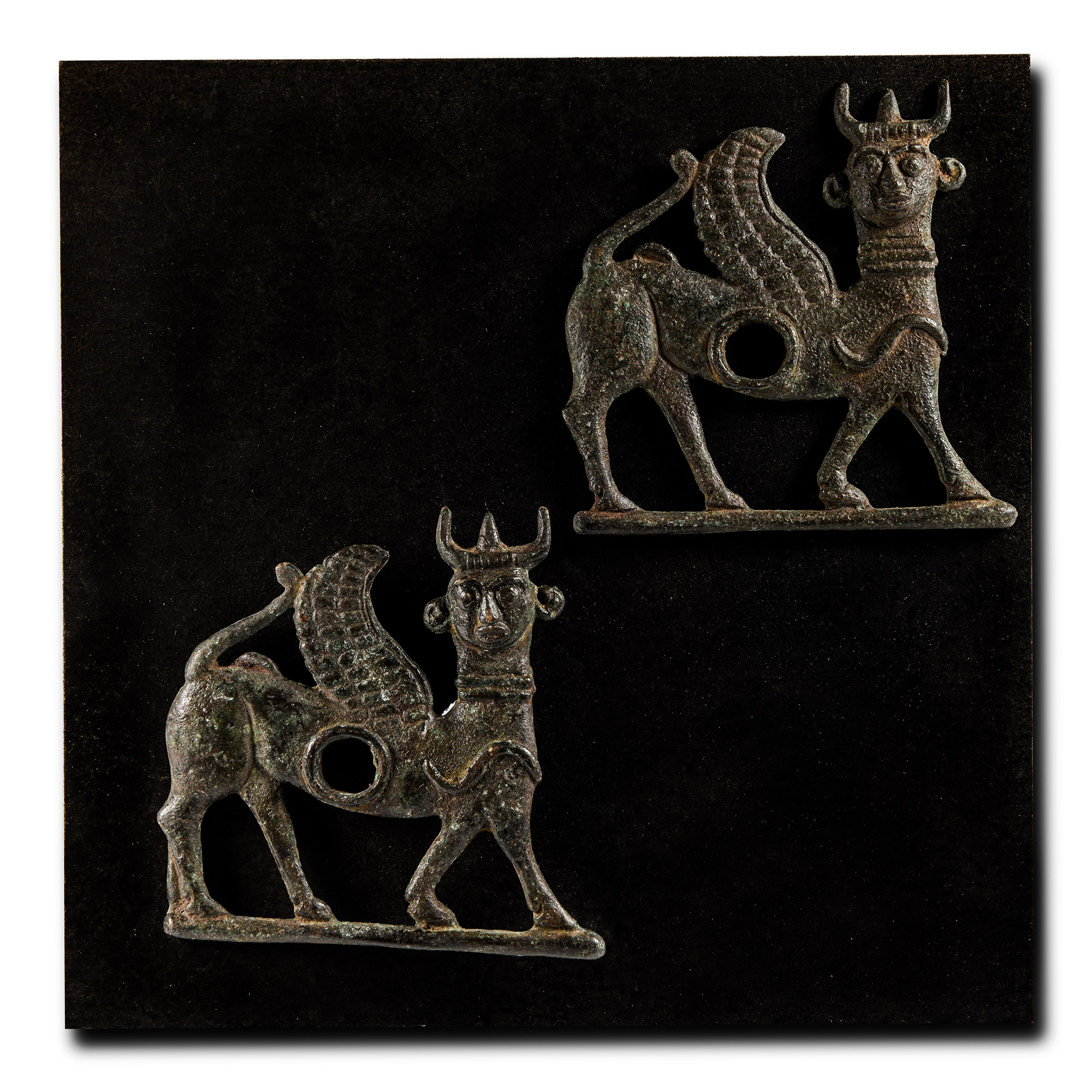
Luristan Bronze Horse Bit Terminal Pair
9TH-8TH CENTURY B.C.
6 in. (218 grams total, 15 cm wide including stand).
Comprising two terminals in the form of human-headed horned and winged sphinxes; mounted on a custom-made display stand.
ProvenanceFrom an old London, UK, collection.
Ex London, UK, gallery.
Cf. Moorey, P.R.S., 'The Art of Ancient Iran', in Ancient Bronzes, Ceramics and Seals, Los Angeles, 1981, items 150-3; British Museum accession no.134746, in Curtis, J.E. & Tallis, N., The Horse from Arabia to Ascot, London, 2012, p.98, cat.25, for the type.
FootnotesThe most admirable horse bits ever created by man are undoubtedly those from Luristan, a province in the north-west of Iran which extended along the valleys that make up the central part of the Zagros mountains. Worked in cast bronze with the lost wax process, they almost always had a rigid cannon in round or square bars which were flattened and rolled up around themselves at the ends, but their exceptional feature were the figural side bars. The local metalsmiths, in a period of time between 1200 and 700 B.C. managed to create an infinite number of typologies: horses, oxen, ibex, roosters and various mythological animals.
CONDITIONTimeLine Auctions follows a vetting process to ensure the authenticity and legality of all items, reinforcing our commitment to integrity and responsible trading. Each antiquity, antique, and coin lot undergoes thorough examination by a vetting committee of at least ten external specialists, professional trade association members, scientists, and archaeologists: Our Vetting Process
AUCTIONS:
TimeLine is a leading auction house specialising in antiquities, ancient art, collectables, natural history, coins, medals, and books. Our auctions offer museums, collectors, historians, and enthusiasts the opportunity to acquire unique and historically significant pieces.
-
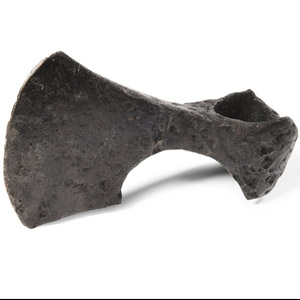
Viking Age Iron Bearded Axehead
9th century A.D.Sold for (Inc. bp): £338
Hand-forged with triangular-section narrow blade widening to a broad bevelled edge with square chin, socket with lateral flanges and rounded panel to the rear. 359 grams, 12.4 cm
From the private collection of a London gentleman, from his grandfather's collection formed before the early 1970s.
The axe seems to belong to the typology of Viking side axes of Wheeler type B (Wheeler III / Rygh 559). Usually these bearded axeheads (skeggöks) had a longer edge, designed to split tree trunks into planks and beams, or heads in two parts. Some of the bearded axes were known as halfÞynna öx, the neck on such 'half thin axe' was thinly forged, to make it lighter. -
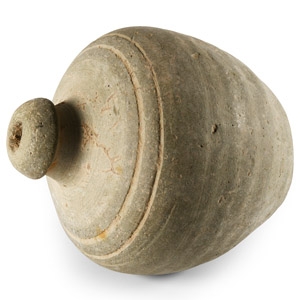
Byzantine 'Greek Fire' Ceramic Fire Bomb or Hand Grenade
9th-11th century A.D.Sold for (Inc. bp): £416
Piriform body with domed filler-hole, marked by horizontal lines to the shoulder; intended to be filled with explosive liquid and wick, used as a hand grenade. 355 grams, 10.3 cm
Acquired 1980-2015. Ex Abelita family collection. Accompanied by an academic paper by military specialist Dr Raffaele D'Amato, dated 15 July 2019 and titled 'Eastern Roman Empire - Greek Fire Bomb or Hand Grenade (μεσαίον kακάβιον) 9th-11th century AD'.
Apart from the use of siphons or manual flame-throwers called cheirosiphona, special corps of Roman soldiers employed terracotta grenades, in the form of small jars, abundantly evidenced in archaeological excavations. Such were the γανωτα, vessels (sometimes also of bronze) used for Greek fire. They were called μεσαία kακαβιά or κυτροκακάβια where the former had a bulbous shape and the latter a more cylindrical form. -
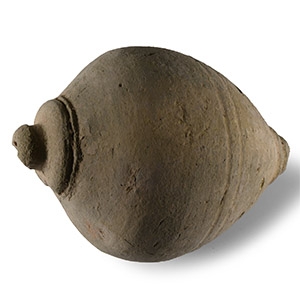
Byzantine 'Greek Fire' Ceramic Fire Bomb or Hand Grenade
Circa 11th-14th century A.D.Sold for (Inc. bp): £144
With a piriform body and domed mouth with two indented lines decorating the mid section; intended to be filled with explosive liquid and wick, used as a hand grenade. 964 grams, 15.5 cm high
Acquired 1980-2015. Ex Abelita family collection. Accompanied by an academic paper by military specialist Dr Raffaele D'Amato, dated 15 July 2019 and titled 'Eastern Roman Empire - Greek Fire Bomb or Hand Grenade (μεσαίον kακάβιον) 9th-11th century AD'.
Apart from the use of siphons or manual flame-throwers called cheirosiphona, special Roman soldiers employed terracotta grenades, in the form of small jars, abundantly evidenced in archaeological excavations. Such were the γανωτα, vessels (sometimes also in bronze) used for Greek fire. They were called μεσαία kακαβιά or κυτροκακάβια where the former had a bulbous shape and the latter a more cylindrical form.
