
Loading, please wait...
LOT 1030
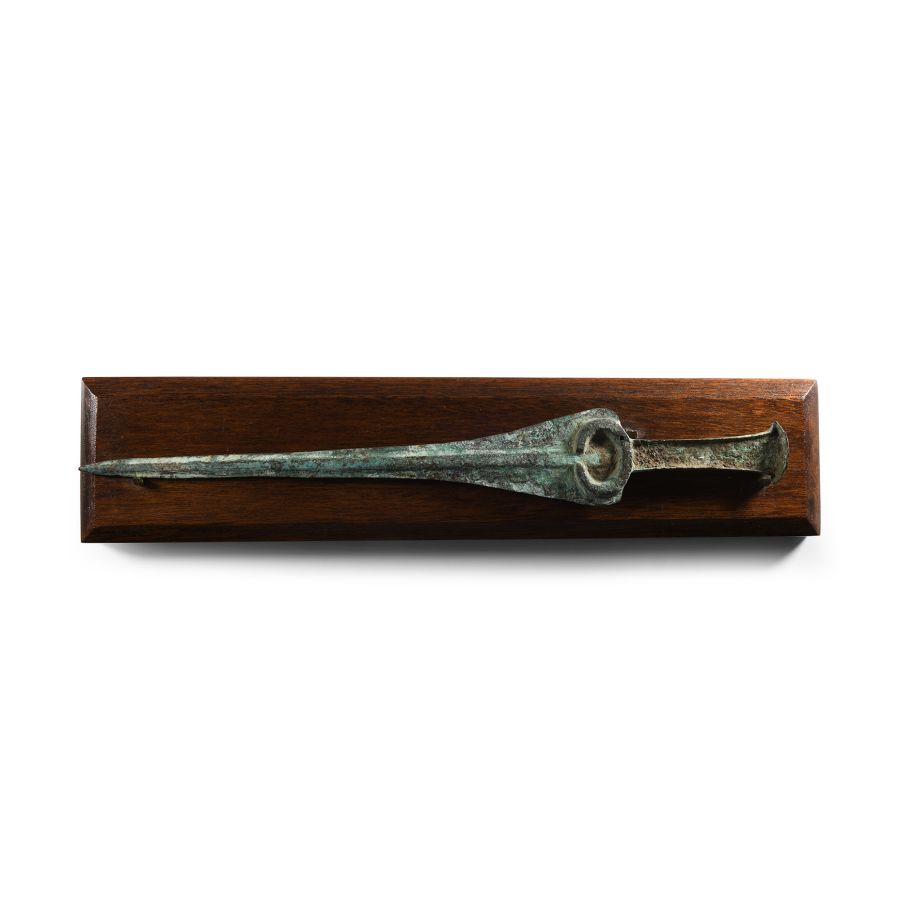
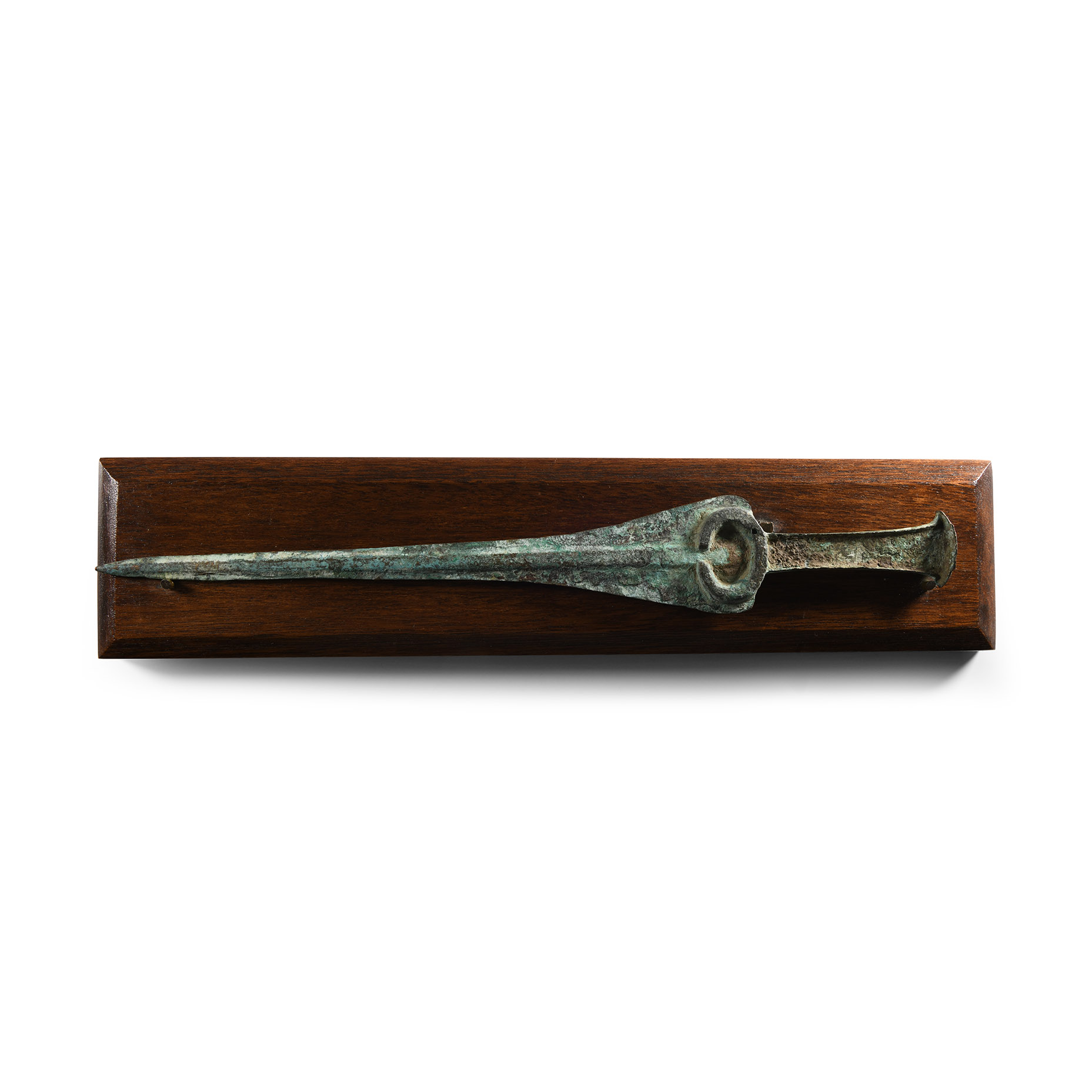
Luristan Bronze Dirk
CIRCA 11TH CENTURY B.C.
13 3/4 in. (14 3/4 in.) (554 grams total, 35 cm (37.5 cm including stand)).
With heavy penannular rib, tapering triangular blade and round shoulders, flanged hilt with straight grip, widening to a fan-shaped pommel; accompanied by a custom-made display stand.
ProvenanceEx P.A., Hertfordshire, UK, specialist collection of Greek art, 1980-1990s.
LiteratureCf. Khorasani, M.M., Arms and Armour from Iran. The Bronze Age to the End of the Qajar Period, Tübingen, 2006, s. cat 12, for type.
FootnotesThese short daggers and dirks were mainly cast in one piece, and especially the penannular rib was cast on at the same time with handle and blade according to Medvedskaya. On the contrary, Moorey said that the penannular rib was later cast on the dirk, possibly to strengthen a weak point at the junction of hilt and blade.
CONDITIONTimeLine Auctions follows a vetting process to ensure the authenticity and legality of all items, reinforcing our commitment to integrity and responsible trading. Each antiquity, antique, and coin lot undergoes thorough examination by a vetting committee of at least ten external specialists, professional trade association members, scientists, and archaeologists: Our Vetting Process
AUCTIONS:
TimeLine is a leading auction house specialising in antiquities, ancient art, collectables, natural history, coins, medals, and books. Our auctions offer museums, collectors, historians, and enthusiasts the opportunity to acquire unique and historically significant pieces.
-
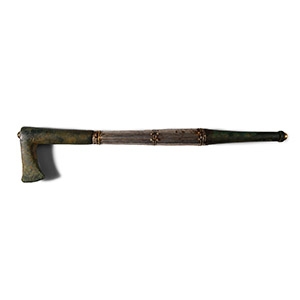
Elamite Ceremonial Axe with Silver Sleeve
3rd-2nd millennium B.C.Estimate: £12,000 - 17,000 (‡+bp*)
Opening Bid: £6,000
With later sheet-silver sleeve to the shaft, attached with ball-headed rivets; gilt dome finial to each end, the lower one in a gusseted collar. 750 grams, 45.5 cm
Acquired in 1996. Ex Samad Khameneh collection. Private Swiss collection. This lot has been checked against the Interpol Database of stolen works of art and is accompanied by search certificate no.11647-199005.
The axe belongs typologically to Type 4 of Maxwell-Hyslop’s classification, with a long and thin shaft narrowing towards the base. When technical developments resulted in heavier axe-blades, it was necessary to prolong the socket into a shaft tube and to cut away the underside of the blade where it joined the shaft. The edge of the blade was curved and this shifted the point of impact of the cutting edge. -
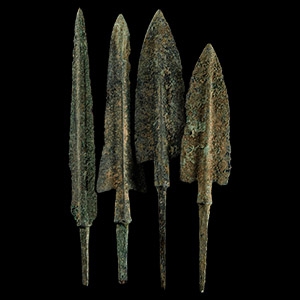
Western Asiatic Bronze Arrowhead Group
13th-6th century B.C.Sold for (Inc. bp): £117
Comprising four large triangular-shaped arrowheads, each with a raised midrib. 129 grams total, 14-15.5 cm
Acquired 1980-2015. Ex Abelita family collection.
Although different in shape, these four heads are apparently related types of a polythetic group. There are represented two basic deltoid forms: one has a sharp, flat blade, the ends of which extend to form wings or barbs, and a prominent midrib extending into a long tang that often has a stop; the blade shape varies from deltoid to more manifestly triangular. The other form has no barbs, but it has a prominent midrib extending to the tang, it is narrow and leaf shaped. -
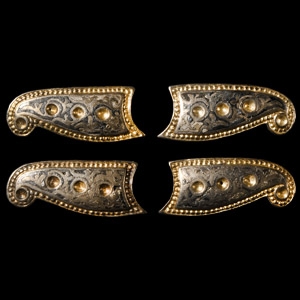
Mongol Silver Belt Mount Group
13th century A.D.Sold for (Inc. bp): £182
Each with a broader scooped edge tapering to a volute flourish, pellets adorning the perimeter, three medial circular dimples, fourth dimple to the scrolled end, against a field of foliate scrolls and niello fill; each with a set of mounting lugs to the reverse. 25.7 grams total, 40-41 mm
Fine condition.
Acquired in the 1980s-1990s. Ex an important central London gallery, London W1.
Similar plaques have been found in the burial graves of Mongol commanders and their wives, probably once part of a waist belt from which the sabre and other weapons were hanging. They were found together with arms, unique elements of the costume of fabric and leather, and splendid jewellery of gold and silver.
