
Loading, please wait...
LOT 1031
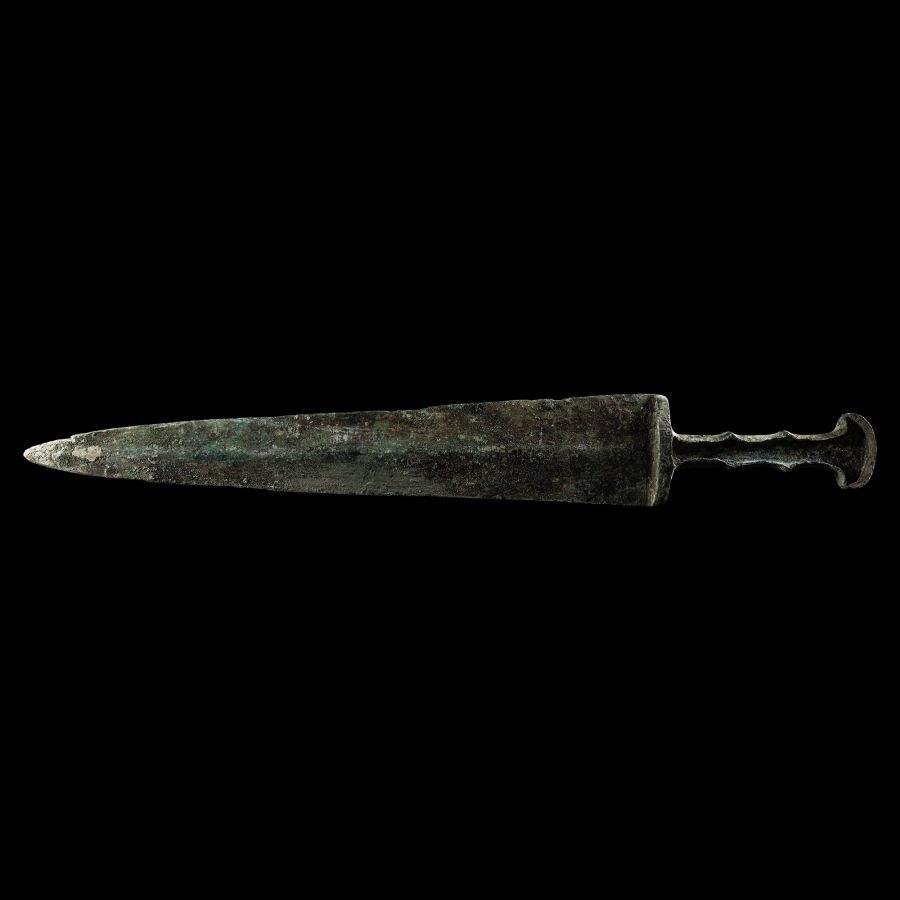
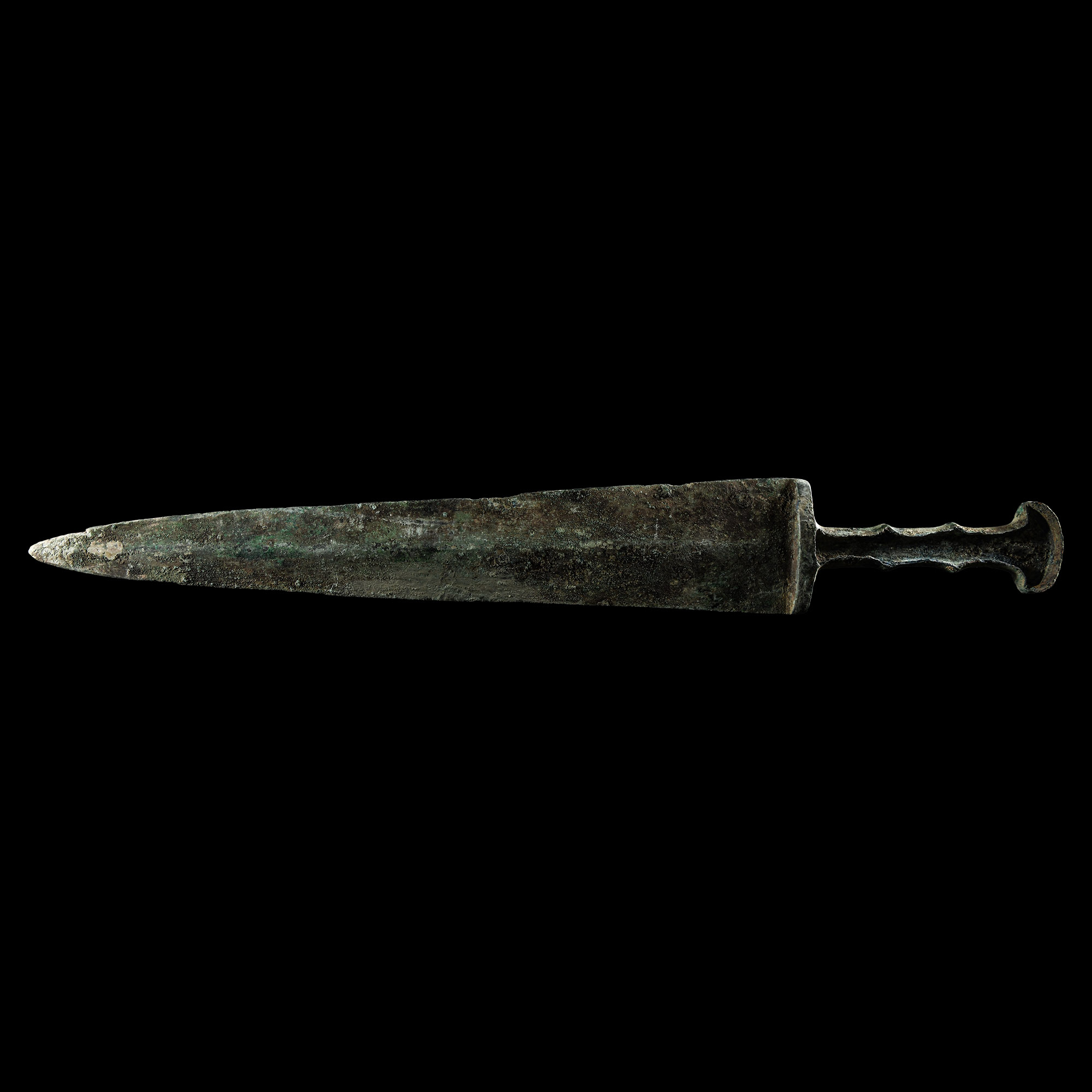
Luristan Bronze Dirk
10TH CENTURY B.C.
17 1/8 in. (474 grams, 43.5 cm).
With triangular blade and flat mid-rib, flanged hilt for the insert of a wood or bone inlay, hilt with expanded guard and crescent-shaped pommel.
ProvenanceAcquired 1980-2015.
Ex Abelita family collection.
Khorasani, M.M., Arms and Armour from Iran. The Bronze Age to the End of the Qajar Period, Tübingen, 2006, item 8.
FootnotesThis type of dirk belongs to the type III of Medvedskaya classification and is very common among daggers and dirks attributed to Luristan. The same scholar suggests that the dating for the whole series of type III daggers is an inscription on a type III dirk with the name of Marduk Nadin Ahhe (1100-1083 B.C.).
CONDITIONTimeLine Auctions follows a vetting process to ensure the authenticity and legality of all items, reinforcing our commitment to integrity and responsible trading. Each antiquity, antique, and coin lot undergoes thorough examination by a vetting committee of at least ten external specialists, professional trade association members, scientists, and archaeologists: Our Vetting Process
AUCTIONS:
TimeLine is a leading auction house specialising in antiquities, ancient art, collectables, natural history, coins, medals, and books. Our auctions offer museums, collectors, historians, and enthusiasts the opportunity to acquire unique and historically significant pieces.
-
.jpg)
Smith and Wesson Old Model No 2 Revolver
1861-1874 A.D.Sold for (Inc. bp): £780
Also known as 'Model No 2 Army' with hinged frame, six shot .32 calibre rimfire cylinder with 'PATENTED APRIL 3 1855 JULY 5 1859 & DEC 18 1860' and 15cm (6") octagonal barrel marked 'SMITH & WESSON SPRINGFIELD MASS' to top with fixed extractor pin and spur trigger; serial number 47946 to butt strap with plain wood grip scales; action working. 690 grams, 27 cm
Acquired from Bolk Antique Arms, Netherlands, 2016. Ex Kusmirek Collection, UK. Accompanied by an original Bolk invoice.
Sold as an exempt item under Section 58 (2) of the Firearms Act, 1968, to be held as a curiosity or ornament. No license required but buyer must be over 18 years of age. Overseas bidders should note that, due to UK regulations governing export of all firearms, overseas buyers will need to make arrangements for shipping this lot out of the UK directly, by air freight, with a specialist company or agent. -
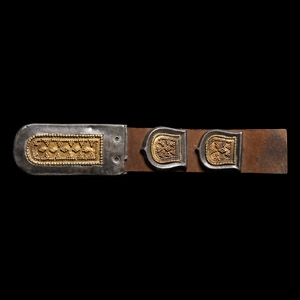
Avar-Byzantine Silver-Gilt Sword Belt Mount Group
7th-9th century A.D.Sold for (Inc. bp): £156
Comprising three belt mounts later remounted onto brown leather comprising: a rectangular strap end with rounded terminal, decorated with granulated borders, lozenges and chevrons; two roughly D-shaped mounts with apex flourish and waisted sides, also decorated with granulated lozenges and chevrons. 26.5 grams, 12.2 cm long
Fine condition.
Acquired in the 1980s-1990s. Ex an important central London gallery, London W1.
This type of belt element, decorated with granulation, is present in the Avar graves of the second half of the 7th century, and was most likely produced in the workshops of the Eastern Roman Empire, from where they reached the Avar lands as imperial gifts (tomb of Kunbàboni) or spoils of war. They were part of multiple belts, to which sabres and knives were attached, commonly used among Avars, Bulgars and Romans during the 7th and 8th centuries A.D. -
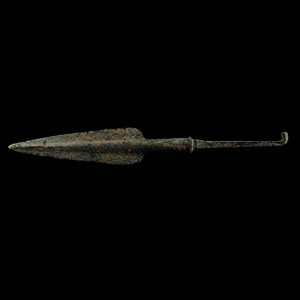
Western Asiatic Tanged Bronze Spearhead
Late 3rd millennium B.C.Estimate: £100 - 140 (+bp*)
Opening Bid: £50
Having foliate blade with central rib and slender shoulders, cylindrical short shaft encasing a rectangular tang with a bent end. 151 grams, 26.5 cm
Acquired 1980-2015. Ex Abelita family collection.
This variant is characterised by a blade of rhomboidal or swollen section, an intermediate part often short widened so as to form a clear stop and a curved bristle at its end, sometimes finished in a button. Most lances are of medium dimensions (23 cm to 36 cm), others are very elongated (more than 50 cm). The best parallels come from Tepe Hissar. Elements of handles found nearby the spearheads in the excavations have made it possible to reconstruct the total length of the weapon (1.40 m).
