
Loading, please wait...
LOT 1114
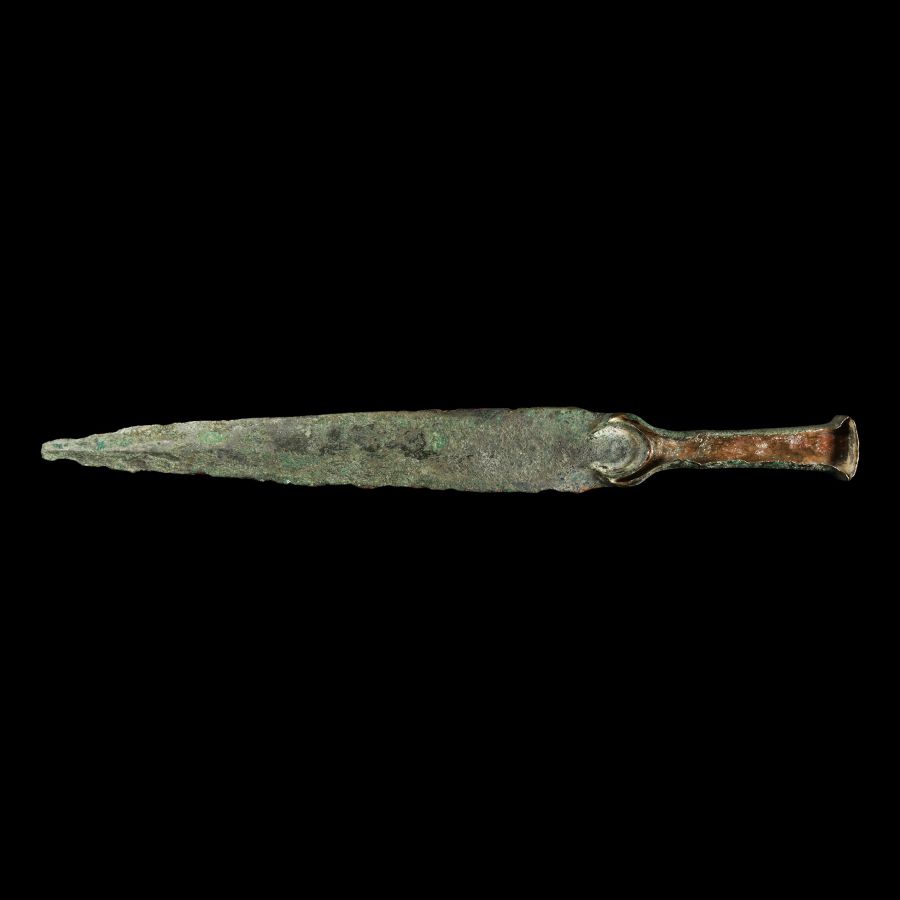
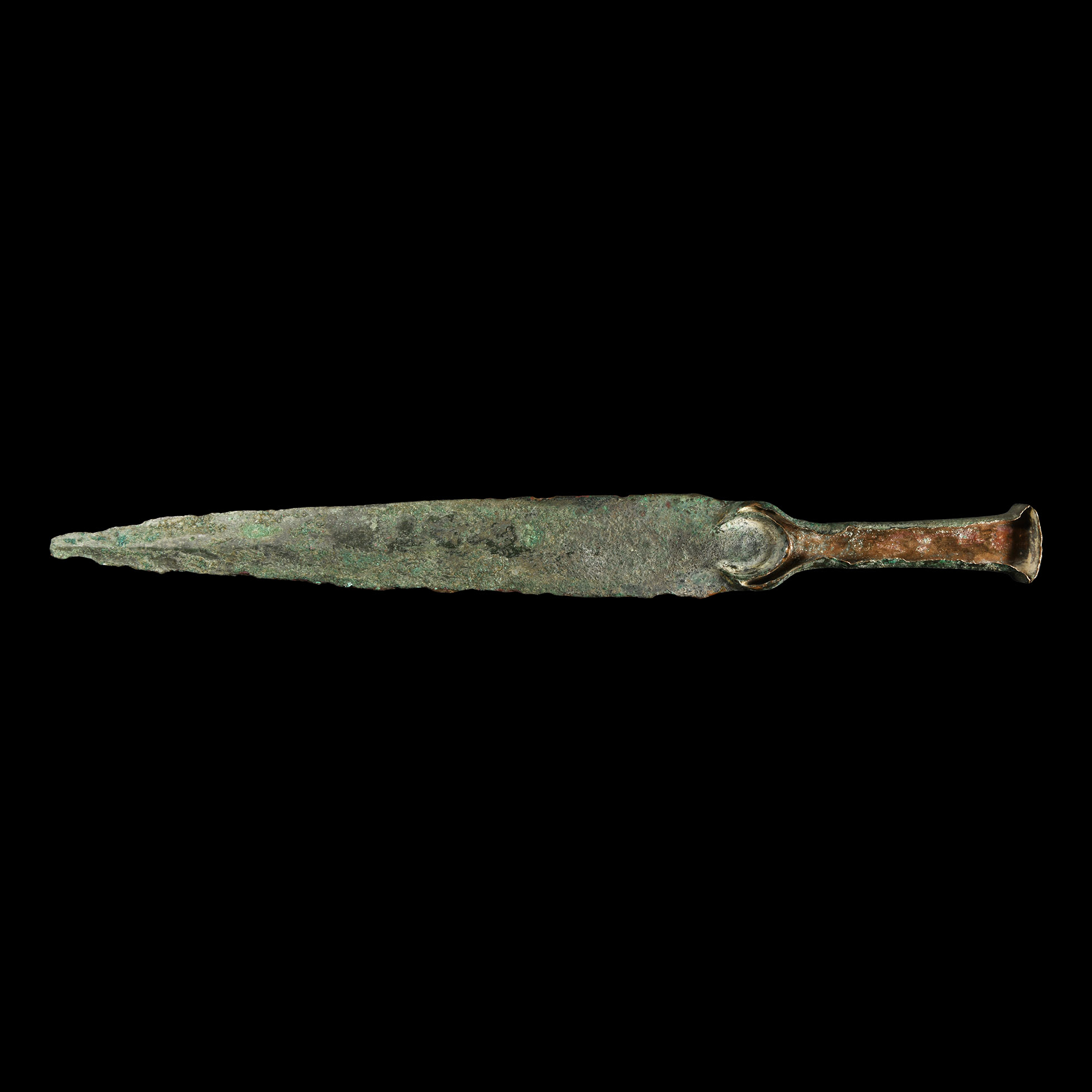
Luristan Bronze Dirk
CIRCA 1000 B.C.
14 3/4 in. (264 grams, 37.5 cm).
Composed of a leaf-shaped blade with a raised penannular rib and slot below the shoulder connected to the grip with lateral flanges and integral pommel, recessed to accept an organic insert.
ProvenanceFrom an old English collection, formed in the 1980s.
The Kusmirek Collection, UK.
Cf. Khorasani, M.M., Arms and Armour from Iran - The Bronze Age to the End of the Qajar Period, Tuebingen, 2006, p.380, Cat.12, inventory no.655.
FootnotesThis dirk, cast in one piece mould, belongs to the daggers that Medvedskaya believes support the thesis that majority of them were cast in one piece. However, there are examples where the penannular grip was cast on later on the dagger or dirk.
CONDITIONTimeLine Auctions follows a vetting process to ensure the authenticity and legality of all items, reinforcing our commitment to integrity and responsible trading. Each antiquity, antique, and coin lot undergoes thorough examination by a vetting committee of at least ten external specialists, professional trade association members, scientists, and archaeologists: Our Vetting Process
AUCTIONS:
TimeLine is a leading auction house specialising in antiquities, ancient art, collectables, natural history, coins, medals, and books. Our auctions offer museums, collectors, historians, and enthusiasts the opportunity to acquire unique and historically significant pieces.
-
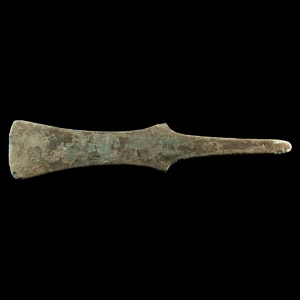
Luristan Bronze Flat Axe
13th-7th century B.C.Estimate: £120 - 170 (+bp*)
Opening Bid: £60
Featuring a tapering tang, winged neck, waisted cheeks and slightly convex cutting edge. 259 grams, 21.2 cm
Acquired 1980-2015. Ex Abelita family collection. -
.jpg)
Roman Bronze Armour Double Fastening Hooks
Circa 1st century A.D.Sold for (Inc. bp): £143
Each a scrolled bar formed as a serpent or other animal with stylised geometric detailing; attachment perforations to both terminals. 19.6 grams total, 64-66 mm
Acquired on the London art market, 1980s-1990s.
In the 1st century B.C.-1st century A.D., the Celtic fastening system of the ring mail armour (gallica, lorica ferro aspera) became the standard in the Imperial Roman army, with a pivot attached to the breast and hinged to the edges of the humeralia (shoulder guards). The chest fastener had various different designs. The double hooks, S-shaped and usually with snake-head terminals, were secured by a central rivet on the chest. The system allowed excellent freedom of movement, giving greater protection to the shoulders and the arms. Similar fasteners for infantry mail have been found on the Kalkriese battlefield, some of them also decorated with niello and inscribed with the name of the soldier. -
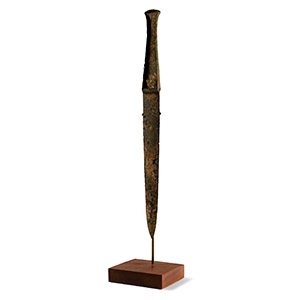
Canaanite Bronze Dirk
13th-12th century B.C.Estimate: £700 - 900 (‡+bp*)
Opening Bid: £375
With lentoid-section blade, tongue-shaped in plan, integral tapering hilt with flared finial, lateral flanges to accept a panel of bone or wood to each face forming the grip. 289 grams total, 39.5 cm high including stand
Ex Joseph J. Gancie (1923-2010), Washington, Silver Spring, Maryland. with Alex Cooper Auctioneers Inc., sale 1035, 27 January 2013, lot 162a.
The dirk belongs to the type III in the Medvedskaya classification, used in Near East from the 13th to the 6th century B.C. The type is the 32a of the Maxwell-Hyslop study. The Asiatic daggers of this type are confined to Syria and Persia, but Transcaucasia also provides an interesting analogy from Kalekent on the Baku peninsula, where a pointed straight-sided dagger blade has a flanged hilt with the whole of the side flanges bent over the centre.
