
Loading, please wait...
_900x900.jpg "Luristan Bronze Dagger")
_200x200.jpg "Luristan Bronze Dagger")
.jpg "Luristan Bronze Dagger")
LOT 1457
Luristan Bronze Dagger
13TH-7TH CENTURY B.C.
8 in. (93 grams, 20.1 cm).
Comprising a two-edged leaf-shaped lentoid-section blade, crescentic lower guard, ribbed hilt and domed finial.
ProvenanceAcquired before 1983.
Ex London gallery, 1990s.
This lot is accompanied by an illustrated lot declaration signed by the Head of the Antiquities Department, Dr Raffaele D'Amato.
See a similar dagger in Godard, A., Les Bronzes du Luristan, Paris, 1931, pl.VII, no.15, for type.
CONDITIONTimeLine Auctions follows a vetting process to ensure the authenticity and legality of all items, reinforcing our commitment to integrity and responsible trading. Each antiquity, antique, and coin lot undergoes thorough examination by a vetting committee of at least ten external specialists, professional trade association members, scientists, and archaeologists: Our Vetting Process
AUCTIONS:
TimeLine is a leading auction house specialising in antiquities, ancient art, collectables, natural history, coins, medals, and books. Our auctions offer museums, collectors, historians, and enthusiasts the opportunity to acquire unique and historically significant pieces.
-
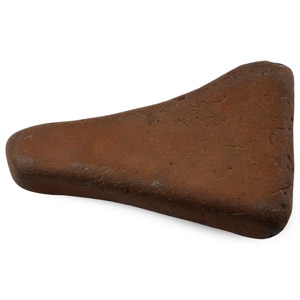
Viking Whetstone Blade Sharpener
8th-12th century A.D.Sold for (Inc. bp): £91
Triangular type with two flat faces, usage wear to edge. 364 grams, 11.4 cm
Found East Anglia, UK. This lot is accompanied by an illustrated lot declaration signed by the Head of the Antiquities Department, Dr Raffaele D'Amato. -
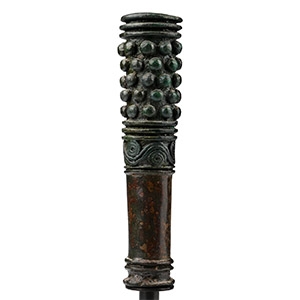
Mesopotamian Bronze Macehead with Raised Bosses
Early 2nd millennium B.C.Estimate: £700 - 900 (+bp*)
Opening Bid: £350
Of cylindrical shape, the upper section with prominent bosses and flanges, short cylindrical shaft edged at top and bottom with collars; mounted on a custom-made stand. 630 grams total, 21 cm including stand
with ArtAncient, 2010. Private collection, London. This lot is accompanied by an illustrated lot declaration signed by the Head of the Antiquities Department, Dr Raffaele D'Amato. -
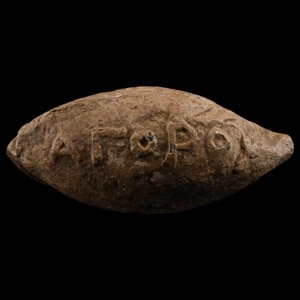
Greek Slingshot with Inscription
4th-1st century B.C.Sold for (Inc. bp): £338
Lentoid in form with raised legend 'AΓOPOY' beneath casting seam. 36.2 grams, 32 mm
Private collection, Austria. Private collection, Europe. This lot is accompanied by an illustrated lot declaration signed by the Head of the Antiquities Department, Dr Raffaele D'Amato.
