
Loading, please wait...
_900x900.jpg "Luristan Bronze Dagger")
_200x200.jpg "Luristan Bronze Dagger")
.jpg "Luristan Bronze Dagger")
LOT 1435
Luristan Bronze Dagger
13TH-7TH CENTURY B.C.
12 3/8 in. (338 grams, 31.5 cm).
With ogival blade featuring a square sectioned mid-rib, tubular handle with two horizontal grooves of circular shape and disc pommel.
ProvenanceAcquired 1980-2015.
Ex Abelita family collection.
Cf. Gorelik, M., Weapons of Ancient East, IV millennium BC-IV century BC, Saint Petersburg, 2003, in Russian, see pl.IV no.76, for a detail on an alabaster relief, Southern Mesopotamia, early 2nd millennium B.C.; pl.V, no.59, from Kafan, X I-IX centuries B.C., for the type.
FootnotesThe dagger represents an uncommon type with its disk pommel and short grip but with a foliate blade of a spearhead. Similar types were already visible in the Mesopotamian reliefs of early 19th century, but pommel disc daggers and foliate blades are a combination that was archaeologically documented on Caucasian daggers until the 9th century B.C., employed by the Urartian warriors.
CONDITIONTimeLine Auctions follows a vetting process to ensure the authenticity and legality of all items, reinforcing our commitment to integrity and responsible trading. Each antiquity, antique, and coin lot undergoes thorough examination by a vetting committee of at least ten external specialists, professional trade association members, scientists, and archaeologists: Our Vetting Process
AUCTIONS:
TimeLine is a leading auction house specialising in antiquities, ancient art, collectables, natural history, coins, medals, and books. Our auctions offer museums, collectors, historians, and enthusiasts the opportunity to acquire unique and historically significant pieces.
-
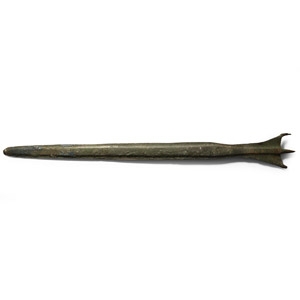
Western Asiatic Bronze Short Sword with Integral Hilt with Horns
Late 2nd-1st millennium B.C.Estimate: £180 - 240 (+bp*)
Opening Bid: £90
With prominently curved guard, which extends out from the ricasso of the blade and partly frames the hilt, thick flat midrib extending slightly above the ricasso where it held the hilt. 466 grams, 53 cm
Acquired 1980-2015. Ex Abelita family collection.
The hilt of such swords was made separately, and unfortunately is nearly always missing from the archaeological records. Similar daggers had a northern Iranian background and excavated examples have been recorded from the South Caspian Area from Tomadjan and Ghalekuti. -
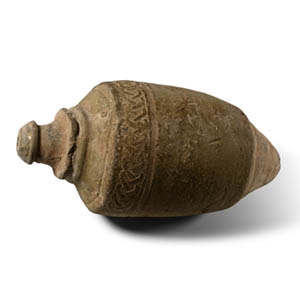
Turco-Mongol 'Greek Fire' Ceramic Fire Bomb or Hand Grenade
14th-15th century A.D.Sold for (Inc. bp): £85
A hollow vessel with cylindrical body, short neck and domed mouth, band of latticework to the shoulder; intended to be filled with explosive liquid and a wick, and used as a hand grenade. 623 grams, 16.5 cm
From a specialist London, UK, arms and armour collection, 1990s.
This was a type of ceramic fire grenade, similar to the ones used by the Eastern Romans but of Turco-Mongol type. Apart from the use of manual flame-throwers, special corps of soldiers employed terracotta grenades, in the form of small jars, abundantly evidenced in archaeological excavations. -
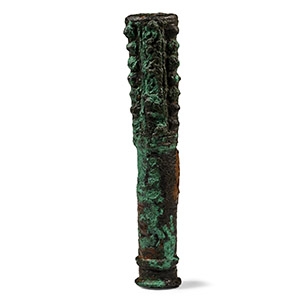
Luristan Mace Head
13th-7th century B.C.Sold for (Inc. bp): £85
Of cylindrical shape, the upper section with alternating rectangular panels and vertical rows of three prominent spikes, short cylindrical shaft edged at top and bottom. 294 grams, 17 cm
Acquired 1980-2015. Ex Abelita family collection.
