
Loading, please wait...


LOT 1456
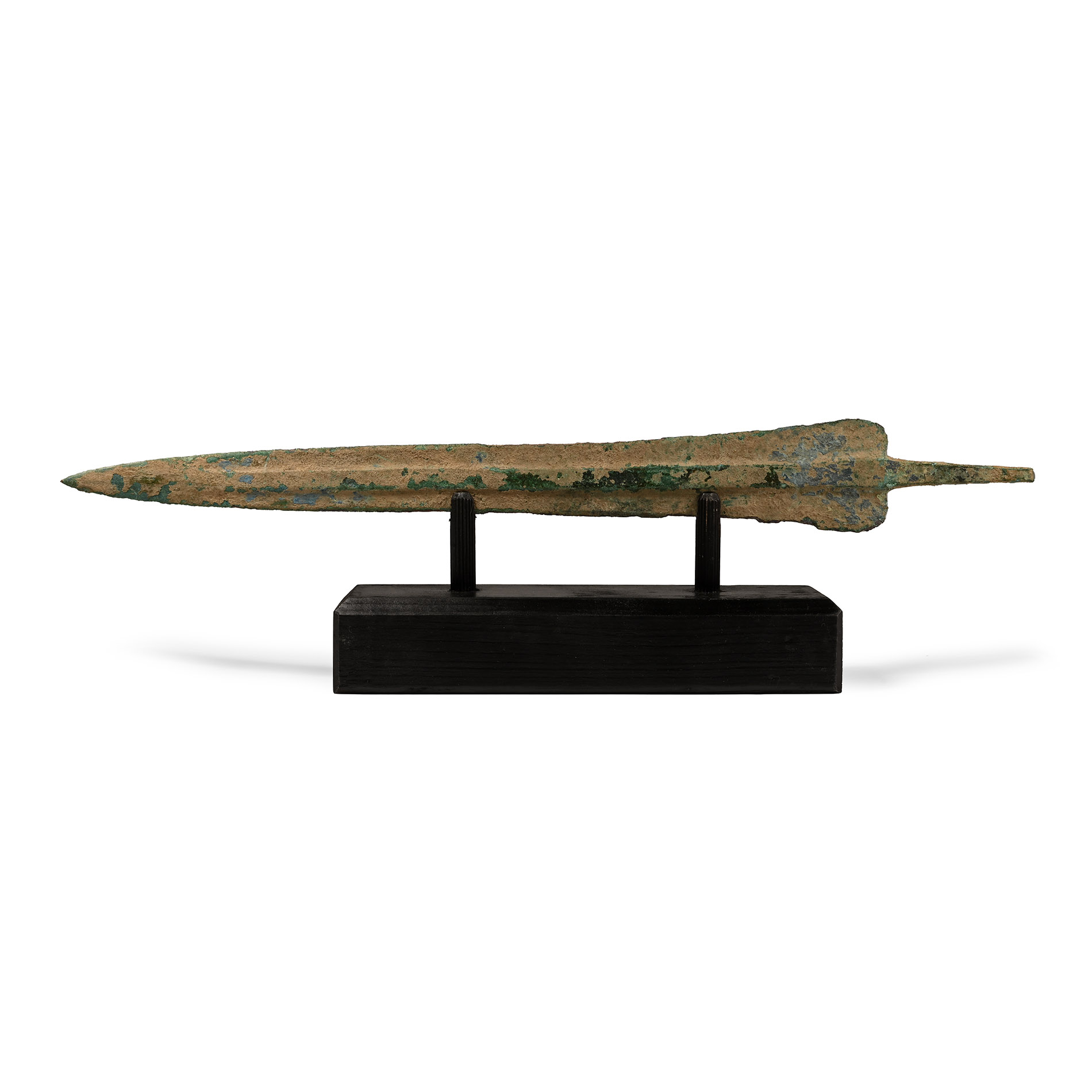
Luristan Bronze Dagger Blade
CIRCA 1ST MILLENNIUM B.C.
15 1/4 in. (420 grams total, blade: 39 cm long).
Comprising a slender blade with a raised midrib extending towards the short tang, broad rounded shoulders; mounted on a custom-made stand. [No Reserve]
ProvenanceFrom the private collection of H. Norry, 1980s-1990s.
LiteratureCf. Christie's, The Axel Guttmann Collection of Ancient Arms and Armour, part 2, London, 2004, item 40, p.36.
FootnotesThe Luri people produced a quantity of fine metalwork, which according to Dr. Khorasani, could be due to a settled period which arose as a result of the defeat of the Elamites by the Babylonians, leaving the Luristani people in relative peace for a period of time after 1200 B.C. According to Khorasani 'A culture of innovation and experimentation flourished, and the repertoire of the Luristan smiths expanded in the period between 1150–1050 BC.'
CONDITIONTimeLine Auctions follows a vetting process to ensure the authenticity and legality of all items, reinforcing our commitment to integrity and responsible trading. Each antiquity, antique, and coin lot undergoes thorough examination by a vetting committee of at least ten external specialists, professional trade association members, scientists, and archaeologists: Our Vetting Process
AUCTIONS:
TimeLine is a leading auction house specialising in antiquities, ancient art, collectables, natural history, coins, medals, and books. Our auctions offer museums, collectors, historians, and enthusiasts the opportunity to acquire unique and historically significant pieces.
-
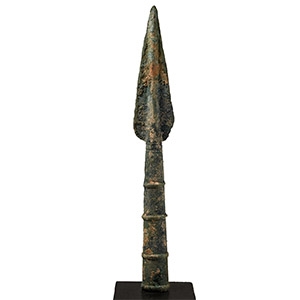
Luristan Bronze Spearhead with Circumferential Rings
9th-6th century B.C.Sold for (Inc. bp): £130
With broad leaf-shaped blade and tapering tubular socket, four graduated horizontal rings securing the split socket. 199 grams total, 26.2 cm including stand
Ex property of a North London, UK, gentleman, 1990s.
The spear belongs to the type VIII classified by Khorasani (spearheads with well-projecting midribs and long folded sockets) and more specifically to subtype C (with leaf-shaped blade and short hollow socket). Usually the willow-leaf blade has an almost straight shoulder base and a wide, flat midrib tapering towards the point. -
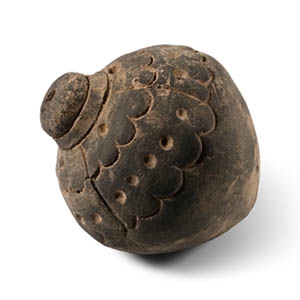
Byzantine 'Greek Fire' Ceramic Fire Bomb or Hand Grenade
9th-11th century A.D.Sold for (Inc. bp): £124
Piriform missile with domed filler-hole, petalled decoration to the upper body with pellets, intended to be filled with explosive liquid and wick, used as a hand grenade. 431 grams, 10.7 cm
From a specialist London, UK, arms and armour collection, 1990s. Accompanied by an academic paper by military specialist Dr Raffaele D'Amato, dated 15 July 2019 and titled 'Eastern Roman Empire - Greek Fire Bomb or Hand Grenade (μεσαίον kακάβιον) 9th-11th century AD'.
Apart from the use of siphons or manual flame-throwers called cheirosiphona, special corps of Roman soldiers employed terracotta grenades, in the form of small jars, abundantly evidenced in archaeological excavations. They were called μεσαία kακαβιά or κυτροκακάβια where the former had a bulbous shape and the latter a more cylindrical form. -
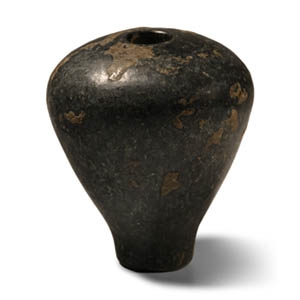
Western Asiatic Mottled Black Stone Mace Head
3rd-2nd millennium B.C.Sold for (Inc. bp): £117
Piriform in profile with vertical socket expanding towards the base, short neck. 459 grams, 80 mm
Ex London gentleman's collection, 1990s.
