
Loading, please wait...
_900x900.jpg "Luristan Bronze Arrowhead Group")
_200x200.jpg "Luristan Bronze Arrowhead Group")
.jpg "Luristan Bronze Arrowhead Group")
LOT 1411
Luristan Bronze Arrowhead Group
13TH-6TH CENTURY B.C.
3 7/8 - 6 3/8 in. (400 grams total, 9.7-16.2 cm).
Comprising triangular types with thick midrib, leaf-shaped and other types. [15]
ProvenanceAcquired 1980-2015.
Ex Abelita family collection.
This lot is accompanied by an illustrated lot declaration signed by the Head of the Antiquities Department, Dr Raffaele D’Amato.
This lot is accompanied by an illustrated lot declaration signed by the Head of the Antiquities Department, Dr Raffaele D'Amato.
TimeLine Auctions follows a vetting process to ensure the authenticity and legality of all items, reinforcing our commitment to integrity and responsible trading. Each antiquity, antique, and coin lot undergoes thorough examination by a vetting committee of at least ten external specialists, professional trade association members, scientists, and archaeologists: Our Vetting Process
AUCTIONS:
TimeLine is a leading auction house specialising in antiquities, ancient art, collectables, natural history, coins, medals, and books. Our auctions offer museums, collectors, historians, and enthusiasts the opportunity to acquire unique and historically significant pieces.
-
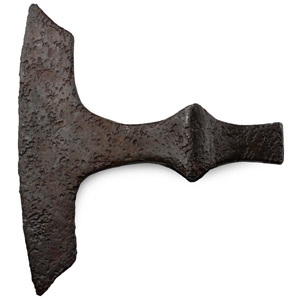
Viking Age Iron T-Shaped Axehead
Circa 9th-11th century A.D.Sold for (Inc. bp): £416
With broad curved edge, narrow neck, round flared socket with triangular flanges to each face and rectangular hammer extension to the rear. 378 grams, 16.5 cm
Ex North American private collection, 1970s. This lot is accompanied by an illustrated lot declaration signed by the Head of the Antiquities Department, Dr Raffaele D'Amato. -
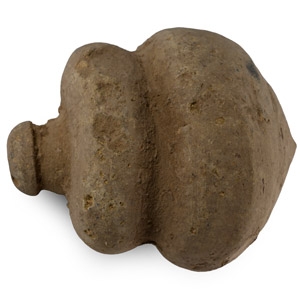
Byzantine 'Greek Fire' Ceramic Fire Bomb or Hand Grenade
9th-11th century A.D.Sold for (Inc. bp): £78
Tiered body with pointed finial and domed mouth; intended to be filled with explosive liquid and a wick, and used as a hand grenade. 421 grams, 10.3 cm
From an important specialist collection, London, UK, 1990s onwards. Accompanied by an academic paper by military specialist Dr Raffaele D'Amato, dated 15 July 2019 and titled 'Eastern Roman Empire - Greek Fire Bomb or Hand Grenade (μεσαίον kακάβιον) 9th-11th century AD'. This lot is accompanied by an illustrated lot declaration signed by the Head of the Antiquities Department, Dr Raffaele D'Amato.
Apart from the use of siphons or manual flame-throwers called cheirosiphona, special corps of Roman soldiers employed terracotta grenades, in the form of small jars, abundantly evidenced in archaeological excavations. They were called μεσαία kακαβιά or κυτροκακάβια where the former had a bulbous shape and the latter a more cylindrical form. -
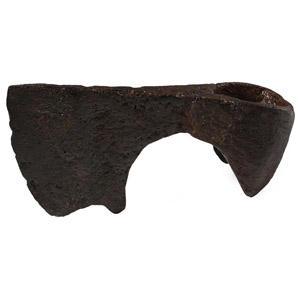
Viking Age Iron Bearded Axehead
11th-12th century A.D.Sold for (Inc. bp): £130
A hand-forged axehead with rectangular-section narrow blade widening to a broad bevelled edge with square chin, socket with rounded extensions to the rear. 531 grams, 15.5 cm
From the private collection of a London gentleman, from his grandfather's collection formed before the early 1970s. This lot is accompanied by an illustrated lot declaration signed by the Head of the Antiquities Department, Dr Raffaele D'Amato.
The more commonly used weapons of the Finno-Ugrian people were axes, commonly found in all Finnic areas, as well as spears. Iron axeheads of this typology show a sub-trapezoidal asymmetrical blade, sometimes perforated through the centre.
