
Loading, please wait...


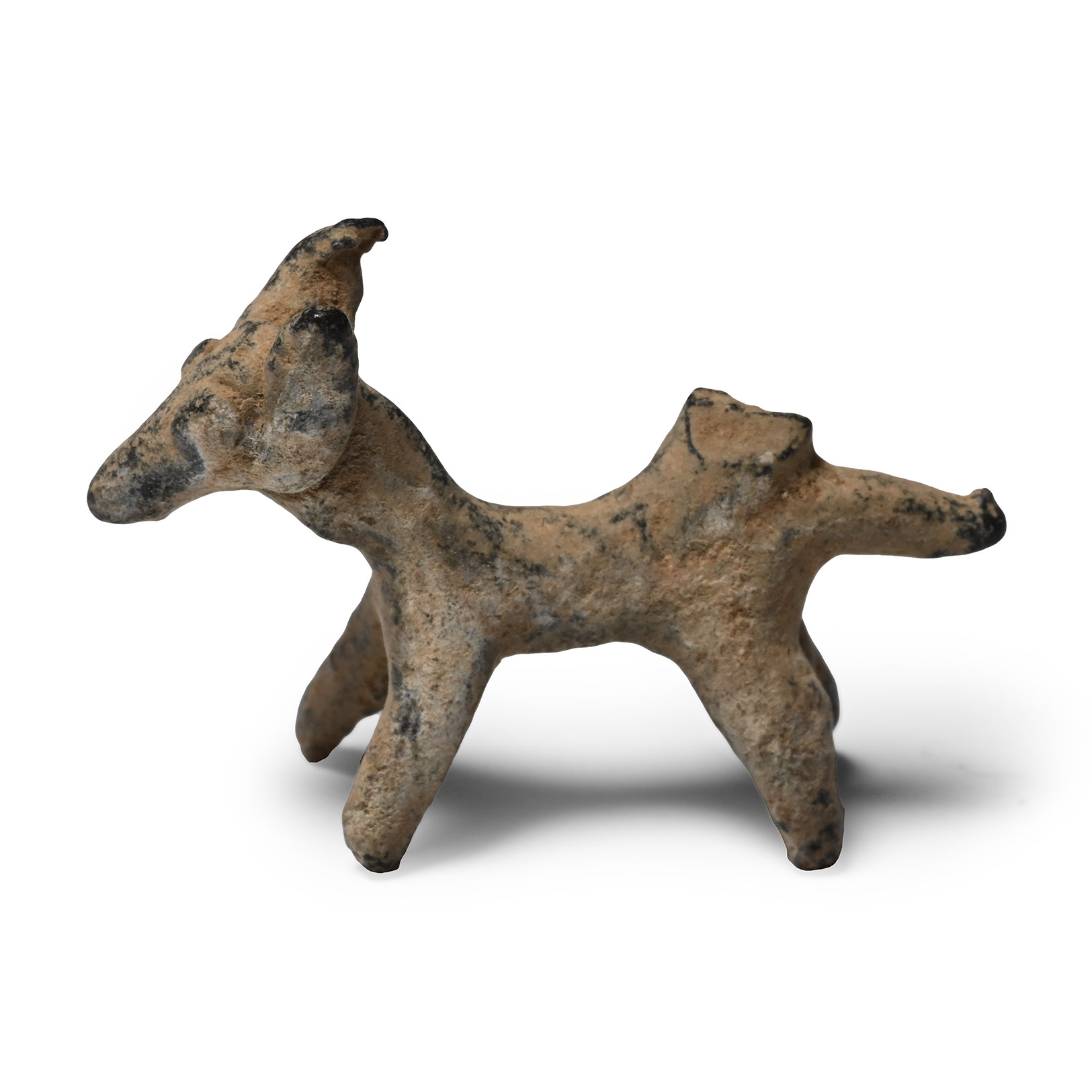
LOT 1300
Luristan Bronze Animal
13TH-7TH CENTURY B.C.
1 1/4 in. (8.4 grams, 33 mm wide).
Advancing pose with tail extended. [No Reserve]
ProvenanceAcquired 1980-2015.
Ex Abelita family collection.
TimeLine Auctions follows a vetting process to ensure the authenticity and legality of all items, reinforcing our commitment to integrity and responsible trading. Each antiquity, antique, and coin lot undergoes thorough examination by a vetting committee of at least ten external specialists, professional trade association members, scientists, and archaeologists: Our Vetting Process
AUCTIONS:
TimeLine is a leading auction house specialising in antiquities, ancient art, collectables, natural history, coins, medals, and books. Our auctions offer museums, collectors, historians, and enthusiasts the opportunity to acquire unique and historically significant pieces.
-
.jpg)
Mesopotamian Hardstone Cylinder Seal with Combat Scene
Circa 2nd-1st millennium B.C.Sold for (Inc. bp): £468
Featuring a single register with a bearded male figure facing right, pair of animals engaged in fight to both sides, possibly depicting an ibex and a lion on their hindlegs. 10.5 grams, 29 mm
Ex property of the late Mr S.M., London, UK, 1970-1990s, thence by descent. Accompanied by a previous typed cataloguing card. -
.jpg)
Bactrian Lapis Lazuli Pin-Head and Bead
3rd millennium B.C.Estimate: £2,000 - 3,000 (+bp*)
Opening Bid: £800
Comprising: a lapis lazuli bead with high-relief figure of a snake in sinuous coils, head poised to strike, with eyes formed as turquoise annular beads; a bronze columnar handle; a tabular banded agate bead; all three bound together from the bronze corrosion products. 50 grams, 10 cm
with Gallery Rosen Ancient Art, Tel Aviv, 1968. with a London, UK gallery, 1971-early 2000s. Accompanied by a copy of the original 1968 invoice. This lot has been checked against the Interpol Database of stolen works of art and is accompanied by a search certificate number no.12409-225344. -
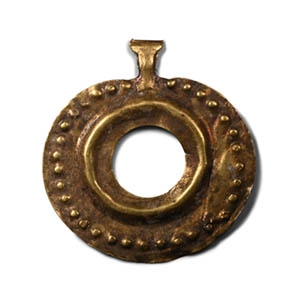
Anatolian Gold Idol
4th millennium B.C.Estimate: £2,000 - 3,000 (‡+bp*)
Opening Bid: £1,000
Sheet gold ring with repoussé annulet and band of pellets, T-shaped suspension. 2.79 grams, 35 mm
Acquired in the mid 1980s-1990s. Private collection, Switzerland, thence by descent. Private collection, since the late 1990s. This lot has been checked against the Interpol Database of stolen works of art and is accompanied by a search certificate number no.12424-226930.
