
Loading, please wait...
LOT 1399
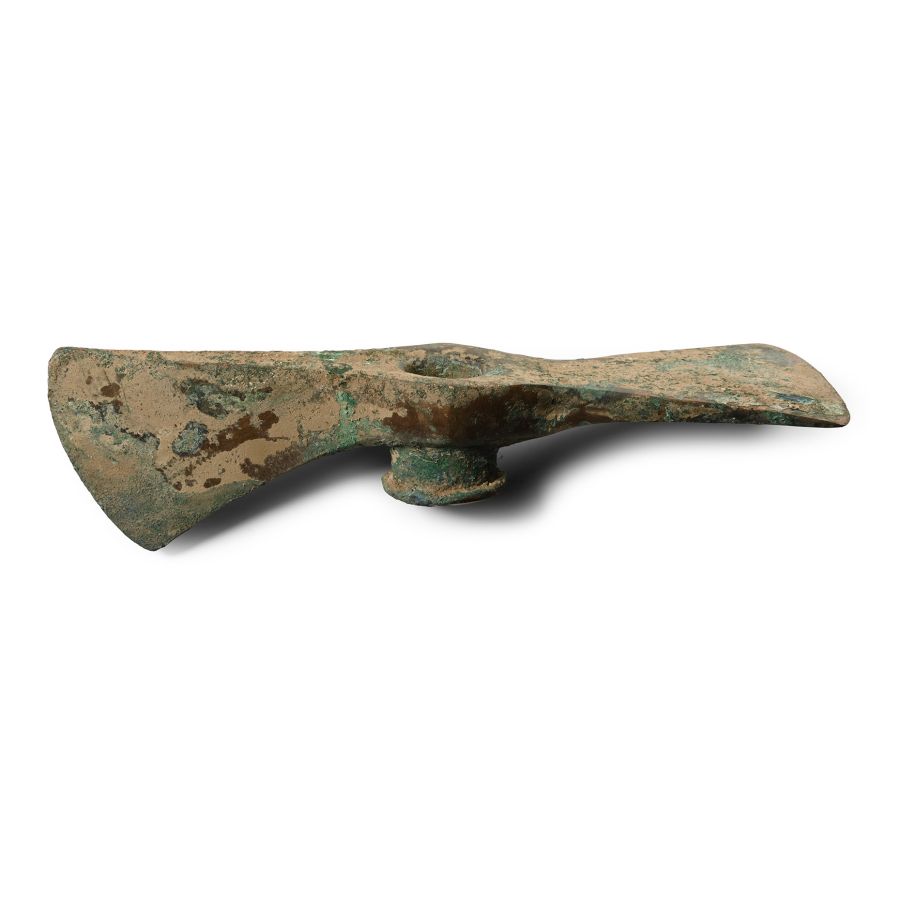
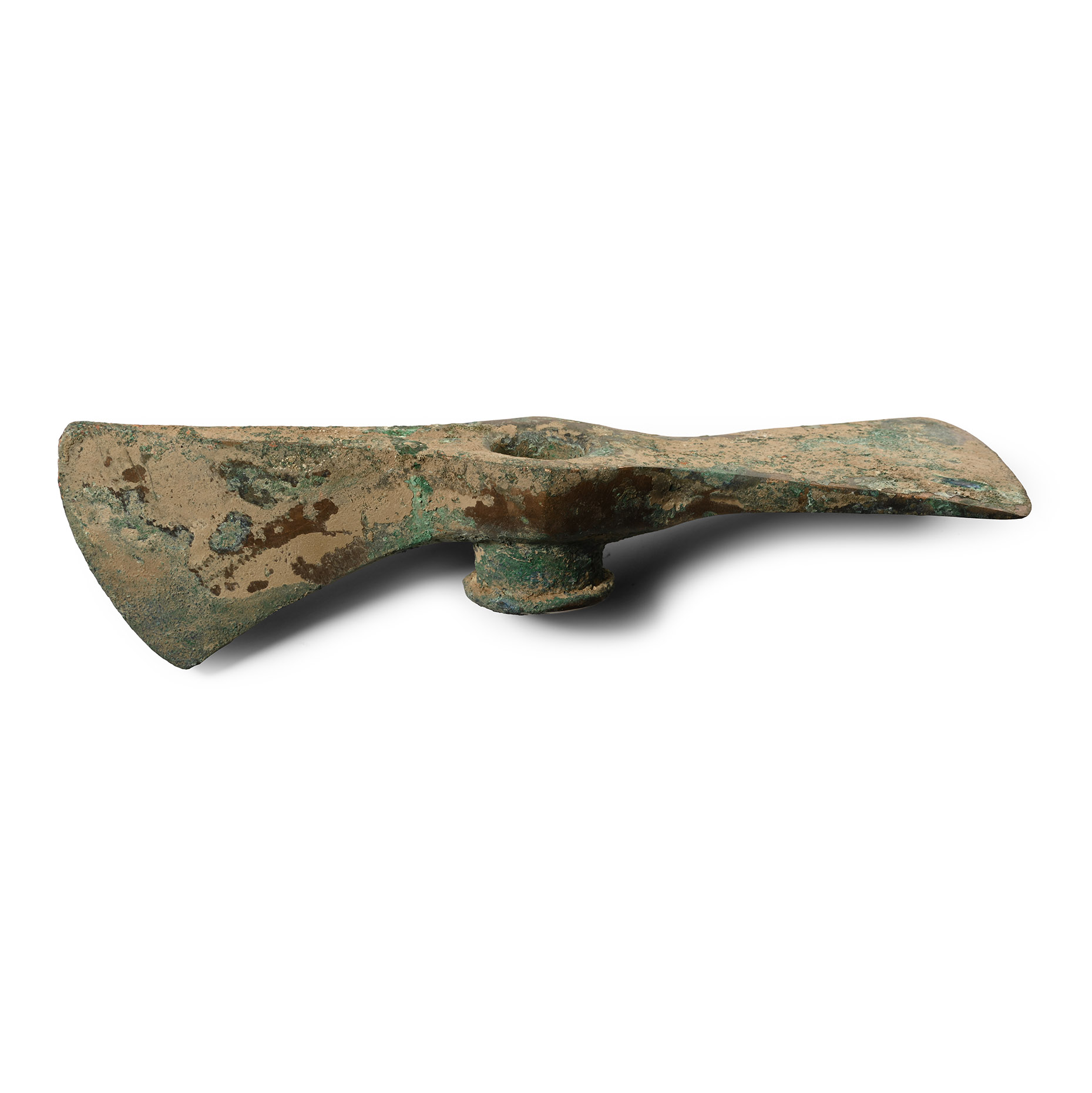
Luristan Bronze Adze-Axe
2ND-1ST MILLENNIUM B.C.
10 in. (1.25 kg, 25.7 cm).
With central shaft hole and blade set at a right angle.
ProvenanceAcquired 1980-2015.
Ex Abelita family collection.
Cf. Christie's, The Axel Guttmann Collection of Ancient Arms and Armour, part 2, London, 2004, item 34, p.32.
FootnotesThe adze-axe was a fundamental axe of many Bronze Age ancient cultures. Its form was one that lends itself to dual purposes - for war and work. As a tool, it functioned in woodwork in fabricating a variety of objects and as a weapon, its heavy mass and compact form make it a very deadly striking and chopping weapon, even able to defeat light armour.
CONDITIONTimeLine Auctions follows a vetting process to ensure the authenticity and legality of all items, reinforcing our commitment to integrity and responsible trading. Each antiquity, antique, and coin lot undergoes thorough examination by a vetting committee of at least ten external specialists, professional trade association members, scientists, and archaeologists: Our Vetting Process
AUCTIONS:
TimeLine is a leading auction house specialising in antiquities, ancient art, collectables, natural history, coins, medals, and books. Our auctions offer museums, collectors, historians, and enthusiasts the opportunity to acquire unique and historically significant pieces.
-
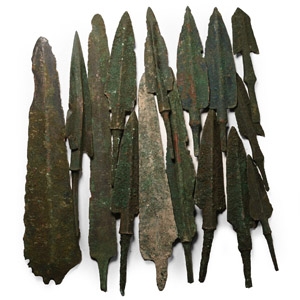
Luristan Bronze Arrows and Blades Group
13th-7th century B.C.Sold for (Inc. bp): £221
Comprising mainly narrow two-edged blades, barbed-and-tanged arrowheads and other types. 503 grams total, 9-20.7 cm
Ex London, UK, collection, 1990s. -
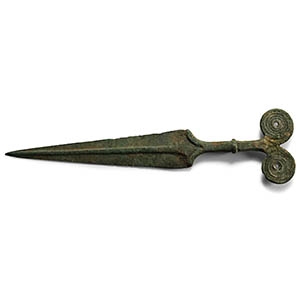
Western Asiatic Bronze Dagger
3rd-2nd millennium B.C.Sold for (Inc. bp): £650
With triangular blade and a square sectioned mid-rib ‘antenna’ guard with tubular grip and spiral ‘ears’. 240 grams, 34 cm
Acquired 1980-2015. Ex Abelita family collection. -
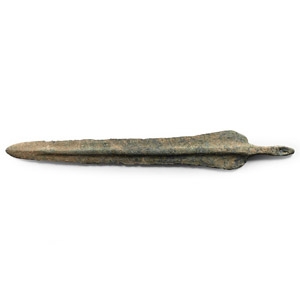
Western Asiatic Bronze Sword Blade
Circa 1000 B.C.Sold for (Inc. bp): £117
With rounded shoulders and square-sectioned mid-rib running to the blade tip; short tang with fastening hole. 254 grams, 34 cm
Acquired 1980-2015. Ex Abelita family collection.
The Luri people produced a quantity of fine metalwork, which according to Dr Khorasani, could be due to a settled period which arose as a result of the defeat of the Elamites by the Babylonians, leaving the Luristani people in relative peace for a period of time after 1200 BC. According to Khorasani 'A culture of innovation and experimentation flourished, and the repertoire of the Luristan smiths expanded in the period between 1150–1050 BC.'
