
Loading, please wait...
LOT 1158
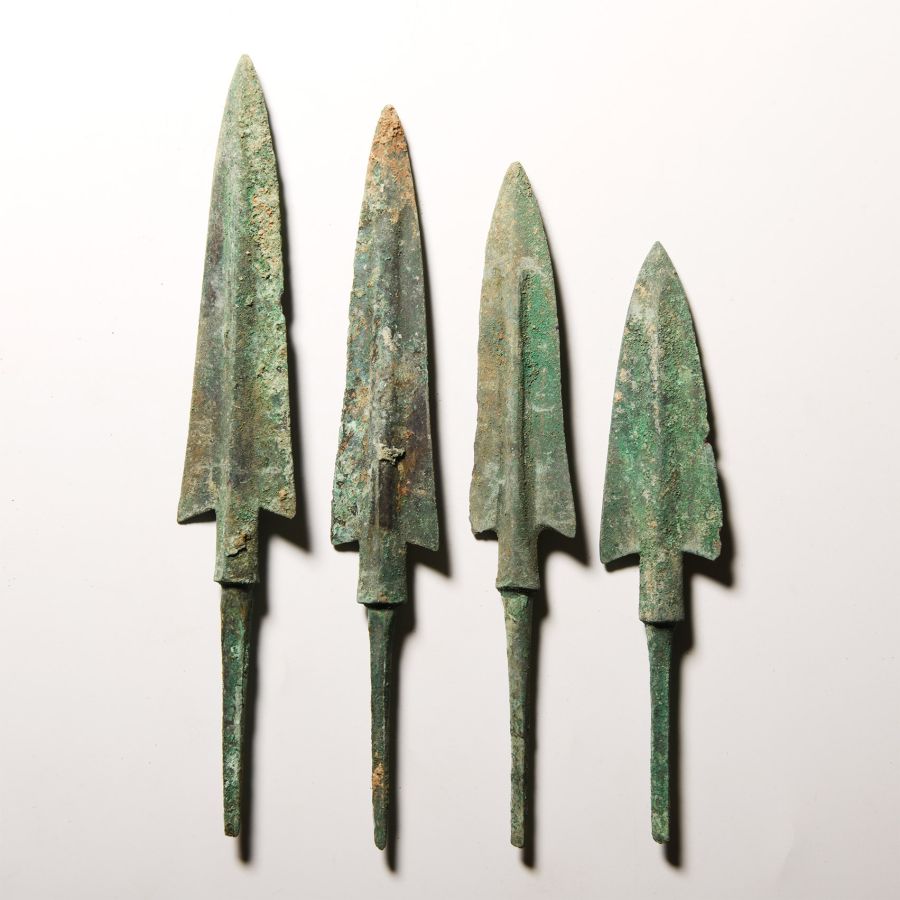
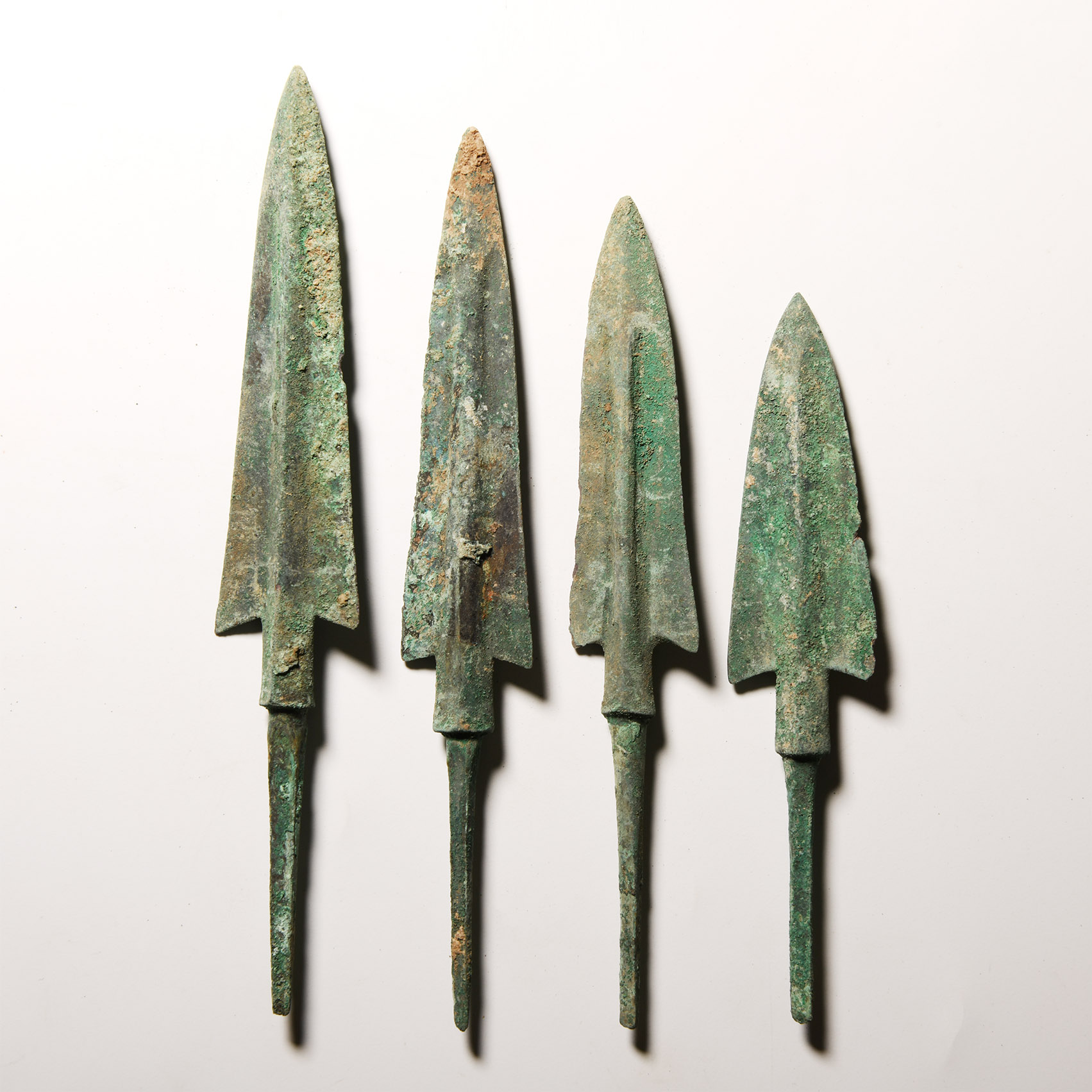
Luristan Arrowhead Group
13TH-9TH CENTURY B.C.
5 1/8 - 6 3/4 in. (161 grams total, 13-17 cm).
Comprising four tanged arrowheads, having large elongated triangular blades and raised midrib, sharp central groove, rectangular section stem with handle for the shaft, barbed shoulders and convex or squared sides. [4]
ProvenanceFrom the private collection of the late Mr S.M., London, UK, 1969-1999; thence by descent.
LiteratureSee Khorasani, M.M., Arms and Armour from Iran. The Bronze Age to the End of the Qajar Period, Tübingen, 2006, figures 467 and 470, for some of these types.
FootnotesThese arrowheads seem to belong to the type V, subcategory types A and C according to the classification of Khorasani and Negahban. In the four categories of triangular bronze arrowheads from Luristan, Marlik and Northern Iran individuated by Negahban, subtypes A and C of type V are larger arrow heads with barbed shoulders and triangular heads. These types of arrowheads were commonly used in Anatolia and Mesopotamia from the 2nd millennium B.C., but apparently their employment began earlier in this area, where types like these occur alongside the non-barbed, predominantly ribbed and tanged types.
CONDITIONTimeLine Auctions follows a vetting process to ensure the authenticity and legality of all items, reinforcing our commitment to integrity and responsible trading. Each antiquity, antique, and coin lot undergoes thorough examination by a vetting committee of at least ten external specialists, professional trade association members, scientists, and archaeologists: Our Vetting Process
AUCTIONS:
TimeLine is a leading auction house specialising in antiquities, ancient art, collectables, natural history, coins, medals, and books. Our auctions offer museums, collectors, historians, and enthusiasts the opportunity to acquire unique and historically significant pieces.
-
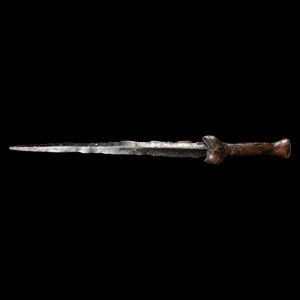
Medieval 'Thames' Iron Kidney Dagger
14th-15th century A.D.Sold for (Inc. bp): £286
The blade with a lozenge-shaped cross-section; restored handle with bulbous cross-guard, waisted grip and flared pommel. 195 grams, 37.2 cm
Found on the Thames foreshore at Vintry, Southwark, London, UK. -
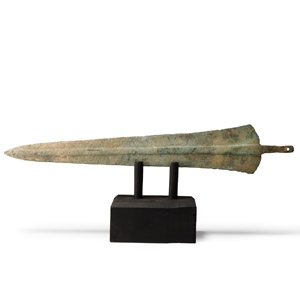
Luristan Short Sword Blade
Early 1st millennium B.C.Sold for (Inc. bp): £156
Triangular with thick rectangular-section midrib, rounded shoulders, narrow tip, short tang with hole for fixing pin for the organic grip; accompanied by a custom-made display stand. 285 grams total, 32 cm wide including stand
Acquired 1980s-1990s. From the H.N. collection, Milton Keynes, Bedfordshire, UK.
This tanged bronze blade from Luristan belongs to a category of Luristan swords still in use in the Achaemenid Period, as proved by a blade with a perished handle (probably bone or wood) of the same type, in the National Museum of Iran (2694/15633). Examples without inscriptions like our model have been classified by Grotkamp-Schepers in the Solingen Museum as pieces from Luristan. -
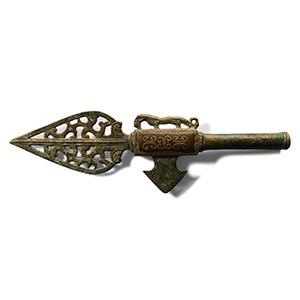
Chinese Style Bronze Ceremonial Halberd Sceptre Head
20th century A.D.Sold for (Inc. bp): £29
The leaf-shaped head displaying sinuous openwork animals on either side, rectangular collar with etched ornament, possibly a nameplate, repeated on both faces, a feline to one side and a flat-section arrow to the other, tubular socket below. 293 grams, 28 cm
Acquired in Germany. Property of RWM Collection.
During the Warring States Period (475-221 B.C.), Chinese warfare evolved. Kings and princes were replaced on the battlefield by infantries lead by military generals. New arms and armour were invented, including the halberd and crossbow. This sceptre head has a spearhead finial that features an openwork motif that is both decorative as well as functional, since it decreases the weight of the bronze, making the spear cheaper to produce and lighter to use.
