
Loading, please wait...


LOT 2071
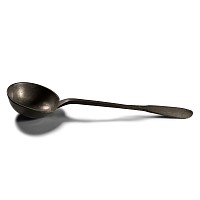
'Lord Carnarvon' Highclere Castle Pewter Ladle
LATE 19TH CENTURY A.D.
14 7/8 in. (407 grams, 37.7 cm).
Base metal ladle with deep bowl, thick neck and spatulate finial, slightly curved in profile; indistinct punched pellet marks to reverse of handle. [No Reserve]
ProvenanceBy repute from Highclere Castle from the 1950s onwards.
Acquired from Newbury Antique Emporium.
Property of a Berkshire, UK, gentleman collector.
This lot is accompanied by an illustrated lot declaration signed by the Head of the Antiquities Department, Dr Raffaele D’Amato.
Property of George Edward Stanhope Molyneux Herbert, 5th Earl of Carnarvon (1866 -1923), who financed the exploratory excavations of Howard Carter which resulted in the discovery and publication of the tomb of the pharaoh Tutankhamen in the 1920s.
On 19 March 1923 Carnarvon contracted blood poisoning after accidentally shaving a mosquito bite infected with erysipelas. He died a few days later on 5 April, in the Continental-Savoy Hotel in Cairo. This unexpected and untimely death gave rise to the story of the 'Curse of the Mummy'. He is buried in a tomb at Beacon Hill, Hampshire and the family lives in Highclere Castle nearby. Highclere is the location chosen for the filming of the BBC drama series 'Downton Abbey'.
TimeLine Auctions follows a vetting process to ensure the authenticity and legality of all items, reinforcing our commitment to integrity and responsible trading. Each antiquity, antique, and coin lot undergoes thorough examination by a vetting committee of at least ten external specialists, professional trade association members, scientists, and archaeologists: Our Vetting Process
AUCTIONS:
TimeLine is a leading auction house specialising in antiquities, ancient art, collectables, natural history, coins, medals, and books. Our auctions offer museums, collectors, historians, and enthusiasts the opportunity to acquire unique and historically significant pieces.
-
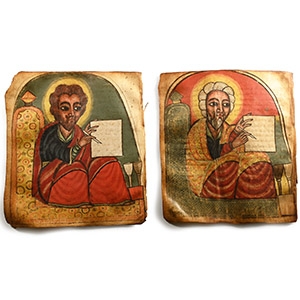
Ethiopian Painted Parchment of Two Evangelist Portraits from a Gospel
Circa 1650-1700 A.D.Sold for (Inc. bp): £1,235
Two leaves from a vellum manuscript, each with a hand-coloured image of a male figure (Evangelists) seated on low stools, covered with embroidered cloths, holding a vellum page in one hand and quill in the other, nimbus around their head; dressed in blue, red and green garments, in front of them two cups in brown and white colour. 19 grams total, 22.5 x 19.8 cm each
Ex central London gallery. This lot is accompanied by an illustrated lot declaration signed by the Head of the Antiquities Department, Dr Raffaele D’Amato.
During the Aksumite period, the Greek text of the Gospels was brought to Ethiopia and translated into Geez. Along with the Greek text came a standard method of Gospel manuscript production, as well as the Eusebian canon tables with their characteristic decoration and tholos miniature, and portraits of the evangelists. In the Gondar period, the tradition continued: usually the four Evangelists were portrayed as a series. Evangelist portraits serve as an introduction, and narrative illustrations were placed within the Gospel texts. -
.jpg)
Bactrian Style Lapis Lazuli Bead Necklace String
20th century A.D.Sold for (Inc. bp): £78
With tabular and annular lapis lazuli beads, gilt beaded collars. 47 grams, 65 cm long
Acquired 1980-2015. Ex Abelita family collection. This lot is accompanied by an illustrated lot declaration signed by the Head of the Antiquities Department, Dr Raffaele D’Amato. -
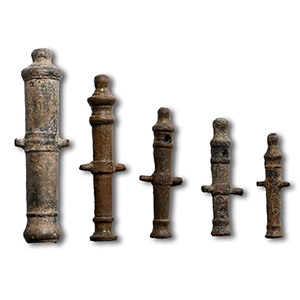
Georgian Bronze Toy Cannon Collection
18th-19th century A.D.Sold for (Inc. bp): £98
Five barrels for toy cannons, each with lateral trunnions. 68 grams total, 37-70 mm
Found on various UK sites since 1974. Property of an Essex collector. This lot is accompanied by an illustrated lot declaration signed by the Head of the Antiquities Department, Dr Raffaele D’Amato.
