
Loading, please wait...
LOT 1069
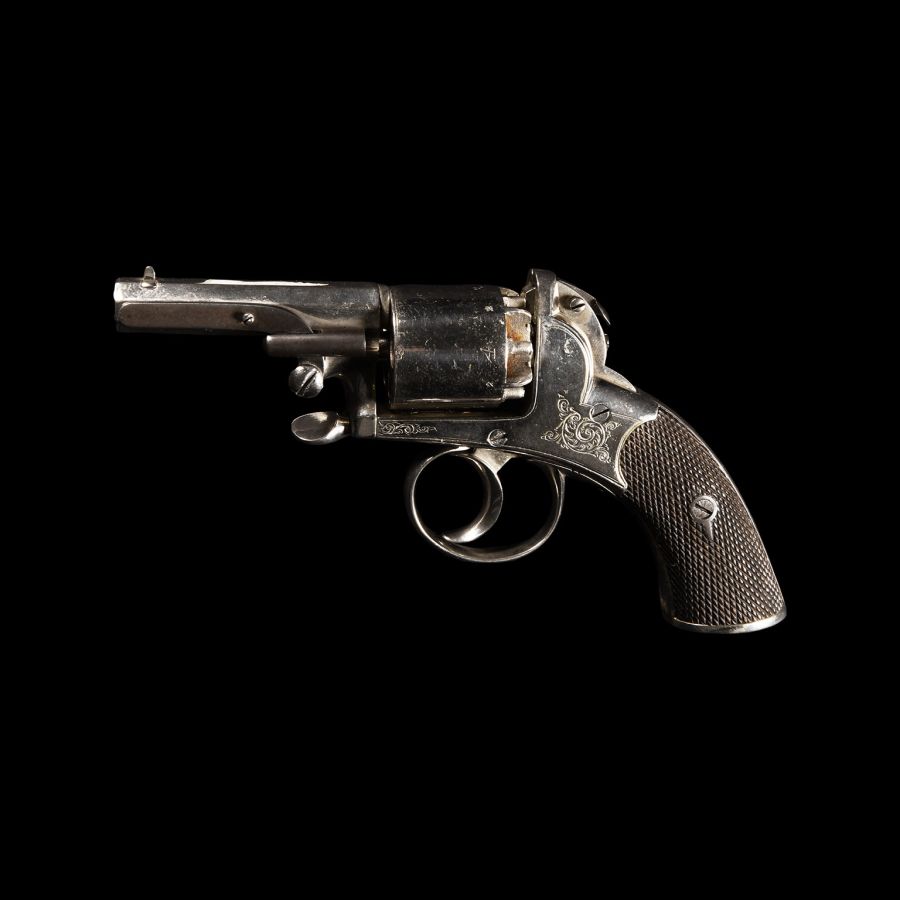
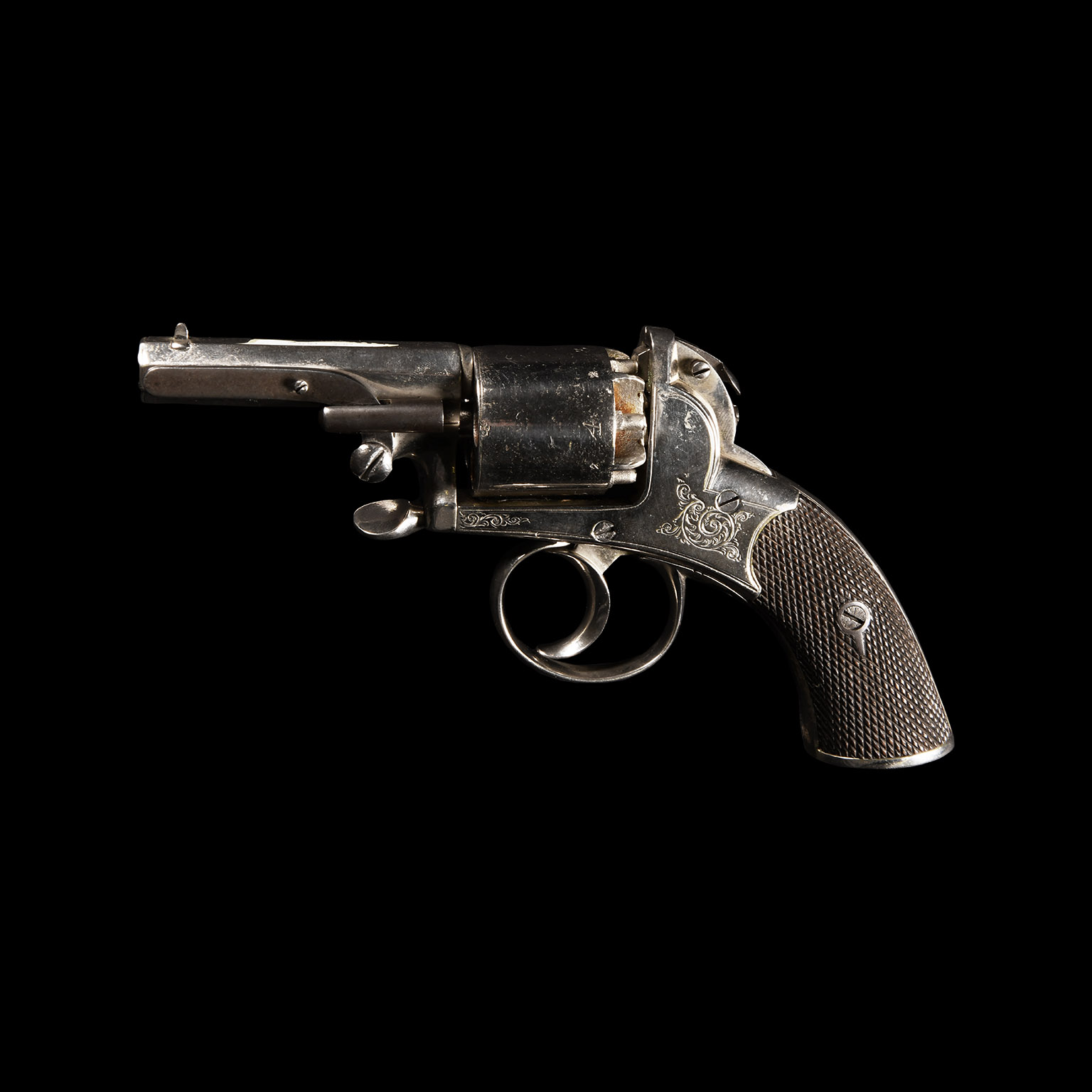
London Proofed Percussion Revolver
19TH CENTURY A.D.
7 in. (480 grams, 18 cm).
A double action nickel plated 5-shot percussion revolver with numbered chambers, the chambers and barrel bearing London proof marks and the barrel numbered 2; the frame with foliate engraving and fitted with chequered wood grip scales with hinged steel loading lever; action in working order.
ProvenanceAcquired Peter Wilson Auction, 2020, lot 10.
Property of a Kent collector.
Accompanied by lot ticket.
Sold as an exempt item under Section 58 (2) of the Firearms Act, 1968, to be held as a curiosity or ornament. No license required but buyer must be over 18 years of age.
CONDITIONTimeLine Auctions follows a vetting process to ensure the authenticity and legality of all items, reinforcing our commitment to integrity and responsible trading. Each antiquity, antique, and coin lot undergoes thorough examination by a vetting committee of at least ten external specialists, professional trade association members, scientists, and archaeologists: Our Vetting Process
AUCTIONS:
TimeLine is a leading auction house specialising in antiquities, ancient art, collectables, natural history, coins, medals, and books. Our auctions offer museums, collectors, historians, and enthusiasts the opportunity to acquire unique and historically significant pieces.
-
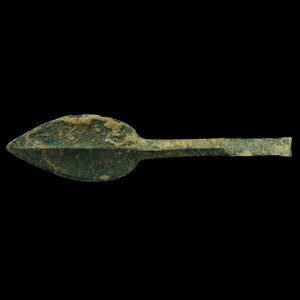
Western Asiatic Tanged Leaf-Shaped Spearhead
Circa 21st-mid 15th century B.C.Estimate: £100 - 140 (+bp*)
Opening Bid: £50
A large bronze tripartite spearhead with biconvex blade and flattened tang. 315 grams, 27.7 cm
Fine condition.
Ex Abelita family collection, 1980-2015.
The spearhead belongs to the subtype L2.B.d of the Gernez classification. -
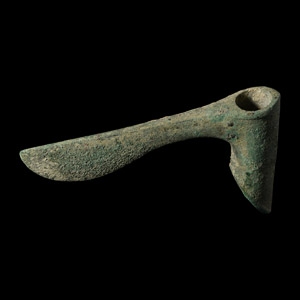
Luristan Sar-e Tabar Socketted Axehead
2nd millennium B.C.Estimate: £200 - 300 (+bp*)
Opening Bid: £111
A bronze axe with plain cylindrical socket and staff, off-set at the base, of simple undecorated shape with a long lentoid-section D-shaped blade with scooped profile. 465 grams, 18 cm
Fine condition, regular patina on the surface.
Earlier 20th century collection. London Mayfair gallery, UK. Dr D.G. collection, 1990s-2019.
Many examples of bronze axeheads are attributed to the Luristan culture and various shapes have been discussed by different scholars. Moorey (1971, pp.39-41) shows similar axeheads, stating that the texts executed on some specimens have shown them made of arsenical bronze, and attributes them to the late 3rd millennium B.C. or 2nd millennium B.C., period in which this alloy was used abundantly. -
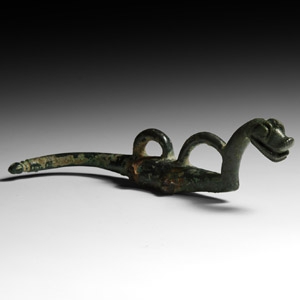
Luristan Horse Harness Cheekpiece
11th-8th century B.C.Estimate: £400 - 600 (+bp*)
Opening Bid: £200
A bronze cheek-piece element in the form of a righthand side bar, surmounted by two loops for additional straps, ending in a lion's head at the front, the other extremity bending outwards and ending with a conical tip, remains of the iron bar visible on the sides; once belonging to an articulate bit. 130 grams, 13.5 cm wide
Fine condition.
Acquired mid 1980s to early 1990s. Private family collection formed in London, UK.
The association of Psalia in the shape of a bar and with an articulated bit is documented in Assyria, in Media and in central Iran starting from the 10th century B.C., but the zoomorphic elements of this specimen suggest that it was produced in Luristan. The use of articulated bits, which moved inside the horse's mouth, exerting a minimal pressure on the reins, allowed for better control of the mount.
