
Loading, please wait...
LOT 0390
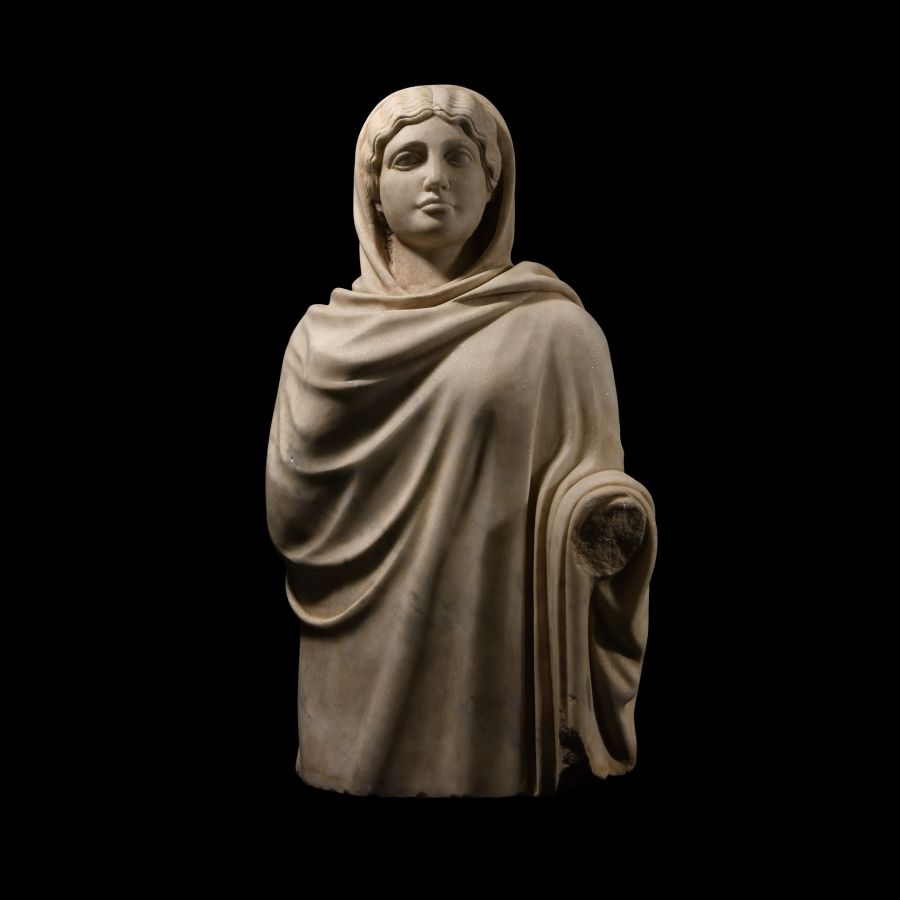
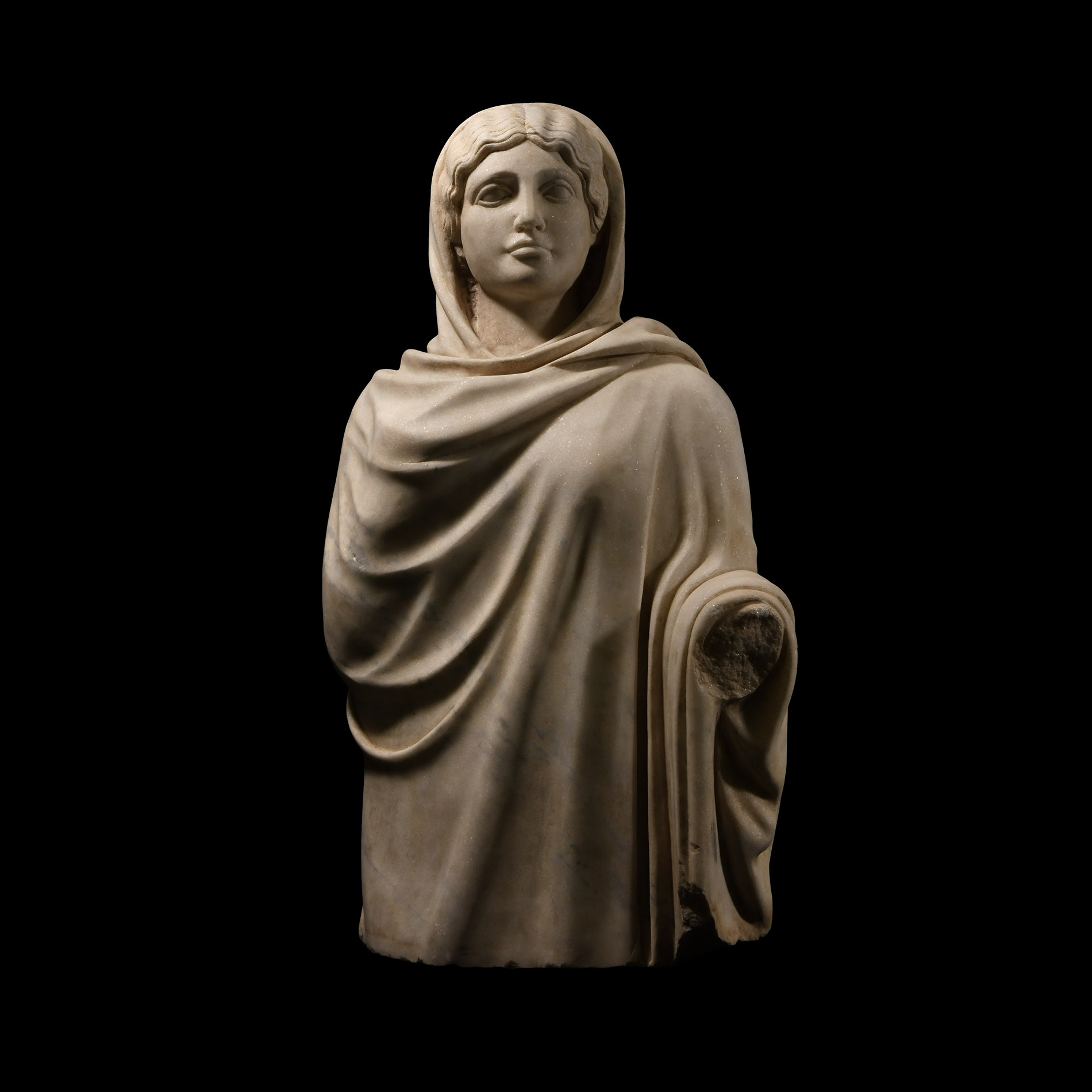
Life-Size Draped Statue of Venus
19TH CENTURY A.D.
33 in. (133 kg, 84 cm high).
A life-size marble upper body of a young female figure, likely the goddess Venus, shrouded in a palla mantle worn over the robe and draped over the head as a hood; the left arm bent to form folds and gatherings in the cloth, the right arm shown beneath the cloth held bent to the right breast.
ProvenanceFrench collection, 1960s-early 2000s.
From an important Paris gallery, France.
This lot has been checked against the Interpol Database of stolen works of art and is accompanied by search certificate number no.11687-199355.
In Roman mythology, Venus was the goddess of love, sex, beauty and fertility. Married to the god Vulcan, Venus' principal divine lover was Mars, with whom she was famously trapped in bed with a net by Vulcan. The goddess also had numerous mortal lovers - Adonis for example. The earliest known appearance of a temple dedicated to Venus was founded on the Aventine Hill in 295 B.C. She is most closely associated with the month of April, the beginning of the season of spring.
CONDITIONTimeLine Auctions follows a vetting process to ensure the authenticity and legality of all items, reinforcing our commitment to integrity and responsible trading. Each antiquity, antique, and coin lot undergoes thorough examination by a vetting committee of at least ten external specialists, professional trade association members, scientists, and archaeologists: Our Vetting Process
AUCTIONS:
TimeLine is a leading auction house specialising in antiquities, ancient art, collectables, natural history, coins, medals, and books. Our auctions offer museums, collectors, historians, and enthusiasts the opportunity to acquire unique and historically significant pieces.
LOT 0390
Life-Size Draped Statue of Venus
Estimate £3,000 - 4,000€3,480 - 4,640 (for guidance only)$4,050 - 5,400 (for guidance only)
-
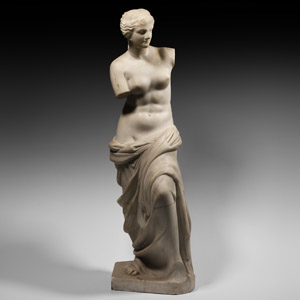
Venus of Milo Statue
19th century A.D.Estimate: £1,200 - 1,700 (+bp*)
Opening Bid: £600
A white marble copy of the famous Venus of Milo, naturalistically portrayed with her garment having fallen from her shoulders, hanging loose at her waist and exposing her breasts. 34.8 kg, 77 cm high
French collection, 1960s-early 2000s. From an important Paris gallery, France.
Aphrodite of Milos, better known as the Venus of Milo, is an ancient Greek statue and one of the most famous works of ancient Greek sculpture known today, created between 130-100 years B.C. The original is currently displayed at the Louvre in Paris. -
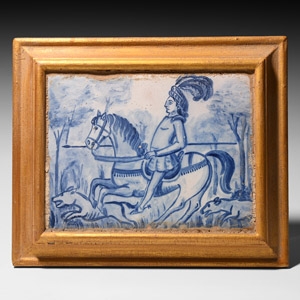
Spanish Blue and White Tile with Hunting Scene
Possibly 18th century A.D.Sold for (Inc. bp): £89
A blue and white rectangular tile depicting a hunting scene set in woodland, showing a mounted rider galloping left, holding a spear and wearing a plumed headdress, hunting hounds running beside him; mounted in a gold-coloured frame. 1.37 kg, 27.5 x 23 cm
Fair condition.
Acquired in the 2000s. Property of a North London collector. -
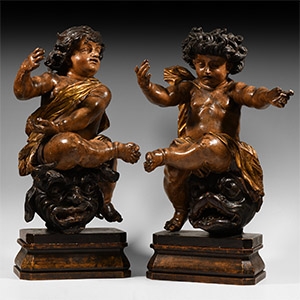
Post Medieval Gilt and Painted Wooden Cherub Pair
Germany, 17th century A.D.Estimate: £8,000 - 10,000 (+bp*)
Opening Bid: £4,000
A pair of naturalistically modelled cherubs shown naked and chubby with infant bodies and mature heads, perched with one crossed leg atop grotesque heads- that of the Devil and a pug, each dynamically posed as though playing an instrument or holding a bowl; with polychrome paint and gilding; Baroque; on octagonal plinth bases. 74-76 cm high
with Hotel Des Ventes De Monte, Monaco, 14 December 2021, lot 60. English private collection. This lot has been checked against the Interpol Database of stolen works of art and is accompanied by search certificate number no.11676-199839.
