
Loading, please wait...
_900x900.jpg "Levantine Helmet with Opposing Ibexes")
_200x200.jpg "Levantine Helmet with Opposing Ibexes")
_900x900.jpg "Levantine Helmet with Opposing Ibexes")
_200x200.jpg "Levantine Helmet with Opposing Ibexes")
_900x900.jpg "Levantine Helmet with Opposing Ibexes")
_200x200.jpg "Levantine Helmet with Opposing Ibexes")
.jpg "Levantine Helmet with Opposing Ibexes")
.jpg "Levantine Helmet with Opposing Ibexes")
.jpg "Levantine Helmet with Opposing Ibexes")
LOT 0229
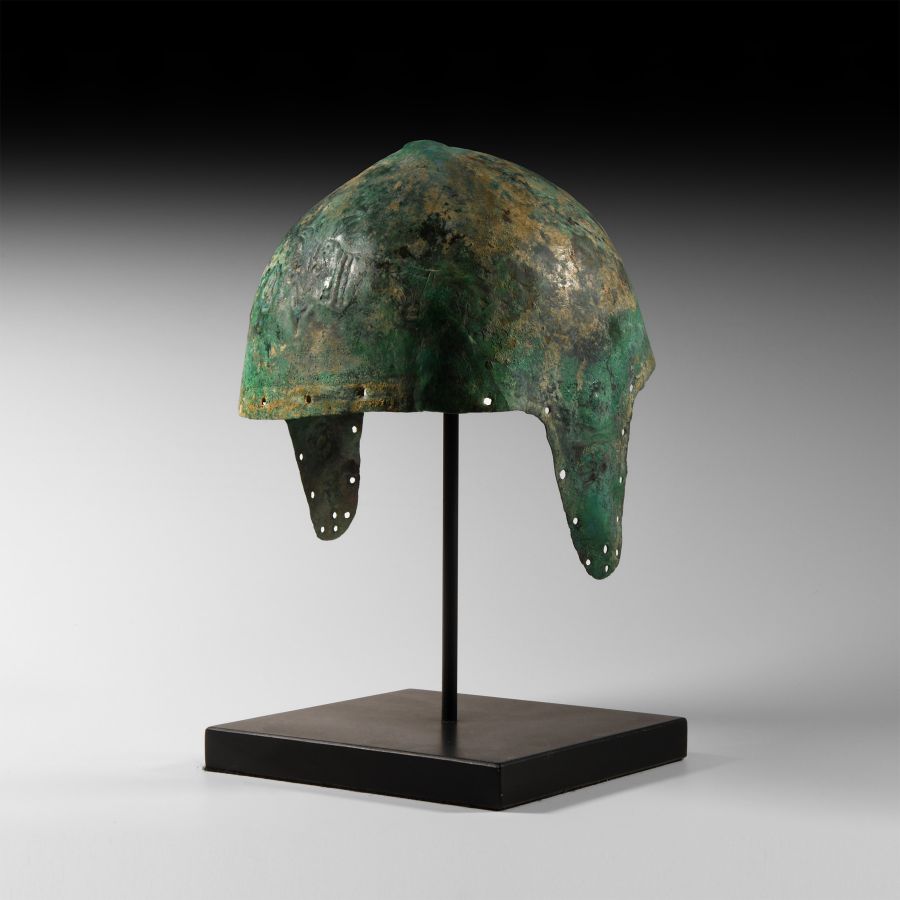
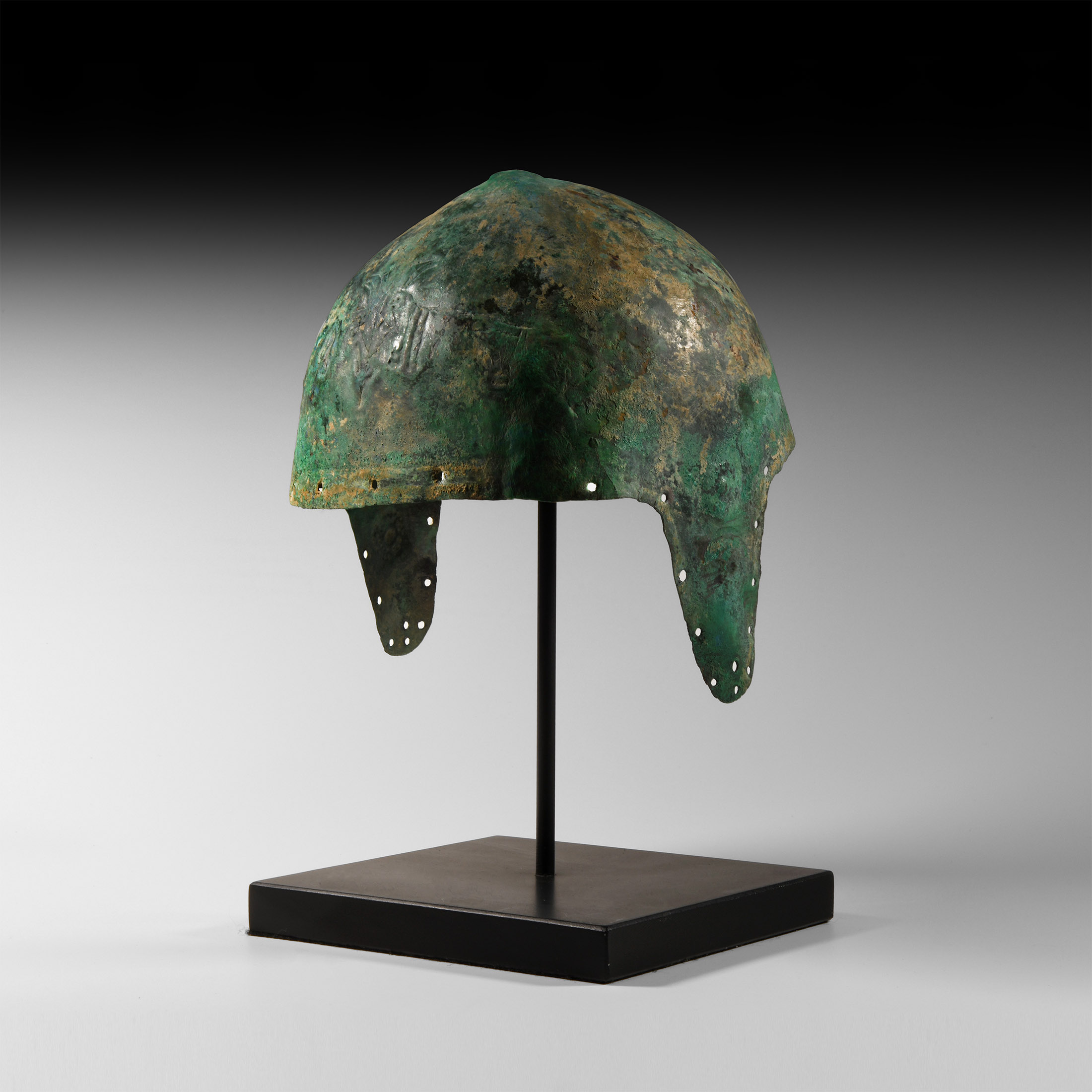
Levantine Helmet with Opposing Ibexes
8TH CENTURY B.C.
9 in. (12 3/8 in.) (458 grams, 23 cm high (2.36 kg total, 31.5 cm high including stand)).
A Levantine or Assyrian domed bronze helmet of ovoid shape with slightly pointed top and integral cheek-pieces; chased low-relief decoration to both front and back depicting insignia of a pair of opposing ibexes flanking a small palm tree; the edge with regularly disposed holes for fastening of the leather lining; accompanied by a custom-made display stand.
ProvenanceAcquired 1960s-1990s.
Late Alison Barker collection, a retired London barrister.
Accompanied by an academic report by Dr Raffaele D'Amato.
This lot has been checked against the Interpol Database of stolen works of art and is accompanied by search certificate no.11386-190447.
Cf. Barron, A.E., Late Assyrian Arms and Armour, Art versus Artefact, Toronto, 2010; Borchardt, J., Homerische Helme: Helmenformen der Ágāis in ihren Beziehungen zu orientalischen und europäischen Helmen in der Bronze-und frühen Eisenzeit, Mainz, 1972, p.99 and pls.31, 32, 3; Gorelik, M., Weapons of Ancient East, IV millennium BC-IV century BC, Saint Petersburg (2003) in Russian; Dezső, T., The Assyrian Army, I. The structure of the Neo-Assyrian army as reconstructed from the Assyrian Palace Reliefs and Cuneiform Sources, 2. Cavalry and Chariotry, Budapest, 2012; similar helmets in Gorelik, 2003, pl.LXI, nos.45, 48, 78.
FootnotesThis rare helmet is an unusual example of a conical strap-helmet, linked with similar Greek strap helmets, but until now in the Near East, known only from the Assyrian reliefs. It is shown together with the crested helmets, on the reliefs of Tiglapilaser III and Sennacherib.
CONDITIONTimeLine Auctions follows a vetting process to ensure the authenticity and legality of all items, reinforcing our commitment to integrity and responsible trading. Each antiquity, antique, and coin lot undergoes thorough examination by a vetting committee of at least ten external specialists, professional trade association members, scientists, and archaeologists: Our Vetting Process
AUCTIONS:
TimeLine is a leading auction house specialising in antiquities, ancient art, collectables, natural history, coins, medals, and books. Our auctions offer museums, collectors, historians, and enthusiasts the opportunity to acquire unique and historically significant pieces.
-
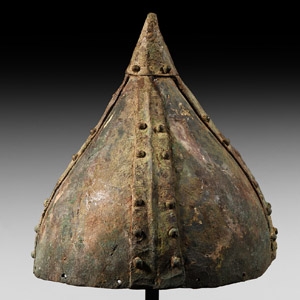
Sassanian Spangenhelm with Rivets
6th-7th century A.D.Sold for (Inc. bp): £4,160
A copper-alloy multi-segmented spangenhelm with an ogival profile, rivetted conical finial and riveted straps running vertically around the circumference, some restoration. 1.14 kg, 23 cm high
UK private collection before 2000. UK art market. Property of a London gentleman. Accompanied by an academic report by Dr Raffaele D'Amato. This lot has been checked against the Interpol Database of stolen works of art and is accompanied by searcher certificate no.11589-199700.
The Spangenhelm is a protective headgear made up from segments or plates held together by a frame. As a popular form of helmet it came to prominence in western Europe in the later Roman Empire, and remained in use for some centuries until replaced by helmets formed from a single sheet. -
.jpg)
Roman Julius Caesar Sling Shot from the Battle of Munda
45 B.C.Sold for (Inc. bp): £572
A biconical facetted lentoid-section lead sling shot (glans), inscription monogram a combination of letters 'C', 'A' and 'E', for 'C A E S' referring to Julius Caesar. 63.29 grams, 36 mm
Fine condition.
Found near to an important village site, close to Seville, 1960-1970. From an old Spanish collection. Swiss private collection. Accompanied by a copy of the Spanish export licence. Accompanied by an academic paper by military specialist Dr Raffaele D'Amato, dated 4th May 2022 and titled 'Roman Res Publica - Lead Slingshots (glandes) of Caesarian Age - 45 B.C circa'.
The shot (type IIb of the Völling classification) is marked with the abbreviated name of Julius Caesar; it was used in quantity at the Battle of Monda (or Munda) against the last fellows of Pompey, the leaders of the Optimates, on the 17th March 45 BC. Similar shots were used in the Caesar's wars. The slingers of Caesar's age were part of the light infantry. Caesar speaks of his Balearic slingers during the conquest of Gaul. They wore a short tunic, with leather or rope sandals to the feet, and a warm overcoat which could also have been used to store projectiles. They also used a satchel to carry very deadly lead-like stones or bullets. -
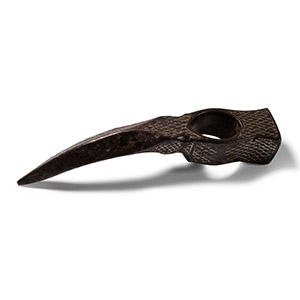
Eastern European Silver Inlaid War-Hammer
16th century A.D.Sold for (Inc. bp): £598
A copper-alloy war-hammer composed of ellipsoidal socket, waisted butt with shallow conical face and tapering, lozenge-section head, inlaid with a silver 'net' design. 453 grams, 18.5 cm
Private collection of Mr M.B., Mainz, Germany, 1990s. Property of a London businessman. This lot has been checked against the Interpol Database of stolen works of art and is accompanied by search certificate no.11203-186235.
The name obuch is Polish and means 'the blind end of an axe', but already at the beginning of the 15th century it meant a [unspecified] war hammer. According to Polish sources of 17th century, the war-hammer could have been formed into the shape of an axe (czekan), or in the form of a thick, slightly sloping spike (nadziak), or curved like a round cracknel (obuch). A 17th century description states: 'It was a terrible instrument in the hand of a Pole...With the sabre one could cut off somebody’s hand, cut the face, injure the head, and the running blood of the adversary would calm down the rancour. But with the obuch one could cause a deadly wound without even seeing the blood, and – not seeing it – he would not calm down instantly, but would strike several times without cutting the skin, breaking ribs and bones at the same time.'
