
Loading, please wait...
LOT 0685
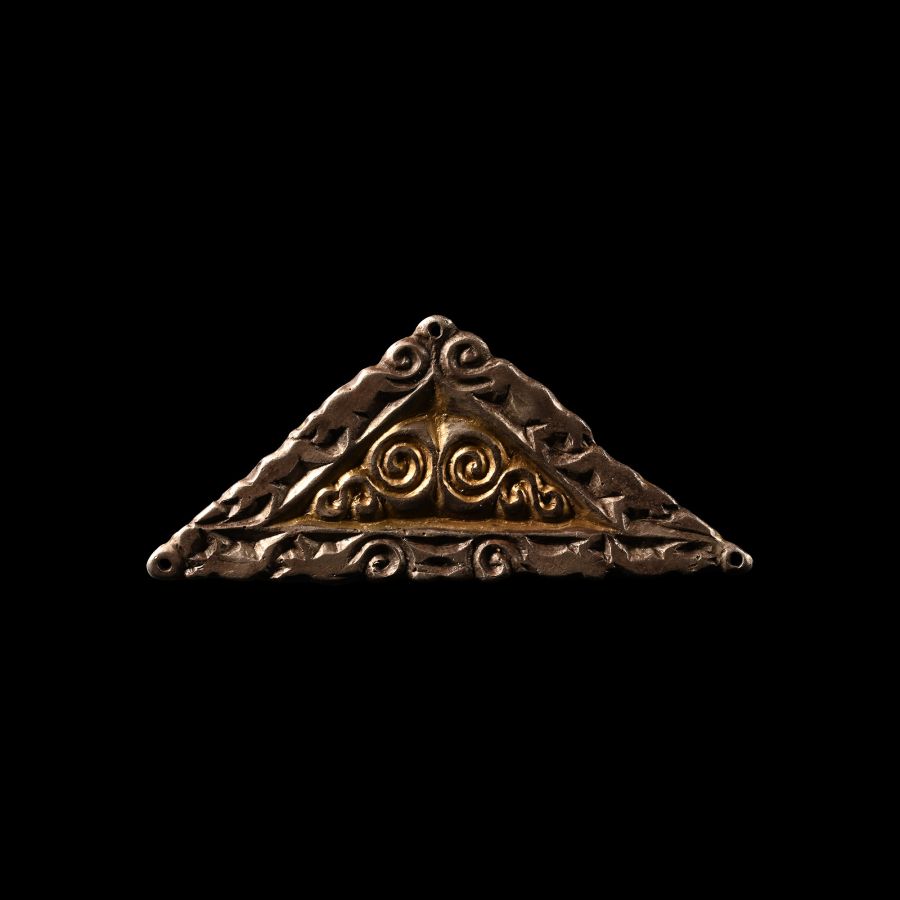
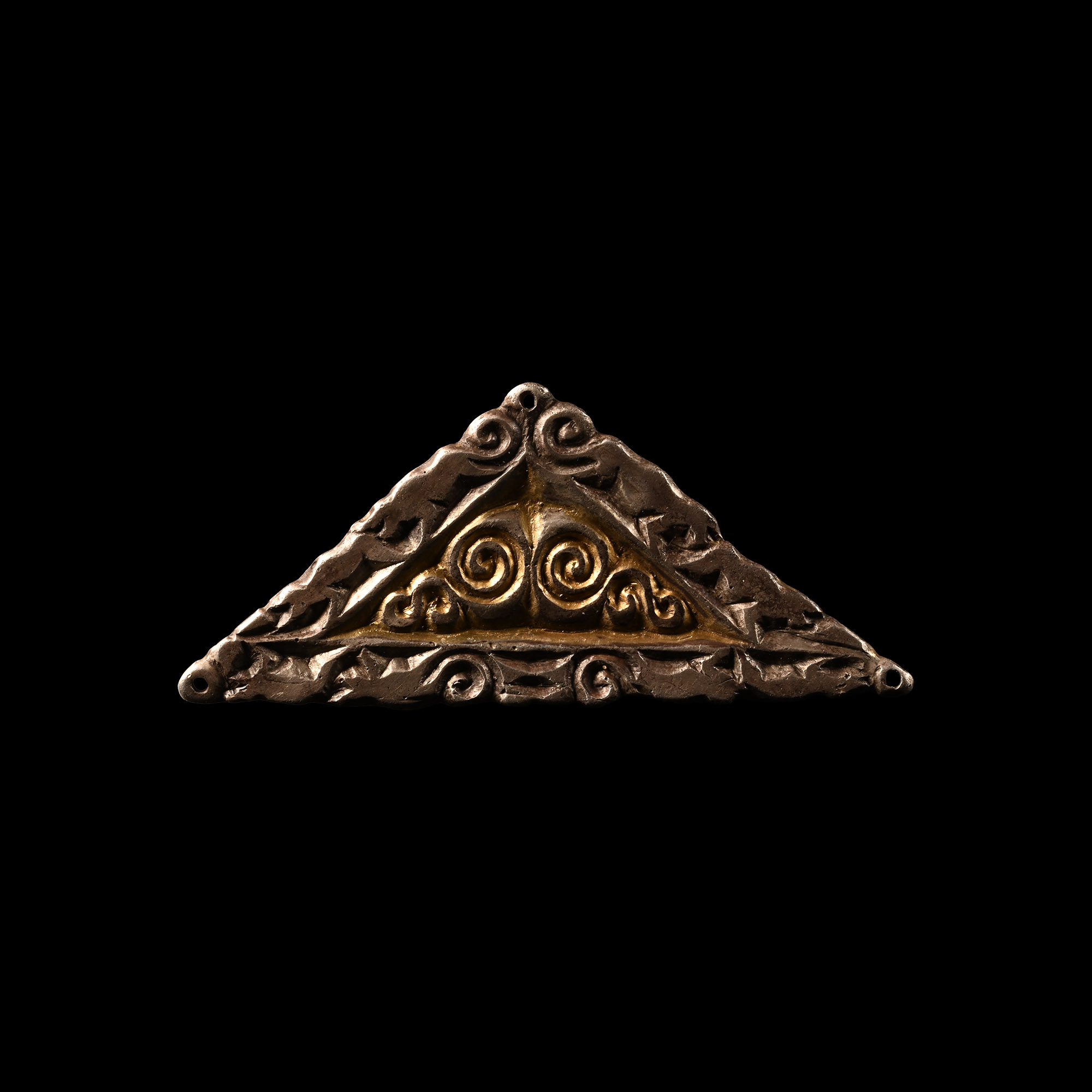
Late Roman Silver-Gilt Triangular Belt Mount with Lions
4TH-5TH CENTURY A.D.
2 3/8 in. (8.97 grams, 60 mm).
The borders with spiral motifs and running lions, a hole in each corner for fastening pins.
ProvenanceAcquired early 1990s.
From an East Anglian private collection.
Cf. Arena, M.S., Delogu, P., Paroli, L., Ricci, M., Saguì, L., Vendittelli, L., Roma, dall’antichitá al Medioevo, archeologia e storia, Milano, 2001, nos.I.3.6a-e, for similar belt elements.
FootnotesBy the second half of the 4th century, broad Roman military belts were decorated with chip-carved mounts and plates. The fittings were realised by punching or by chip carving different patterns and motifs.
CONDITIONTimeLine Auctions follows a vetting process to ensure the authenticity and legality of all items, reinforcing our commitment to integrity and responsible trading. Each antiquity, antique, and coin lot undergoes thorough examination by a vetting committee of at least ten external specialists, professional trade association members, scientists, and archaeologists: Our Vetting Process
AUCTIONS:
TimeLine is a leading auction house specialising in antiquities, ancient art, collectables, natural history, coins, medals, and books. Our auctions offer museums, collectors, historians, and enthusiasts the opportunity to acquire unique and historically significant pieces.
LOT 0685
Late Roman Silver-Gilt Triangular Belt Mount with Lions
Estimate £500 - 700€580 - 810 (for guidance only)$680 - 950 (for guidance only)
-
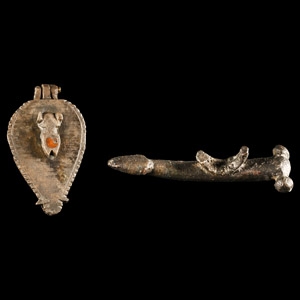
Roman 'Thames' Bronze Phallic Seal Box and Pendant Group
1st-4th century A.D.Sold for (Inc. bp): £98
The seal box with remains of articulate hinge, raised phallus to top face with red enamelled detail; exaggerated stylised penis pendant with fragment of suspension loop remaining. 10.6 grams total, 29-41 mm
Found Billingsgate spoil from the Thames foreshore, London, UK. -
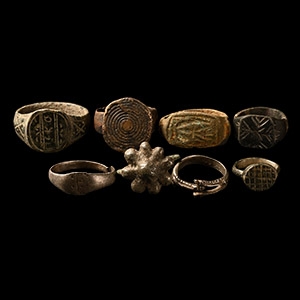
Roman and Byzantine Bronze and Silver Ring Group
1st century A.D. and laterSold for (Inc. bp): £182
Comprising finger rings of various types and sizes, most with bezels with decorative motifs, including: a cross with pellet in each quarter; an inscribed panel with dashes and X motifs; a hatched oval; raised flower head; spiraling oval and a feathered cross, together with other enigmatic designs. 32 grams total, 15-25 mm
From the Sullivan family collection, UK; acquired since 2003. -
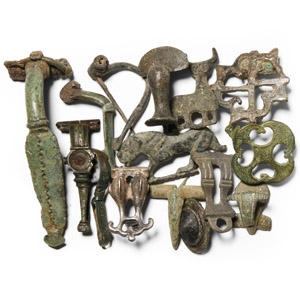
Roman Bronze and Silver Brooch Collection
Circa 2nd-4th century A.D.Sold for (Inc. bp): £286
Exhibiting a range of brooch types, including openwork and zoomorphic brooches together with other types, most featuring decorative elements; one complete. 148 grams total, 23-81 mm
Acquired on the UK art market. Property of a Ruislip, UK, gentleman, by inheritance.
