
Loading, please wait...
_900x900.jpg "Late Roman Redware Oil Lamp With Daniel Standing")
_200x200.jpg "Late Roman Redware Oil Lamp With Daniel Standing")
.jpg "Late Roman Redware Oil Lamp With Daniel Standing")
LOT 0120
Late Roman Redware Oil Lamp With Daniel Standing
NORTH AFRICAN, 5TH CENTURY A.D.
5 3/4 in. (196 grams, 14.5 cm).
With a lug handle and oval elongated body, two central filling-holes flanking the image of prophet Daniel enclosed within a decorative shallow border; two thin concentric circles on the base, possibly a blurred potter’s mark to the middle.
ProvenanceFrom the collection of the French archaeologist Suzanne Gozlan, 1921-2022.
LiteratureSee Bussière, J., Lindros Wohl, B., Ancient Lamps in the J. Paul Getty Museum, Malibu, 2017, nos.492-499, p.351ff.
FootnotesThe lamp belongs to the type Atlante X or Hayes II A. The so-called Christian lamps in Terra Sigillata Africana have been classified by Hayes into two major types, I and II. He has distinguished two classes in his type II, according to geographic place of manufacture or origin. Subtype II A group lamps from central Tunisia are characterised by a fine clay, glossy light orange slip, and carefully executed decoration using a great number of neatly drawn shoulder motives.
CONDITIONTimeLine Auctions follows a vetting process to ensure the authenticity and legality of all items, reinforcing our commitment to integrity and responsible trading. Each antiquity, antique, and coin lot undergoes thorough examination by a vetting committee of at least ten external specialists, professional trade association members, scientists, and archaeologists: Our Vetting Process
AUCTIONS:
TimeLine is a leading auction house specialising in antiquities, ancient art, collectables, natural history, coins, medals, and books. Our auctions offer museums, collectors, historians, and enthusiasts the opportunity to acquire unique and historically significant pieces.
-
.jpg)
Roman Crystal Gemstone with Galley
Circa 1st century B.C.-1st century A.D.Estimate: £500 - 700 (+bp*)
Opening Bid: £250
With intaglio ship under sail with banks of oars; supplied with a museum-quality impression. 0.94 grams, 14 mm
From the collection of a Swiss gentleman formed in Europe from 1970-1980s; thence by descent from the family in London. -
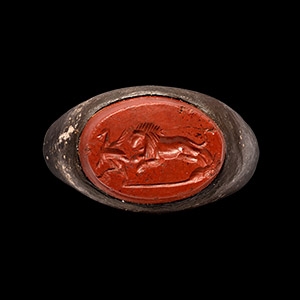
Roman Silver Ring with Lion Attacking a Bird Gemstone
Circa 2nd-3rd century A.D.Estimate: £1,000 - 1,400 (+bp*)
Opening Bid: £550
Rounded bezel with inset jasper gemstone, intaglio scene of a lion pouncing upon a goose taking flight; possibly a marriage or the stone has been displaced due to corrosion in the socket. 7.73 grams, 25.14 mm overall, 18.22 mm internal diameter (approximate size British Q, USA 8, Europe 17.49, Japan 16)
From a collection of a London lady, acquired annually during 1990s-2000s. -
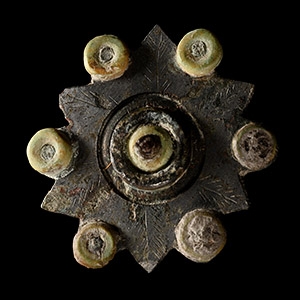
Roman Tinned Bronze Plate Brooch Complete with Coral Appliques
Circa 2nd century A.D.Estimate: £200 - 300 (+bp*)
Opening Bid: £100
Formed as six radiating triangles with incised leaf detailing, interstitial applied bone discs, central raised collar with bone disc insert; complete with pin and catchplate to verso. 9.1 grams, 40 mm
Acquired on the UK art market in the 1990s. Property of a Stowmarket, UK, gentleman.
