
Loading, please wait...
LOT 0855
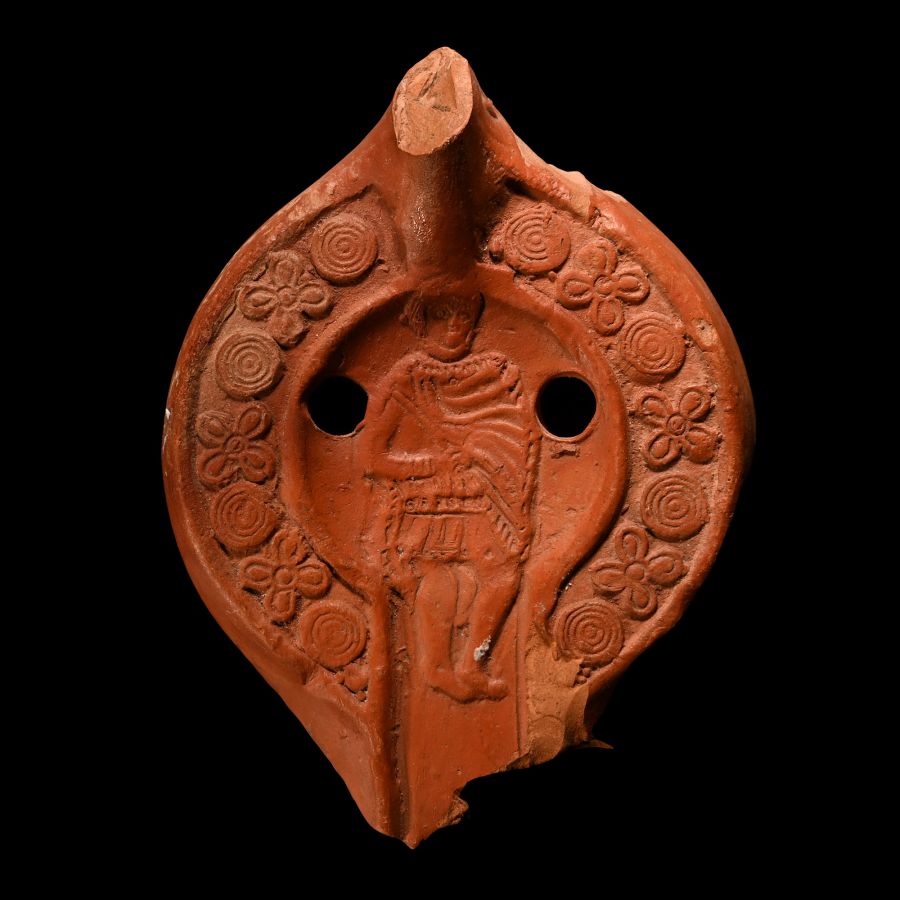
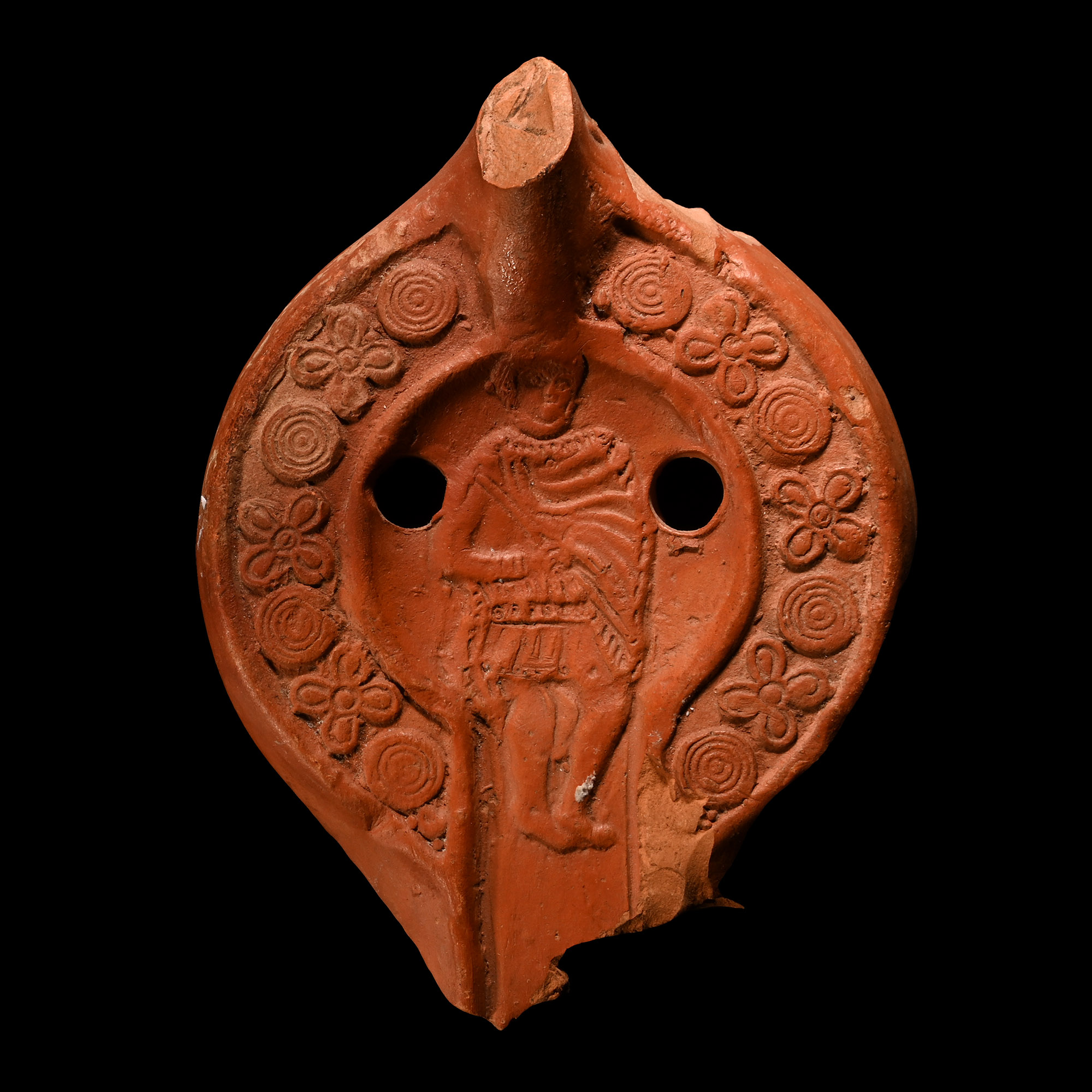
Late Roman Redware Lamp Face with Military Officer
LATE 5TH-EARLY 6TH CENTURY A.D
4 1/2 in. (101 grams, 11.4 cm).
Comprising the upper part of an oil lamp with part of the handle in situ; band of concentric circles and floral motifs to the shoulder; discus with low-relief figure seated with flexed knees, wearing a thigh-length tunic and cingulum military belt over bracae, and a short sagum clasped at the right shoulder; with short hair and beard; right arm folded across the body holding the hem of the sagum; modern suspension ring to reverse. [No Reserve]
ProvenanceAcquired 1960s-1990s.
From the late Alison Barker collection, a retired London barrister.
See Bussière, J., Lindros Wohl, B., Ancient Lamps in the J. Paul Getty Museum, Malibu, 2017, nos.493-500, p.35.
FootnotesThe lamp belongs to the type Atlante X or Hayes II A. The so-called Christian lamps in Terra Sigillata Africana have been classified by Hayes into two major types, I and II. He has distinguished two classes in his type II, according to geographic place of manufacture or origin. Subtype II A group lamps from central Tunisia are characterised by the use of fine clay, glossy light orange slip, and carefully executed decoration using a great number of neatly drawn shoulder motifs. The image of this military officer is unusual, and it can represent an imperial primikerios of the African army after the reconquest of Belisarius in 533 A.D.
CONDITIONTimeLine Auctions follows a vetting process to ensure the authenticity and legality of all items, reinforcing our commitment to integrity and responsible trading. Each antiquity, antique, and coin lot undergoes thorough examination by a vetting committee of at least ten external specialists, professional trade association members, scientists, and archaeologists: Our Vetting Process
AUCTIONS:
TimeLine is a leading auction house specialising in antiquities, ancient art, collectables, natural history, coins, medals, and books. Our auctions offer museums, collectors, historians, and enthusiasts the opportunity to acquire unique and historically significant pieces.
-
.jpg)
Roman Bronze Vessel with Folding Handles
1st-2nd century A.D.Estimate: £15,000 - 20,000 (‡+bp*)
Opening Bid: £7,500
Ellipsoid in plan with low basal ring and thick convex rim, carination to the forward end; hinges to each lateral rim, the knuckles formed as addorsed duck-heads each with scrolled panel to the rear retaining the pivot of the ribbed D-shaped handles. 1.68 kg, 28 cm
Acquired in Switzerland, 1996. Private collection, Europe. Accompanied by an academic report by Dr Raffaele D'Amato. Accompanied by a copy of an Art Loss Register certificate dated 30th April 2004. This lot has been checked against the Interpol Database of stolen works of art and is accompanied by search certificate number no.12363-226688.
This vessel (lanx) was part of Roman and provincial bronze instrumentum domesticum, i.e. culinary or domestic utility ware. The form of the bowl resembles a type of helmet with carination to the front, the handles placed as hinged cheek-protectors. -
.jpg)
Roman Green Glass Vessel
1st-3rd century A.D.Sold for (Inc. bp): £91
A small mould-blown vessel with body formed from asymmetrical pleats, long neck, flared and rolled rim, pontil on base. 10.4 grams, 70 mm
Acquired from Allan Cherry, Bournemouth, UK, 2004. Ian Wilkinson collection, Nottinghamshire, UK. -
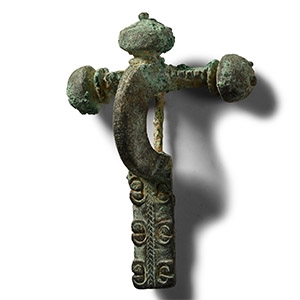
Roman Bronze Brooch
3rd-4th century A.D.Sold for (Inc. bp): £117
With three facetted knops to the crossbar, the upper one with beaded collar, and pierced moulding to the upper face, deep bow, stepped junction with foot, trapezoidal foot with ring-and-dot motifs and integral catch; hinged pin to reverse; Keller Type 4. 47.7 grams, 64 mm
Acquired in the mid 1980s-1990s. Private collection, Switzerland, thence by descent. Private collection, since the late 1990s.
