
Loading, please wait...
LOT 0128
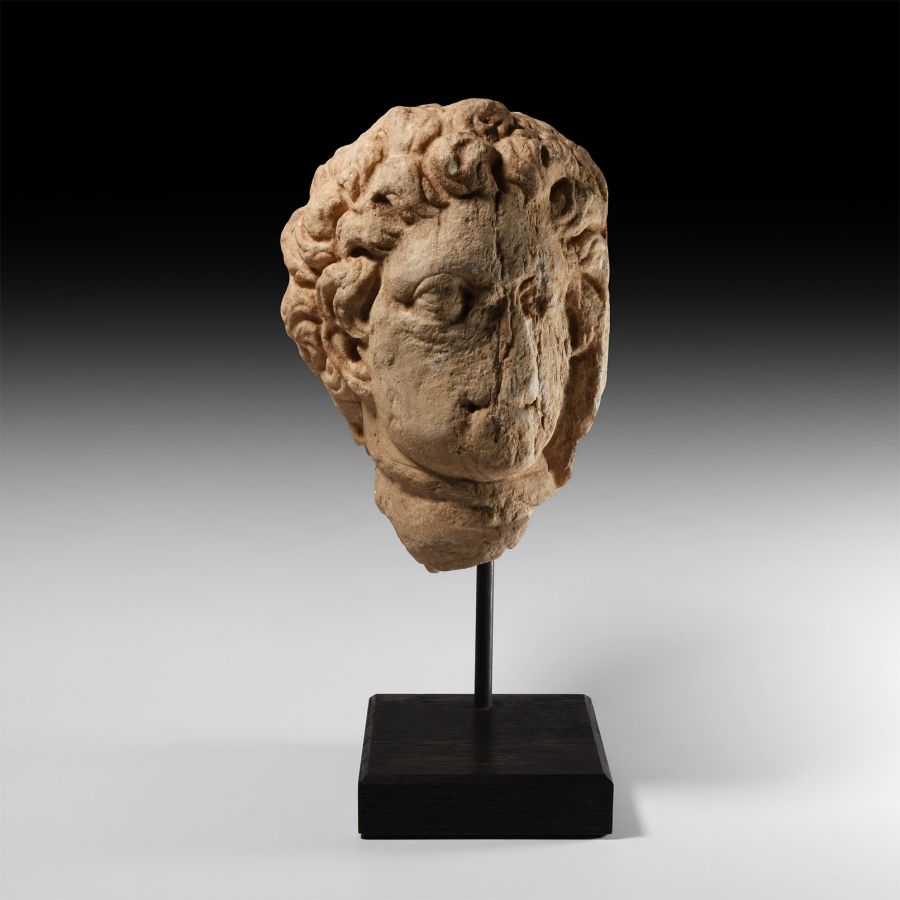
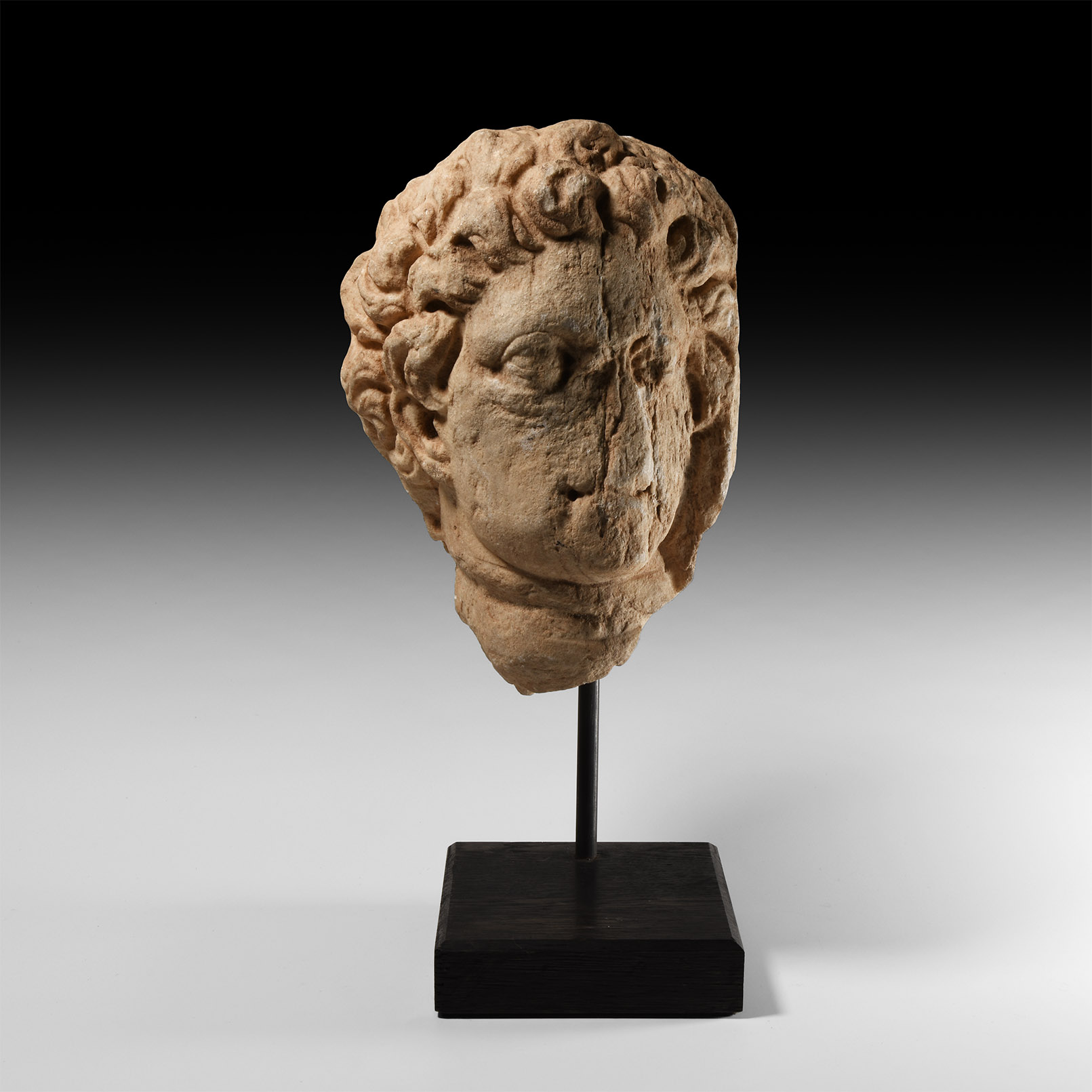
Late Roman Provincial Marble Head
3RD-6TH CENTURY A.D.
14 1/2 in. (8.9 kg total, 37 cm high including stand).
A carved marble head with large lentoid eyes and wavy hair; mounted on a custom-made stand.
ProvenanceFrench collection, 1960s-early 2000s.
From an important Paris gallery, France.
Cf. similar style of portraits in Bianchi Bandinelli, R., Roma, la fine dell'arte antica, Milano, 1970, figs. 340-346; Auinger, J., Aurenhammer, M., 'Antik Donemin Sonunda Ephesos Heykeltrasligi (Ephesos Sculpture at the end of the Antiquity)' in Daim, F., Ladstatter, S., Bizans Döneminde Ephesos (Ephesus in the Byzantine Period), Istanbul, 2011, pp.163-195, figs.22, 23, 24.
FootnotesA series of portrait heads, busts and marble statues from the 5th-6th century A.D. Ephesus, show great affinity with this sculpture. This typology of portraits shows how the late Roman art progressed in the search for a characterisation. The hair is deeply worked with a drill creating a chiaroscuro and immobile mass, the face is treated with large expressive folds, making this head a magnificent expression of late Imperial Roman art.
CONDITIONTimeLine Auctions follows a vetting process to ensure the authenticity and legality of all items, reinforcing our commitment to integrity and responsible trading. Each antiquity, antique, and coin lot undergoes thorough examination by a vetting committee of at least ten external specialists, professional trade association members, scientists, and archaeologists: Our Vetting Process
AUCTIONS:
TimeLine is a leading auction house specialising in antiquities, ancient art, collectables, natural history, coins, medals, and books. Our auctions offer museums, collectors, historians, and enthusiasts the opportunity to acquire unique and historically significant pieces.
-
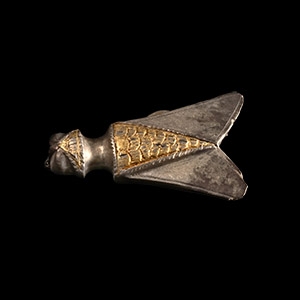
Roman Silver-Gilt Cicada Brooch
4th-5th century A.D.Sold for (Inc. bp): £494
A silver-gilt brooch in form of cicada with hollow-formed D-section head and neck, flat triangular wings; the head with bulbous eyes above a waisted neck; granule detailing to the head; pin-lug and catch-wire to the reverse. 3.82 grams, 23 mm
Acquire in the 1990s. Ex Cambridgeshire, UK, collection.
This type of brooch was popular among the Hunnic tribes, as well as in Roman Pannonia and Illyricum before the arrival of the Huns. Early Hunnic designs from Pannonia may have borrowed from late Roman types. With the arrival of new populations due to migration from the east, a new material culture developed, described as the Danubian or Ponto-Danubian style, as many of its features appear in the Pontic region as well. Although the exact meaning of the cicada brooch is not known to us, it is possible that it retained its ancient symbolism of rebirth or regeneration of the soul. -
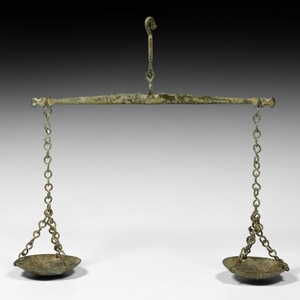
Roman Balance Scales Pair
Circa 4th century A.D.Sold for (Inc. bp): £1,430
A set of copper-alloy balance scales composed of a hook and shaped bar suspending a link chain at each end, each single chain diverging into three shorter chains supporting a shallow dish. 93 grams, 20.2 cm wide
Acquired in the late 1990s-2000. Property of an East London gentleman. -
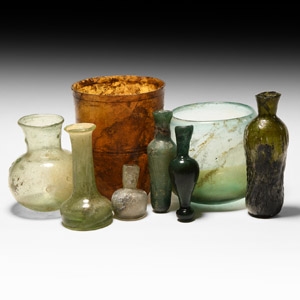
Roman Byzantine and Islamic Glass Vessel Collection
1st century A.D. and laterSold for (Inc. bp): £221
A group of eight glass vessels from the Roman, Byzantine and Islamic civilisations, of various types and dates: a pale green bulbous jar with a flared neck and rim, blobs to the neck and shoulder; a green bottle with waisted cylindrical body and short neck decorated with raised vertical ribs and hatching; a miniature piriform green bottle with globular foot and slightly flared neck; a clear glass miniature bottle of squat form, with a tubular neck and remains of iridescence to the internal surface; a pale green bottle with a squat body, long tubular neck and everted rim; a piriform green bottle with high shoulder and rounded base, tubular neck; a barrel-shaped pale blue vessel with inverted rim; an amber-brown coloured vessel of carinated form, wheel-cit bands to the equator and rim. 387 grams total, 40-97 mm
Acquired 1960s-1990s. From the late Alison Barker collection, a retired London barrister.
