
Loading, please wait...
LOT 0311
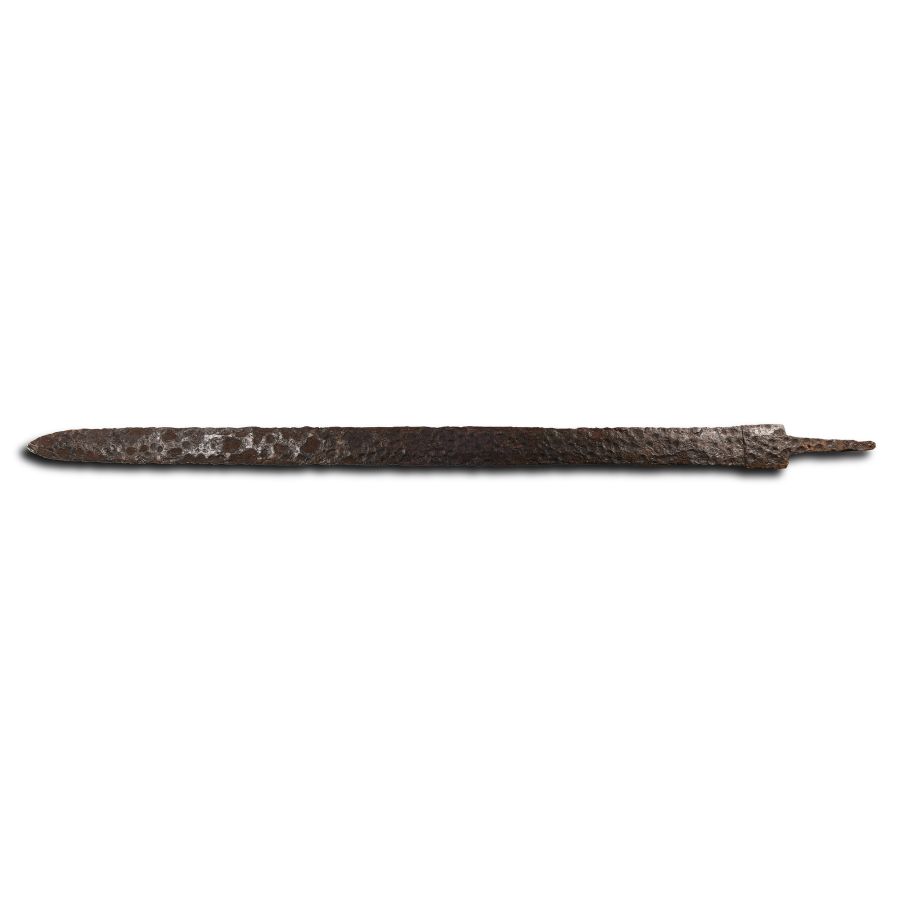
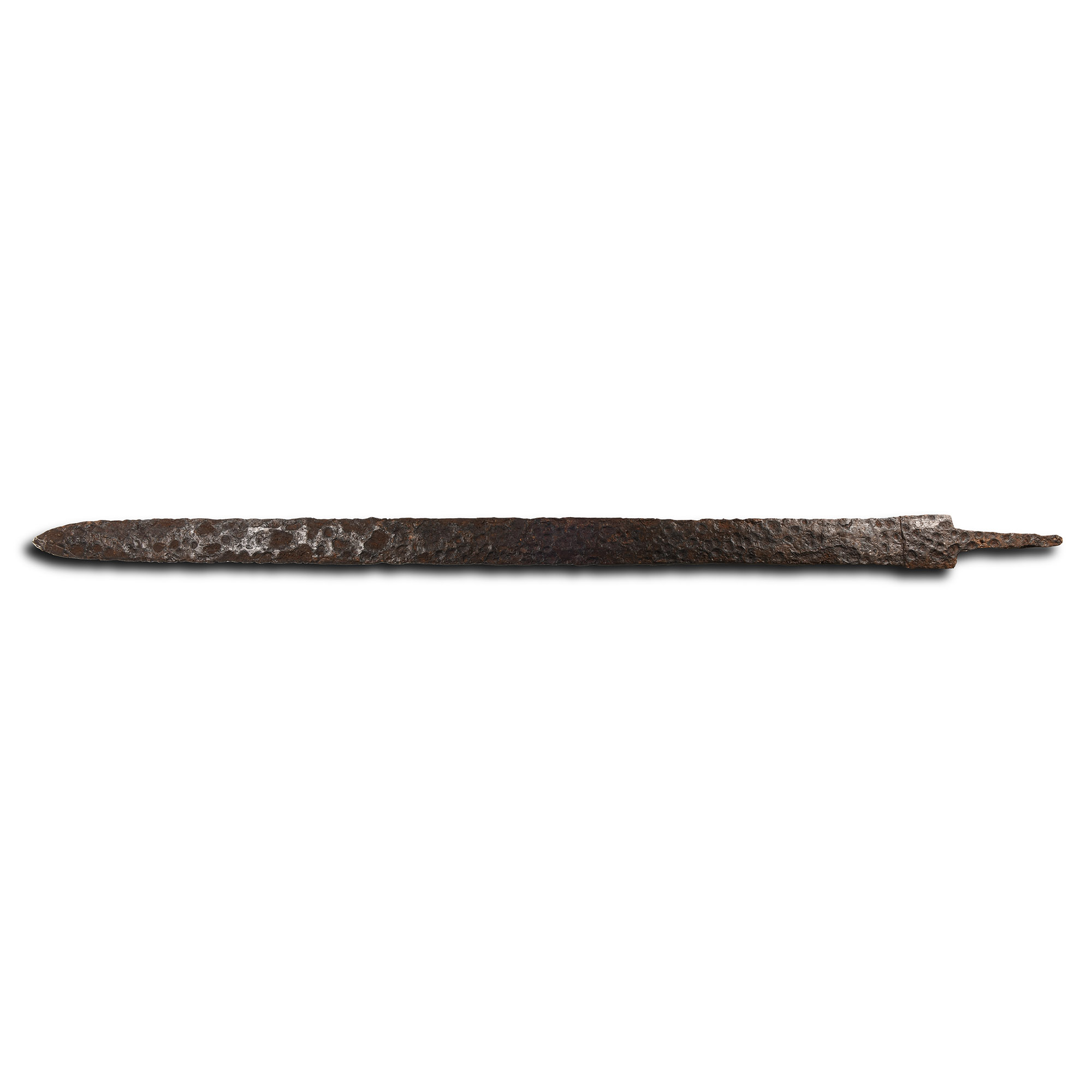
Late Roman Iron Sword of Herulian Type
5TH-6TH CENTURY A.D.
35 in. (604 grams, 89 cm).
The double-edged spatha with parallel-sided blade and pointed tip, battle nicks to both cutting edges; the hilt and tang extending over the blade as a tight-fitting sleeve; remains of rivet on the tang.
ProvenanceEx private collection of Mr M.B., Mainz, Germany, since the 1980s.
Acquired from the above, 2004.
This lot has been checked against the Interpol Database of stolen works of art and is accompanied by search certificate number no. 11939-210916.
See Dennis, G., Maurice’s Strategikon, handbook of Byzantine Military Strategy, University of Pennsylvania Press, 1984; Lebedinski, I., Armes et guerriers Barbares au temps des grandes invasions IVème au Vième siècle après J.C., Paris, 2001, p.118, for a similar example from Chapka-Tserkovnyi Kholm (Abkhazia); Kazanski, M., Mastykova, A., Tsibilium II, La nécropole apsile de Tsibilium, l’étude du site, BAR, 2007, see swords on pl.6, no.27 (Chapka-Cerkovnyj Holm), pl.13, no.14 (Anuhva).
FootnotesThis sword belongs to the group of spathae of late Roman typology, widespread among the Germanic and Abkhazian foederati, and garrison troops of the Northern Black Sea and Caucasus. These swords could have been the prototypes of the Eastern Roman spathia, classified in the Strategikon of Pseudo-Mavrikios as Herouliskia (Herulian swords) for their connections with the Germanic mercenaries bearing them in service with the Roman army.
CONDITIONTimeLine Auctions follows a vetting process to ensure the authenticity and legality of all items, reinforcing our commitment to integrity and responsible trading. Each antiquity, antique, and coin lot undergoes thorough examination by a vetting committee of at least ten external specialists, professional trade association members, scientists, and archaeologists: Our Vetting Process
AUCTIONS:
TimeLine is a leading auction house specialising in antiquities, ancient art, collectables, natural history, coins, medals, and books. Our auctions offer museums, collectors, historians, and enthusiasts the opportunity to acquire unique and historically significant pieces.
LOT 0311
Late Roman Iron Sword of Herulian Type
Estimate £3,000 - 4,000€3,480 - 4,640 (for guidance only)$4,050 - 5,400 (for guidance only)
-
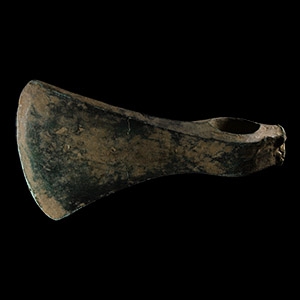
Large Western Asiatic Socketted Bronze Axehead
Late 2nd millennium B.C.Sold for (Inc. bp): £234
Composed of flared cheeks, convex cutting edge and lentoid-shaped socket with raised circumferential rib and butt, with a vertical rib to the rear. 1.16 kg, 19.2 cm
Acquired 1980-2015. Ex Abelita family collection.
In the 2nd millennium B.C., in the Caucasus area, variants of axes with a curved horizontal blade and a tubular eye developed. The simplest variants of these types were borrowed through the north of Ciscaucasia by the inhabitants of the Eurasian steppes. In the steppes, war axes became, around the middle of the 2nd millennium B.C., the most powerful bronze weapons, spreading far to the east. -
.jpg)
Viking Age Iron Sword with Seven-Lobed Pommel
11th-13th century A.D.Estimate: £5,000 - 7,000 (+bp*)
Opening Bid: £2,500
Couronian sword of Petersen Type K with double-edged tapering blade and tapering fullers; bronze cross-guard extending at each end to serpent- or horse-heads, wheeled ornament to both faces; the lower guard with similar motifs; seven-lobed pommel with annulets and pellets. 1.02 kg, 86.5 cm
From the private collection of a London gentleman, from his grandfather's collection formed before the early 1970s. Accompanied by an academic report by Dr Raffaele D’Amato. This lot has been checked against the Interpol Database of stolen works of art and is accompanied by search certificate no.11925-209658.
Couronian swords of this type, with animal-head decoration on the lower guard, were widespread and used in the Eastern Baltic lands from the 10th to 13th century. Such zoomorphic detailing was a clear influence from Germanic art. Regular geometric ornamentation, derived from Romanesque art, was also widespread, with one of the most common ornaments being a cross-in-circle. -
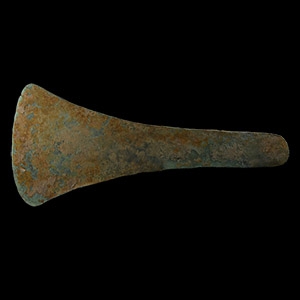
Western Asiatic Bronze Flat Axe
2nd millennium B.C.Sold for (Inc. bp): £117
Flat in cross-section with a convex cutting edge and rounded butt. 178 grams, 20.3 cm
Acquired 1980-2015. Ex Abelita family collection.
This flat axe belongs to Type 1, sub-type a.4 of the Çetin-Bilgi classification of flat axes. They have concave-sided blade, rectangular in section, a splayed cutting edge and a narrow butt. The first examples of axe-type weapons appear in the last phase of the Late Chalcolithic Age in the Middle East and Anatolia.
