
Loading, please wait...


LOT 0727
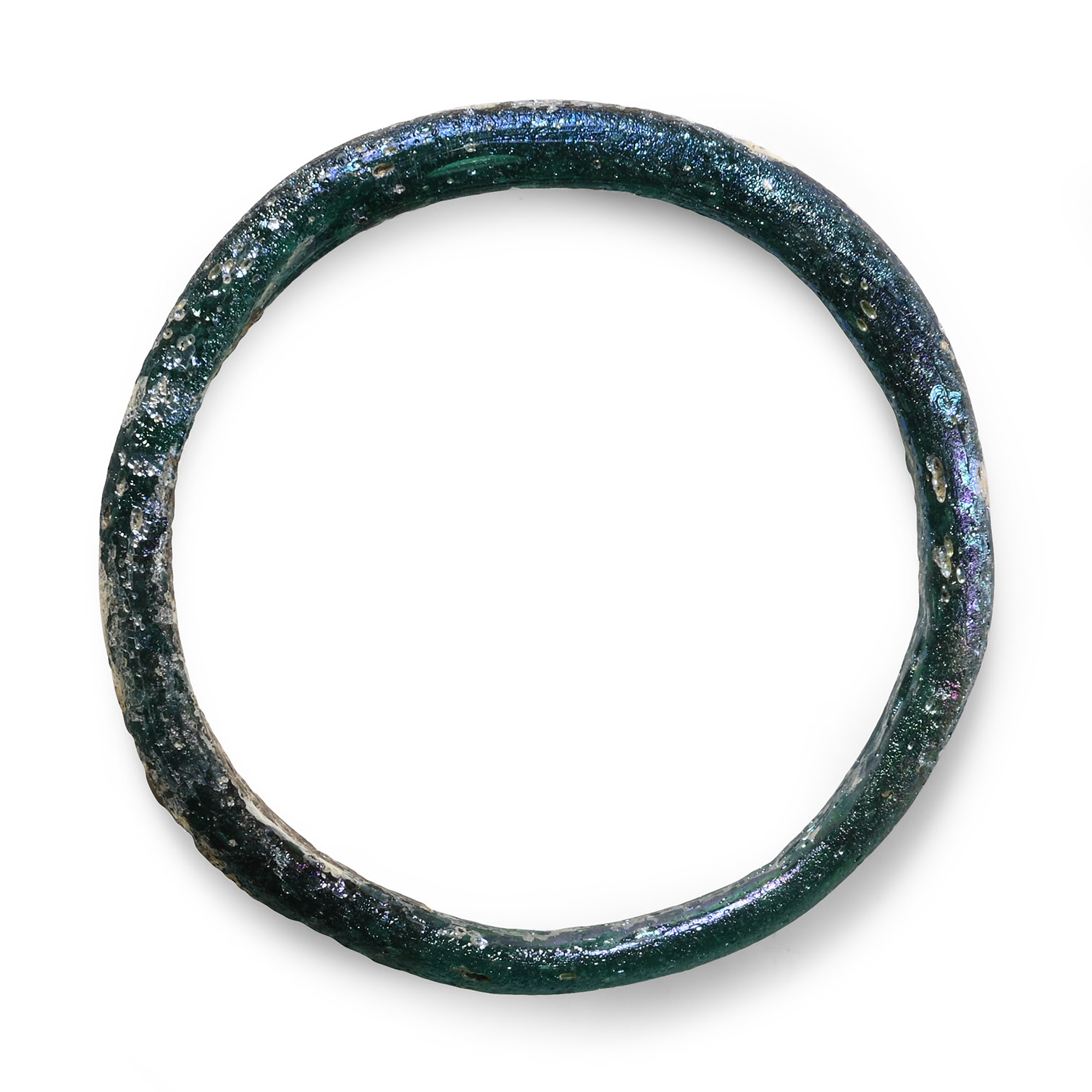
Late Roman Iridescent Blue Bracelet
4TH-6TH CENTURY A.D.
2 in. (7.34 grams, 53 mm).
Round-section bangle with iridescent surface.
ProvenanceAcquired 1980-2015.
Ex Abelita family collection.
TimeLine Auctions follows a vetting process to ensure the authenticity and legality of all items, reinforcing our commitment to integrity and responsible trading. Each antiquity, antique, and coin lot undergoes thorough examination by a vetting committee of at least ten external specialists, professional trade association members, scientists, and archaeologists: Our Vetting Process
AUCTIONS:
TimeLine is a leading auction house specialising in antiquities, ancient art, collectables, natural history, coins, medals, and books. Our auctions offer museums, collectors, historians, and enthusiasts the opportunity to acquire unique and historically significant pieces.
-
Roman Bronze Silenus Statuette
1st-2nd century A.D.Sold for (Inc. bp): £1,690
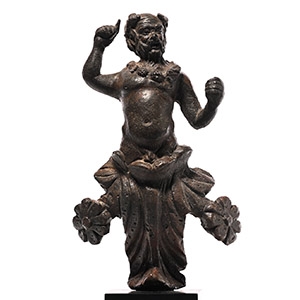
Bust and torso of Silenus in dramatic pose with right hand raised, wreath of leaves to the hair and garland of grapes and vine leaves to the chest; lower body developing to a scrolled foliage mount with lateral rosettes; mounted on a custom-made stand. 319 grams total, 13.5 cm including stand
with Bonhams, Knightsbridge, 8 April 1997, no.102. From an important Cambridgeshire estate; thence by descent.
The figure represents either Silenus himself, the aged and semi-bestial companion of Dionysus, or a satyr - a member of the feral group of which he was the leader. As a devotee of Dionysus, Silenus is often shown with Bacchantes, female celebrants in the cult of wine-drinking, music and other pleasurable pursuits. -
Roman Bronze Military Armilla Bracelet
1st-2nd century A.D.Sold for (Inc. bp): £494
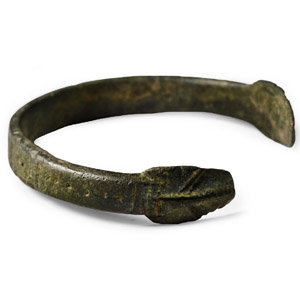
Comprising a penannular flat-section hoop with punched decoration, deltoid-shaped terminals formed as stylised snake heads with hatched line detailing. 25.5 grams, 58 mm
Ex German art market, 2000s. Acquired from an EU collector living in London. From the collection of Surrey, UK, gentleman. -
Roman Bronze Turtle Pendant
1st-4th century A.D.Sold for (Inc. bp): £312
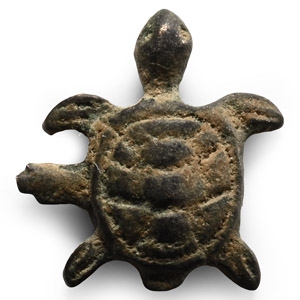
With segmented domed shell and radiating limbs; lateral spur; pierced at the neck for suspension. 4.3 grams, 20 mm
Private collection, Arundel, West Sussex, UK, 1980s-1990s.
