
Loading, please wait...
_900x900.jpg "Late Roman Inscribed Silver Ring for Konstantinos")
_200x200.jpg "Late Roman Inscribed Silver Ring for Konstantinos")
.jpg "Late Roman Inscribed Silver Ring for Konstantinos")
LOT 0200
Late Roman Inscribed Silver Ring for Konstantinos
CIRCA 4TH-5TH CENTURY A.D.
3/4 in. (2.48 grams, 19.61 mm overall, 17.64 mm internal diameter (approximate size British N, USA 6 1/2, Europe 13.72, Japan 13)).
Comprising an octagonal band with rounded inside, engraved inscription in Greek on four facets reading 'ΚΟΝ ΑΝΒ /ΟΗΑ ΙΑΤΟ /ΥΥΨ ΙϹΤΟ/ +ΘΚ ΑΤΟΙ', interspersed with a palm branches on the other facets.
ProvenanceEx London, UK, collection, 2000s.
Accompanied by a copy of a statement of opinion from Striptwist Ltd, a London-based company run by precious metal specialist Dr Jack Ogden, reference number 210711.
Cf. Ruseva-Slokoska, L., Roman Jewellery, Sofia, 1991, item 223, for type.
FootnotesThis type of ring (type III, Variant 1, of the Ruseva-Slokoska classification) is common among gold and silver examples since the 3rd century A.D. The inscription on our ring, however, shows Christian elements (such as the palm branch) which allow a dating to the 4th-5th century A.D. The inscription '+ΘΚ ΑΤΟΙ /ΚΟΝ ΑΝΒ /ΟΗΑ ΙΑΤΟ /ΥΥΨ ΙϹΤΟ' is not simple to interpret. It could be read as '+Θ(ΕΟΤΟΚ)E A (ΓΙΑ) TOI/ KON(ϹΤ)ΑΝ (TINΩ) B/OH(Θ EI) A(Γ)ΙΑ TO/ Υ ΥΨΙϹΤΟ' = 'Holy Mother of God help Constantine from the heights of your Holiness [Konstantinos being the possible owner of the ring]'.
CONDITIONTimeLine Auctions follows a vetting process to ensure the authenticity and legality of all items, reinforcing our commitment to integrity and responsible trading. Each antiquity, antique, and coin lot undergoes thorough examination by a vetting committee of at least ten external specialists, professional trade association members, scientists, and archaeologists: Our Vetting Process
AUCTIONS:
TimeLine is a leading auction house specialising in antiquities, ancient art, collectables, natural history, coins, medals, and books. Our auctions offer museums, collectors, historians, and enthusiasts the opportunity to acquire unique and historically significant pieces.
-
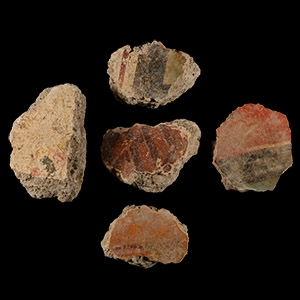
Roman Fresco Painted Wall Plaster Collection
1st century A.D.Sold for (Inc. bp): £130
Comprising five pieces in cream, orange, blue and red with painted architectural lines; one with floral decoration and one with a shaded 'grid' making it look three-dimensional. 622 grams total, 73 - 98 mm
Acquired in the 19th century. Ex Jeger collection, Switzerland. -
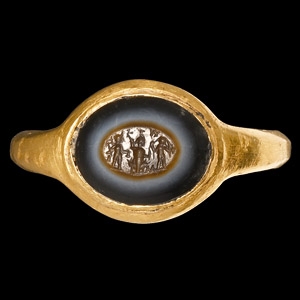
Roman Gold Ring with Sardonyx Gemstone
Circa 2nd-3rd century A.D.Estimate: £3,500 - 4,500 (+bp*)
Opening Bid: £1,750
Facetted hoop and disc bezel with inset sardonyx depicting three facing goddesses holding attributes. 6.76 grams, 24.93 mm overall, 21.92 mm internal diameter (approximate size British R 1/2, USA 8 3/4, Europe 19.38, Japan 18)
From a collection of a London lady, acquired annually during 1990s-2000s. This lot has been checked against the Interpol Database of stolen works of art and is accompanied by search certificate no.11962-210875. -
.jpg)
Roman Bronze Dancing Sol Statuette
Circa 1st-2nd century A.D.Sold for (Inc. bp): £2,340
Standing nude on one leg on a cuboid socle base, the other leg raised and extended, right arm raised and bent, hand open to accept a sceptre, left arm extended with patera in the open hand, short mantle to the shoulders, hair and rays framing the face. 57 grams, 72 mm including stand
Acquired on the German art market before 2000. From an EU collection before 2020.
