
Loading, please wait...

LOT 0701
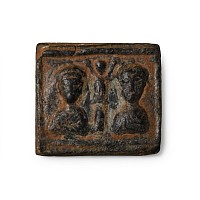
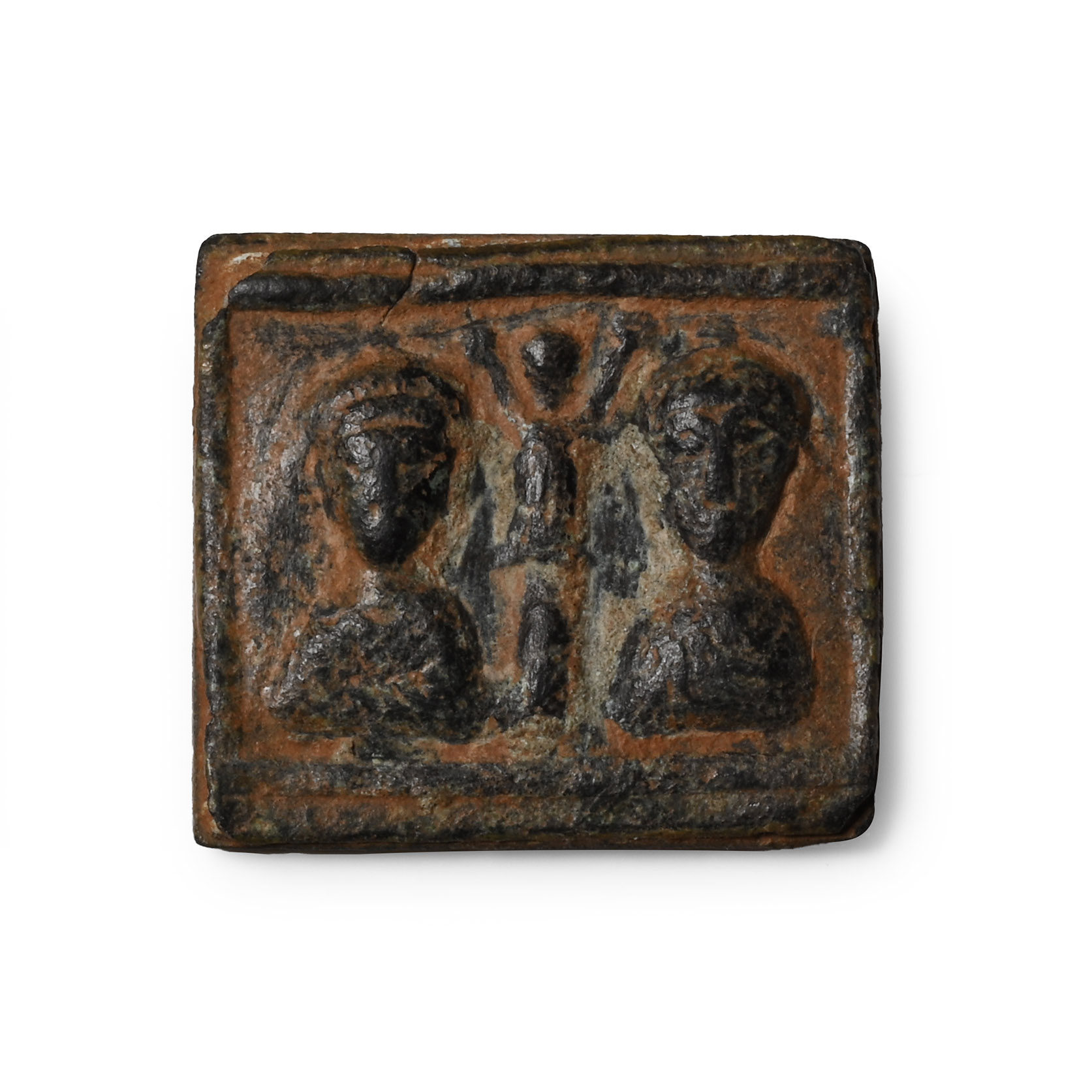
Late Roman Honorius with Theodosius II AE Exagium Solidi Weight
408-423 A.D.
3/4 in. (4.11 grams, 18mm).
Diademed and draped facing busts of Honorius and Theodosius II; between them above, Victory standing facing, crowning the emperors; to the reverse twenty-five pellets in form of a pyramid.
ProvenanceFrom the collection of a gentleman, acquired on the London art market in the 1990s.
Ex Classical Numismatic Group, Electronic Auction 562, 15 May 2024, lot 792.
Bendall -; Rochesnard -; CPAI -; Pondera 4231 var. (cross instead of Victory); for similar example cf. Leu Web 16, 4070; for Exagia see RIC X, p. 8.
CONDITIONTimeLine Auctions follows a vetting process to ensure the authenticity and legality of all items, reinforcing our commitment to integrity and responsible trading. Each antiquity, antique, and coin lot undergoes thorough examination by a vetting committee of at least ten external specialists, professional trade association members, scientists, and archaeologists: Our Vetting Process
AUCTIONS:
TimeLine is a leading auction house specialising in antiquities, ancient art, collectables, natural history, coins, medals, and books. Our auctions offer museums, collectors, historians, and enthusiasts the opportunity to acquire unique and historically significant pieces.
LOT 0701
Late Roman Honorius with Theodosius II AE Exagium Solidi Weight
Sold for (Inc. bp): £195
-
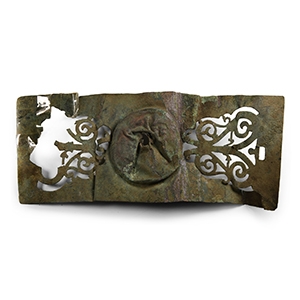
Large Roman Bronze Military Mount
2nd-3rd century A.D.Estimate: £120 - 170 (+bp*)
Opening Bid: £65
Composed of a central domed boss and openwork volutes to the sides; for a sword belt or a chariot, one corner separated. 69 grams, 14 cm wide
Good condition, very rare
Acquired 1960s-1990s. Late Alison Barker collection, a retired London barrister.
In 3rd century A.D. the sword (spatha) was mainly carried suspended from a broad baldric usually on the soldier’s left side. This sword’s shoulder belt, visible on many monuments related to the 3rd century, was composed from a leather strap, reinforced on the rims. The four specimens of Vimose provided valuable information about the shape of the baldric: one end was broad and finished in a straight edge, the other tapered to a narrow strip. They were decorated with silver disks (phalerae) of circa 6.4 cm. of diameter, with rings on the reverse for fastening. These phalerae were of different shapes, styles and decorations: we can observe a range from simple copper-alloy discs to bronze openwork pieces fitted with a plate or an openwork disc showing elaborate figures. They were usually attached at about 29-30 cm from the wider and squared top of the baldric. One of the finial parts of the baldric was in fact very wide and ended with a straight edge, upon which could be placed a hinged rectangular openwork terminal plate (like our specimen), attached to a belt terminal pendant. The lack, in our specimen, of holes for the attachment rivets could also support the thesis that the piece is not for a baldric, but a mount for cart or chariot as some examples in a similar style found in Roman North Africa. -
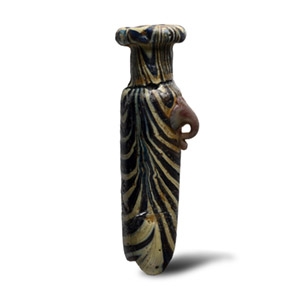
Eastern Roman Core-Formed Glass Alabastron Fragment
3rd-4th century A.D.Sold for (Inc. bp): £130
Modelled in blue and yellow glass with everted rim and loop handle to the shoulder; lower body and one handle absent. 20.29 grams, 64 mm
From the collection of a gentleman, acquired on the London art market in the 1990s. -

Roman Glass Double Unguentarium
3rd-5th century A.D.Sold for (Inc. bp): £468
Comprising two conjoined tapering tubular cells, with applied handles at the shoulder, decorated with applied trails; lateral loop handles at the rim and strap handle above. 82 grams, 16 cm
Formerly in North American collection, 1990s. From the collection of a London, UK, gentleman.
