
Loading, please wait...
_900x900.jpg "Late Roman Hematite Gnostic Gemstone")
_200x200.jpg "Late Roman Hematite Gnostic Gemstone")
.jpg "Late Roman Hematite Gnostic Gemstone")
LOT 0158
Late Roman Hematite Gnostic Gemstone
3RD CENTURY A.D.
1 in. (6 grams, 27 mm).
Ellipsoid bifacial cloison with chamfered edge; obverse - horseman with spear pointing at a fallen enemy with legend 'ΝΩΜΟΛΟ'; reverse - retrograde legend 'ΠΤΘΕΟΛΓΙCΨ[..]'; supplied with a museum-quality impression.
ProvenanceAcquired in 1994.
Private collection, thence by descent.
Private collection, since the late 1990s.
This lot has been cleared against the Art Loss Register database, and is accompanied by an illustrated lot declaration signed by the Head of the Antiquities Department, Dr Raffaele D'Amato.
TimeLine Auctions follows a vetting process to ensure the authenticity and legality of all items, reinforcing our commitment to integrity and responsible trading. Each antiquity, antique, and coin lot undergoes thorough examination by a vetting committee of at least ten external specialists, professional trade association members, scientists, and archaeologists: Our Vetting Process
AUCTIONS:
TimeLine is a leading auction house specialising in antiquities, ancient art, collectables, natural history, coins, medals, and books. Our auctions offer museums, collectors, historians, and enthusiasts the opportunity to acquire unique and historically significant pieces.
-
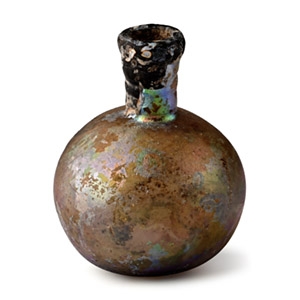
Roman Iridescent Glass Flask
4th century A.D.Sold for (Inc. bp): £234
With squat bulbous body and slender cylindrical neck with rolled rim, pontil base; iridescent surfaces. 19 grams, 53 mm
Ex Mayfair, London, UK, gallery, 1990s-2000s. From an important collection of glass, the property of a London gentleman. This lot is accompanied by an illustrated lot declaration signed by the Head of the Antiquities Department, Dr Raffaele D'Amato. -
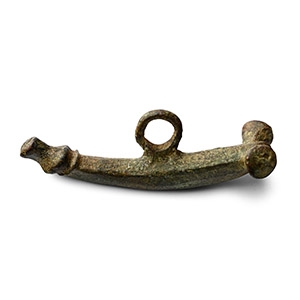
Roman Bronze Phallic Pendant
1st-4th century A.D.Sold for (Inc. bp): £124
Modelled as an elongated phallus with lateral testis and ridged glans, integral suspension loop above. 10.7 grams, 45 mm
Acquired on the UK art market during the late 20th century. From the private collection of David King (1940-2024), Hoddesdon, Hertfordshire, UK. This lot is accompanied by an illustrated lot declaration signed by the Head of the Antiquities Department, Dr Raffaele D'Amato. -
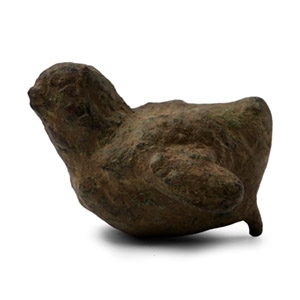
Roman Bronze Bird Figure
1st-4th century A.D.Sold for (Inc. bp): £98
Modelled in the round figure of a fledgling with bulbous body and short, stubby wings, head raised to accept food. 133 grams, 46 mm
Found Little Blakenham, Suffolk, UK. Accompanied by a copy of the British Museum's Portable Antiquities Scheme (PAS) report no.SF-4991D6. This lot is accompanied by an illustrated lot declaration signed by the Head of the Antiquities Department, Dr Raffaele D'Amato.
