
Loading, please wait...
_900x900.jpg "Late Roman Haematite Four-Sided Amulet with FIgures")
_200x200.jpg "Late Roman Haematite Four-Sided Amulet with FIgures")
_900x900.jpg "Late Roman Haematite Four-Sided Amulet with FIgures")
_200x200.jpg "Late Roman Haematite Four-Sided Amulet with FIgures")
.jpg "Late Roman Haematite Four-Sided Amulet with FIgures")
.jpg "Late Roman Haematite Four-Sided Amulet with FIgures")
LOT 1015
Late Roman Haematite Four-Sided Amulet with FIgures
4TH-5TH CENTURY A.D.
3/4 in. (3.9 grams, 20 mm).
Pierced longitudinally, the first side with a figure standing below a large tree (the god Hop?), the second with a tree and three animals, the third with an altar with two birds and a dancing pair of figures below, the fourth side with a dog, symbols above. [No Reserve]
ProvenanceFrom the private collection of a European gentleman (1942-2024), formed since the 1970s.
LiteratureFor a similar figure cf. Mastrocinque, A., Les intailles magiques du department des monnaies Médailles et Antiques, Paris, 2014, no.273.
CONDITIONTimeLine Auctions follows a vetting process to ensure the authenticity and legality of all items, reinforcing our commitment to integrity and responsible trading. Each antiquity, antique, and coin lot undergoes thorough examination by a vetting committee of at least ten external specialists, professional trade association members, scientists, and archaeologists: Our Vetting Process
AUCTIONS:
TimeLine is a leading auction house specialising in antiquities, ancient art, collectables, natural history, coins, medals, and books. Our auctions offer museums, collectors, historians, and enthusiasts the opportunity to acquire unique and historically significant pieces.
-
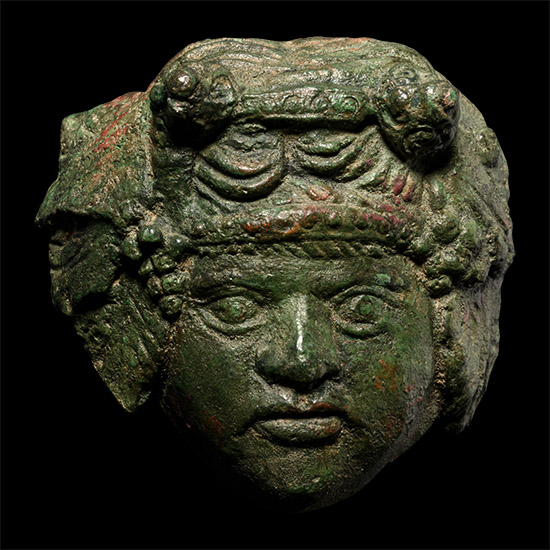
Roman Bronze Head of Dionysus Mount
1st-2nd century A.D.Sold for (Inc. bp): £546
Large convex mount depicting the head of the god of wine, shown facing with rounded cheeks and staring eyes, large vine leaves with bunches of grapes framing his face; ferrous spike on the reverse. 103 grams, 61 mm
Ex German art market, 2000s. Acquired from an EU collector living in London. From the collection of a Surrey, UK, gentleman. -
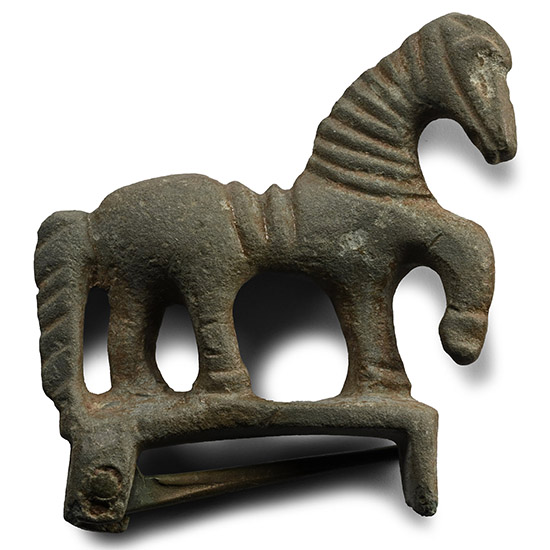
Roman Bronze Prancing Horse Brooch
2nd-3rd century A.D.Sold for (Inc. bp): £124
The horse standing on a groundline with its front leg raised and head turned to right, ribbed tail and mane, simple saddle on the back; hinged pin and remains of catchplate beneath. 17.7 grams, 37 mm
Ex German art market, 2000s. Acquired from an EU collector living in London. From the collection of Surrey, UK, gentleman. This lot is accompanied by an illustrated lot declaration signed by the Head of the Antiquities Department, Dr Raffaele D’Amato. -
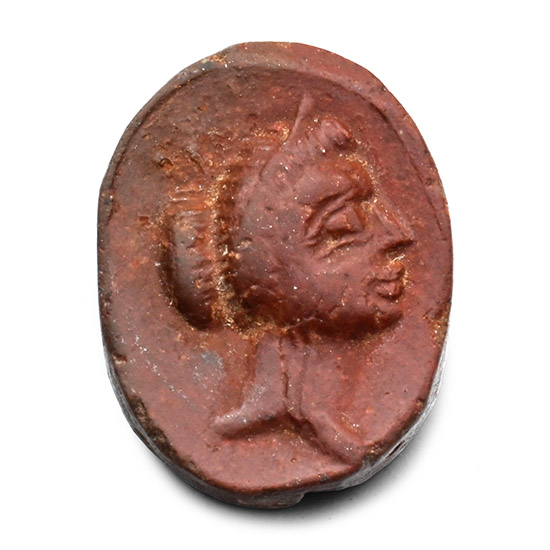
Roman Brown Stone Cameo with Female Bust
2nd-3rd century A.D.Sold for (Inc. bp): £33
Ellipsoid in plan with a low-relief female profile portrait bust with hair dressed in a chignon. 0.57 grams, 13 mm
Property of a European gentleman, acquired from the estate of a London collector (formed before 2000).
