
Loading, please wait...
_900x900.jpg "Late Roman Green Glass Vessel")
_200x200.jpg "Late Roman Green Glass Vessel")
.jpg "Late Roman Green Glass Vessel")
LOT 0784
Late Roman Green Glass Vessel
4TH-6TH CENTURY A.D.
2 1/2 in. (13.2 grams, 64 mm).
Bulbous in profile with dimpled underside, blown construction, everted rolled rim. [No Reserve]
ProvenanceAcquired from Allan Cherry, Bournemouth, UK, 2006.
Ian Wilkinson collection, Nottinghamshire, UK.
Cf. Whitehouse, D., Roman Glass in the Corning Museum of Glass, vol.1, New York, 1997, item 217, for type; Oliver, A. Jr., Ancient Glass, In the Carnegie Museum of Natural History, Pittsburgh, Pittsburgh, 1980, p.111, no.180, for similar.
FootnotesSimilar flasks and bottles were produced in Roman Asia Minor; this is a typical example of a type found in all corners of the empire. These were decorated in many ways including applying additional pieces of glass, by cutting the surface, or (as in our case) by moulding the vessels when they were blown.
CONDITIONTimeLine Auctions follows a vetting process to ensure the authenticity and legality of all items, reinforcing our commitment to integrity and responsible trading. Each antiquity, antique, and coin lot undergoes thorough examination by a vetting committee of at least ten external specialists, professional trade association members, scientists, and archaeologists: Our Vetting Process
AUCTIONS:
TimeLine is a leading auction house specialising in antiquities, ancient art, collectables, natural history, coins, medals, and books. Our auctions offer museums, collectors, historians, and enthusiasts the opportunity to acquire unique and historically significant pieces.
-
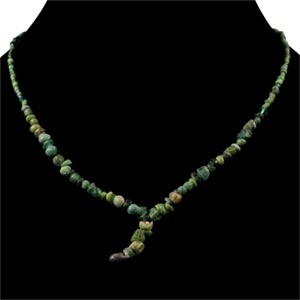
Roman Glass Bead Necklace String
1st-4th century A.D. and laterSold for (Inc. bp): £26
Composed of graduated green beads in various shapes, restrung to a Y-shape. 9.52 grams, 37 cm
Ex property of a late Japanese collector, 1970-2000s. -
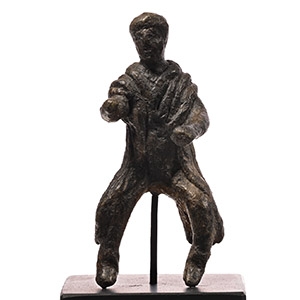
Roman Bronze Cavalryman Statuette with Paenula
1st-3rd century A.D.Sold for (Inc. bp): £221
Modelled in the round in seated pose with both hands extended forwards to hold reins; the body covered by an open-fronted paenula riding cape; boots to the feet; mounted on a custom-made stand. 271 grams, 10.1 cm including stand
Found in Britain. From a collection acquired on the UK art market from various auction houses and collections mostly before 2000. From an important Cambridgeshire estate; thence by descent.
The statuette, like the one from Rouen published by Mackintosh, represents a link between the Romano-British and Gallo-British figurines of the cavalrymen and Imperial statuary. They are of relatively good workmanship and represents a rider seated on a walking horse. The rider is dressed in a short-sleeved tunic and the military paenula, echoing the representation of Marcus Aurelius on his horse. The raised arm could mean that he was wearing a spear. -
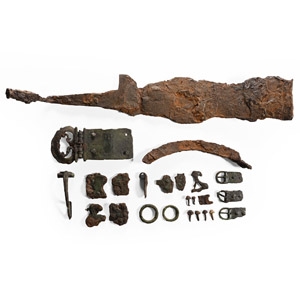
Roman Legionary's Grave Goods
1st century A.D.Sold for (Inc. bp): £1,560
Suite of military fittings including a large part of a bent gladius, Polden Hill type brooch, belt plate with scrolls to the loop, various buckles and armour attachments for lorica segmentata. 418 grams total, 1.1-35 cm
From a West Country collection, 1940s.
