
Loading, please wait...
LOT 1267
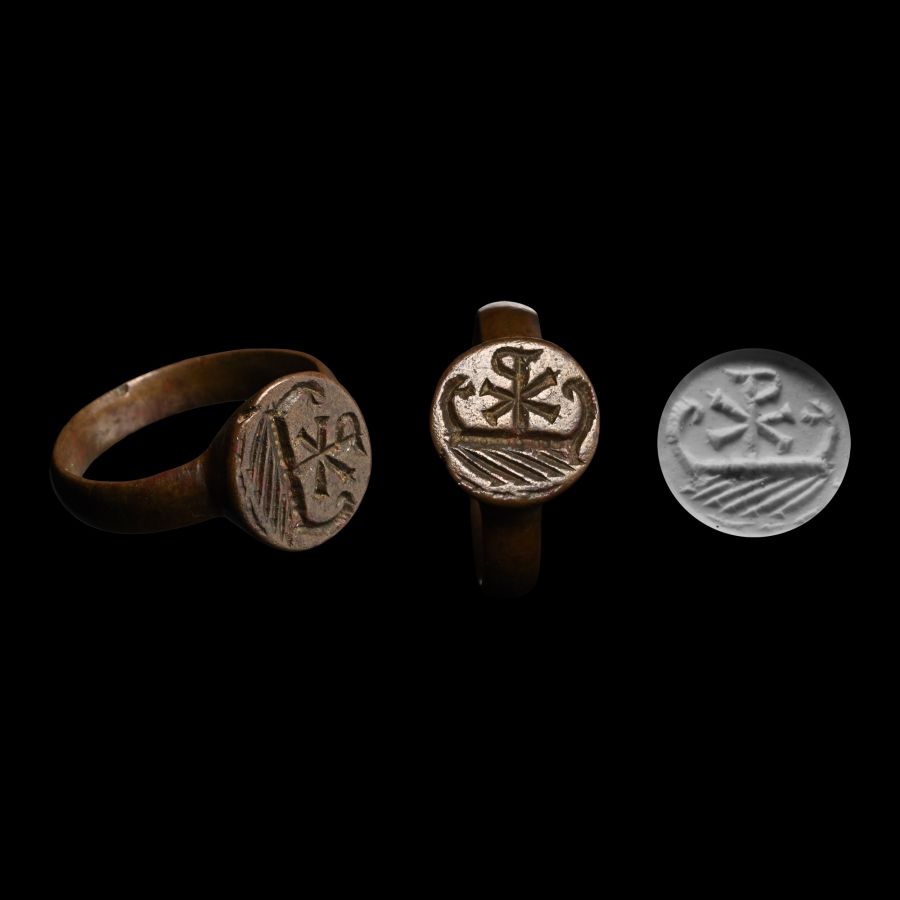
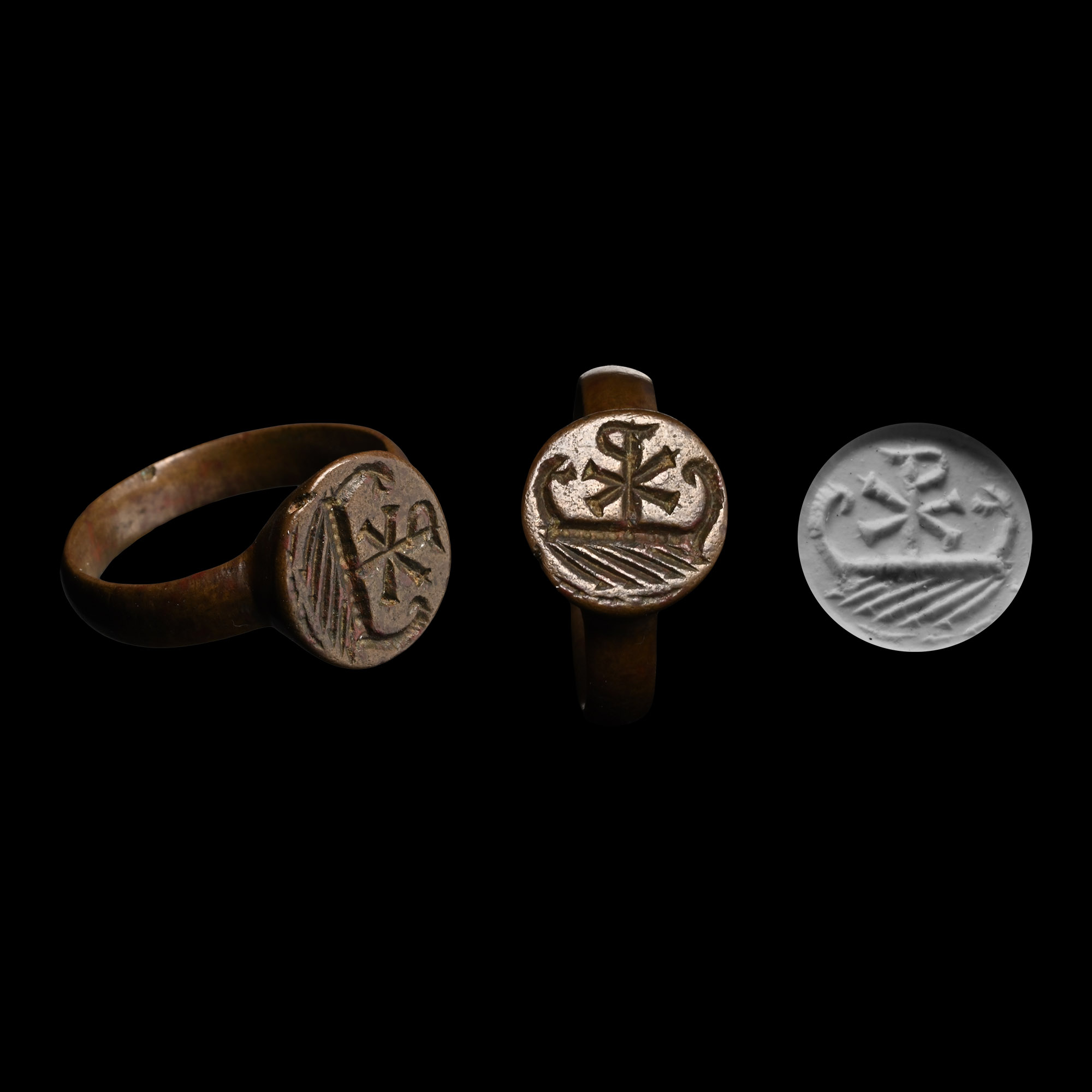
Late Roman Bronze Ring with Boat and Monogram
CIRCA 4TH CENTURY A.D.
1 in. (7.85 grams, 25.90 mm overall, 21.03 mm internal diameter (approximate size British U 1/2, USA 10 1/4, Europe 23.15, Japan 22)).
With D-section hoop and flared discoid bezel, incuse figure of a boat with curved stem and stern, bank of oars extended, Christogram in place of the mast.
ProvenancePrivate collection of Kal Noselson, New York, acquired between 1976 and the late 1990s; thence by descent.
LiteratureCf. Chadour, A.B., Rings. The Alice and Louis Koch Collection, volume I, Leeds, 1994, item 489, for type.
CONDITIONTimeLine Auctions follows a vetting process to ensure the authenticity and legality of all items, reinforcing our commitment to integrity and responsible trading. Each antiquity, antique, and coin lot undergoes thorough examination by a vetting committee of at least ten external specialists, professional trade association members, scientists, and archaeologists: Our Vetting Process
AUCTIONS:
TimeLine is a leading auction house specialising in antiquities, ancient art, collectables, natural history, coins, medals, and books. Our auctions offer museums, collectors, historians, and enthusiasts the opportunity to acquire unique and historically significant pieces.
LOT 1267
Late Roman Bronze Ring with Boat and Monogram
Estimate £200 - 300€230 - 350 (for guidance only)$270 - 410 (for guidance only)
-
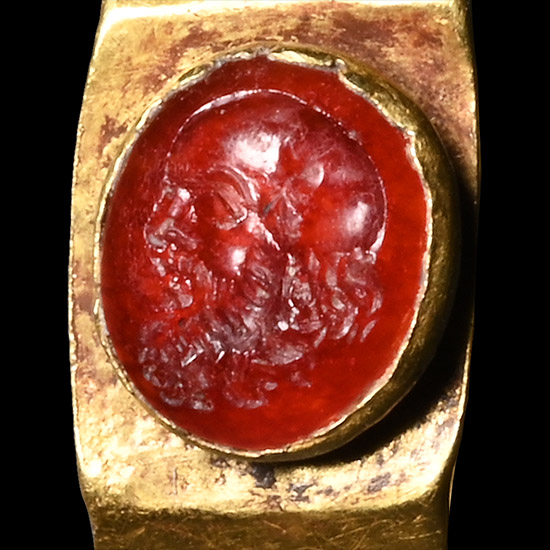
Roman Gold Ring with Gemstone of Silenus
1st-3rd century A.D.Estimate: £2,000 - 3,000 (+bp*)
Opening Bid: £1,000
Comprising a flat-section facetted hoop with a raised collet set with a red carnelian intaglio showing the profile head of Silenus; the intaglio is of the 1st century and set in a 3rd-century ring. 2.58 grams, 22.25 mm overall, 18.29 x 17.68 mm internal diameter (approximate size British P 1/2, USA 7 3/4, Europe 16.86, Japan 16)
Private collection, London. This lot has been checked against the Interpol Database of stolen works of art and is accompanied by search certificate no.13534-263674.
The ring belongs to the type VI, variant 1, of Ruseva-Slokoska classification of Roman gold rings. Polygonal-ellipsoid hoops with sectoral planes cut on the outside of the massive hoop, widening and thickening towards the shoulders, are typical of the 3rd century A.D. -
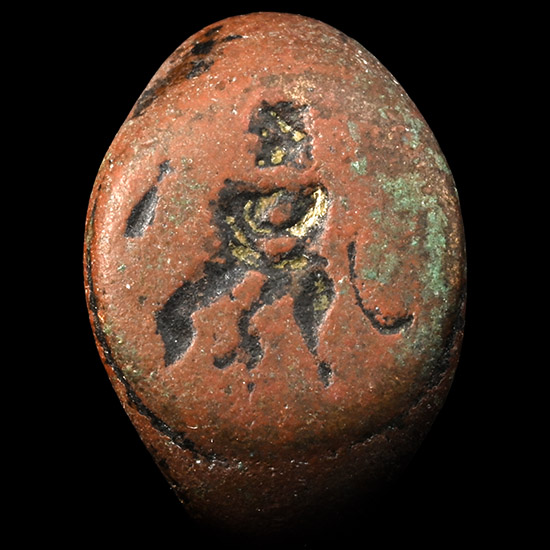
Roman Bronze Ring with Satyr
3rd-4th century A.D.Estimate: £40 - 60 (+bp*)
Opening Bid: £5
With a narrow hoop and thick integral bezel, incuse design of Hercules grappling the Nemean lion. 10.90 grams, 25.50 mm overall, 19.39 x 15.78 mm internal diameter (approximate size British L 1/2, USA 6, Europe 11.87, Japan 11)
From the private collection of a European gentleman (1942-2024), formed since the 1970s. -
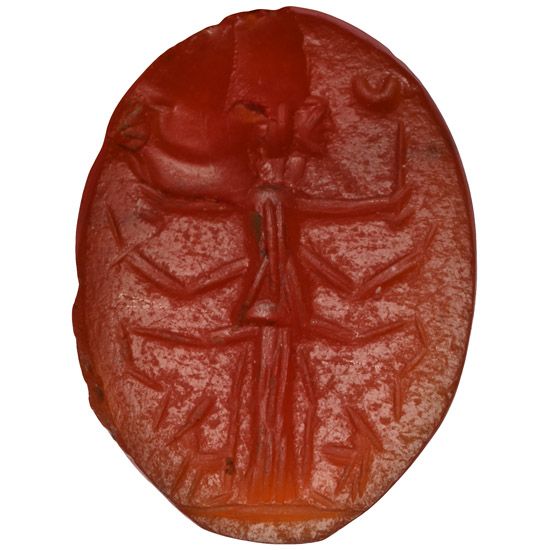
Roman Carnelian Gemstone with Goddess Hecate
1st-2nd century A.D.Estimate: £400 - 600 (+bp*)
Bids: 1 | Current Bid: £5
Ellipsoid in plan with intaglio standing robed figure of Hecate, her heads facing left and right, with six arms; holding the leashes of two dogs standing to either side of her, with birds in the field; chipped; supplied with a museum-quality impression. 0.65 grams, 13 mm
From the private collection of a European gentleman (1942-2024), formed since the 1970s.
Hecate, the goddess of the Underworld, is often represented with 6 arms: the uppermost hands holding torches, the middle hands holding daggers, and the lowermost hands holding whips. Hecate was a chthonic (underworld) goddess. As the holder of the keys that can unlock the gates between realms, she could unlock the gates of death, as described in a 3rd-century B.C. poem by Theocritus. In the 1st century AD, Virgil described the entrance to hell as 'Hecate's Grove', though he says that Hecate is equally 'powerful in Heaven and Hell.'
