
Loading, please wait...
LOT 1098
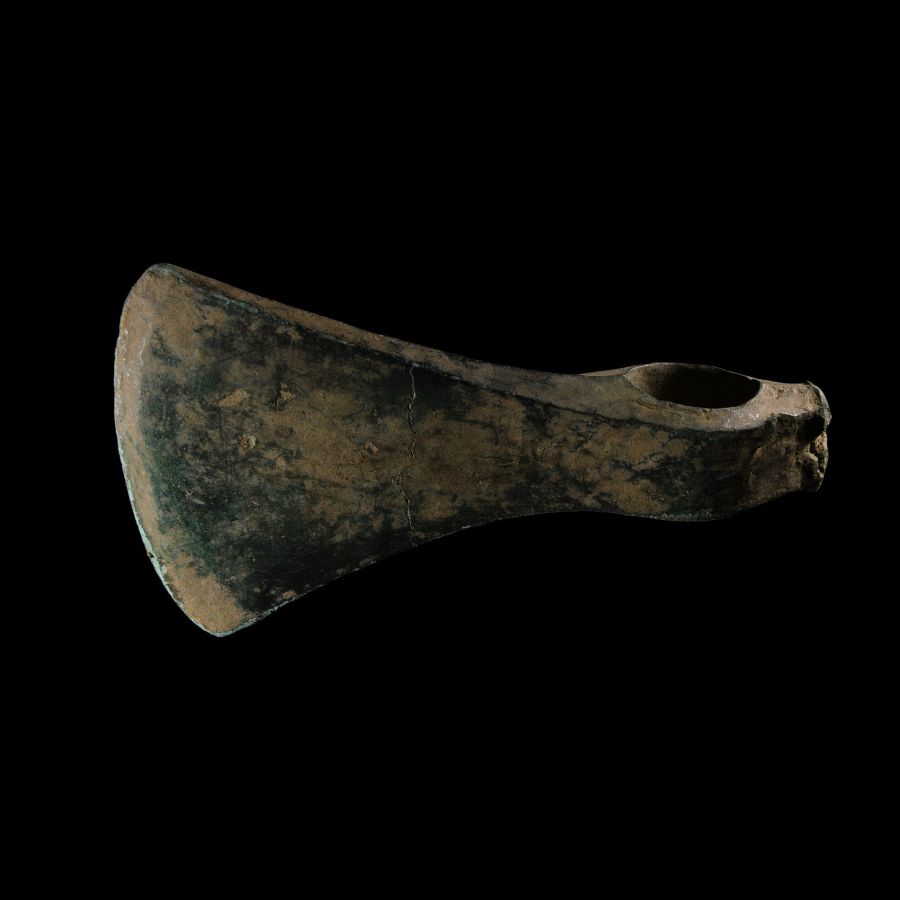
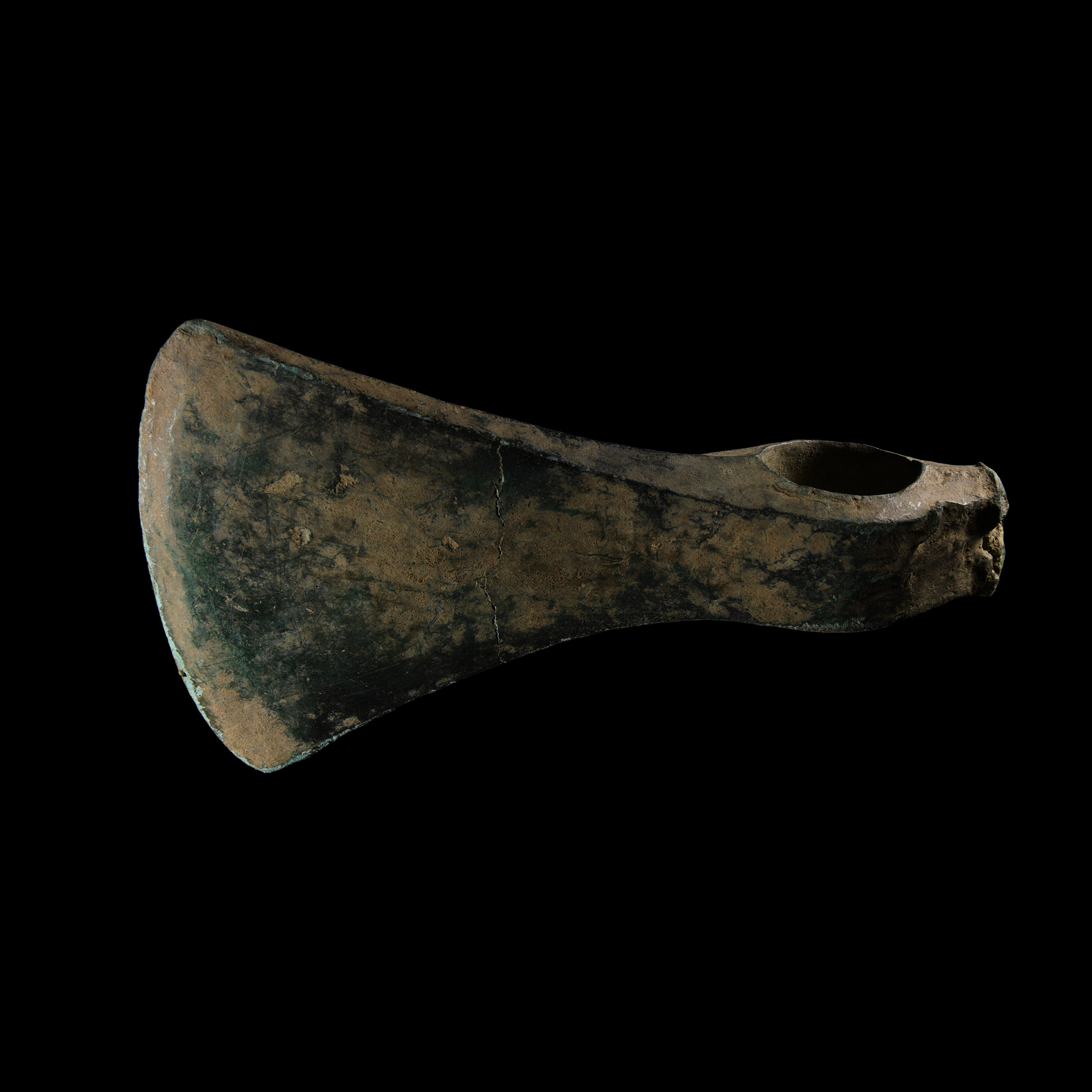
Large Western Asiatic Socketted Bronze Axehead
LATE 2ND MILLENNIUM B.C.
7 1/2 in. (1.16 kg, 19.2 cm).
Composed of flared cheeks, convex cutting edge and lentoid-shaped socket with raised circumferential rib and butt, with a vertical rib to the rear.
ProvenanceAcquired 1980-2015.
Ex Abelita family collection.
See Gorelik, M., Weapons of Ancient East, IV millennium BC-IV century BC, Saint Petersburg (2003), pl.XXII, nos.30,39 (Artik and Nalchik, in Caucasus), for similar.
FootnotesIn the 2nd millennium B.C., in the Caucasus area, variants of axes with a curved horizontal blade and a tubular eye developed. The simplest variants of these types were borrowed through the north of Ciscaucasia by the inhabitants of the Eurasian steppes. In the steppes, war axes became, around the middle of the 2nd millennium B.C., the most powerful bronze weapons, spreading far to the east.
CONDITIONTimeLine Auctions follows a vetting process to ensure the authenticity and legality of all items, reinforcing our commitment to integrity and responsible trading. Each antiquity, antique, and coin lot undergoes thorough examination by a vetting committee of at least ten external specialists, professional trade association members, scientists, and archaeologists: Our Vetting Process
AUCTIONS:
TimeLine is a leading auction house specialising in antiquities, ancient art, collectables, natural history, coins, medals, and books. Our auctions offer museums, collectors, historians, and enthusiasts the opportunity to acquire unique and historically significant pieces.
-
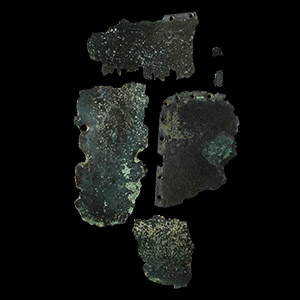
Roman Bronze Armour Sections for Limbs
3rd-4th century A.D.Sold for (Inc. bp): £221
Comprising four large plate sections from a segmented armour for arm (manica) or leg, three with pierced attachment holes to the edges, rounded extremity. 54 grams total, 6-12 mm
Found Northern Europe. UK private collection. Acquired from Redhouse Antiques Centre, York, 2005. Property of a Nottinghamshire gentleman.
On the Adamclisi monument, at least thirteen Roman legionaries and three standard-bearers have the right arm covered by an armoured sleeve (manica). It is likely that this laminated protection of the arm, derived from that worn by the gladiators, was introduced in the Imperial army in the early first century A.D., and extended to the legionaries fighting during the Dacian Wars. Domitian’s militia had already experienced the importance of protecting the arms from enemy falces. Modern scholars however do not consider this the only and exclusive reason for the introduction of this part of equipment to the Roman army between 21 and 70 A.D. The armoured sleeve can often be seen on weaponry trophies of 1st century A.D., not only on those linked with the revolt of Sacrovir, like that of Scafa, but also those related to the civil wars, like the armoury assemblage of Split, where the manica is even furnished with laminated gauntlet. This combat item can also be seen on legionary tombstones like those of Sextus Valerus Severus and Gaius Annius Salutus, both from Mainz; and legionaries of Legio XXII Primigenia, who were based in Mogontiacum between 43-70 A.D. Their tombstones show manicae as part of the decorative edge of weaponry surrounding the inscription of the tombstone. Severus' manica shows eleven plates and a hand shaped section of four plates. As suggested by Paul Brown all this clearly places the manica as being used by Roman legions around 21-70 A.D., with a widespread use throughout the empire at the time of the Dacian Wars. In the following period its use continued: a monument of Legio XIII Gemina, from Apulum (now Alba Julia) still shows a legionary of early third century in lorica segmentata combined with a manica like his predecessors of Adamclisi. Several specimens have been found in all the territories of the Empire, especially in England (Carlisle, Newstead), Austria (Carnuntum), Spain (Santa Marina de Leon), and of course in Romania (Ulpia Sarmizegetusa Trajan). However, we cannot exclude that our fragments are related to the limb armour of Roman heavy cavalryman, the cataphractarius or clibanarius. The peculiarity of the pieces is that they had rounded edges, and were certainly fixed to a leather backing. Also Ammianus (XVI,8) speaks about the lamminarum circuli (circles of laminated sheets) protecting the Roman heavy cavalrymen of the Imperial Guard. -
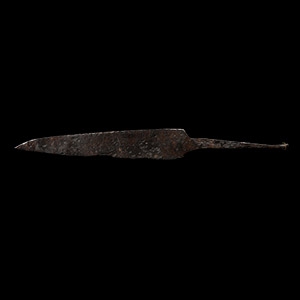
Tudor Period Iron Dagger
16th century A.D. or laterEstimate: £80 - 100 (+bp*)
Opening Bid: £40
Comprising a single cutting edge and tang. 155 grams, 28.5 cm
Acquired 1960s-1990s. Late Alison Barker collection, a retired London barrister. -
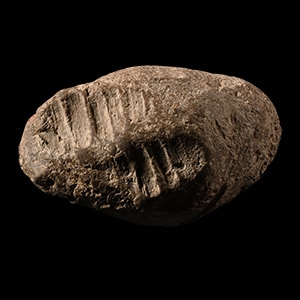
Roman Praetorian Guard Terracotta Sling Shot with Scorpion
1st century A.D.Sold for (Inc. bp): £286
Lentoid section with a raised 'keel' to one end, depicting a stylised scorpion. 25.75 grams, 43 mm
Ex Simmons Gallery, London E11, UK, in the 1990s. From a North London collection.
The sling (funda) with its lead (plumbea pondera) and stone missiles was used by special funditores, illustrated on Trajan’s Column where they are dressed in broad tunics with no armour, but carry a shield. Interestingly, this glans has the emblem usually associated with the Praetorian Guard - the scorpion. It was an emblem also used in Ptolemaic Egypt, and it is not impossible that this bullet could be Ptolemaic or Romano-Egyptian. We believe this bullet could be associated with the Praetorian regiments which means this could be one of the first pieces of evidence for their use.
