
Loading, please wait...
_900x900.jpg "Large Villanovan Geometric Black-Glazed Vase with Handle")
_200x200.jpg "Large Villanovan Geometric Black-Glazed Vase with Handle")
.jpg "Large Villanovan Geometric Black-Glazed Vase with Handle")
LOT 0055
Large Villanovan Geometric Black-Glazed Vase with Handle
9TH-8TH CENTURY B.C.
16 1/4 in. (4.5 kg, 41 cm).
Biconical impasto body with broad flaring rim, bell-shaped upper section with bands of incised geometric decoration and impressed roundels, lower section tiered and sharply funicular with narrow flat base, a lateral upturned loop handle; small hole beneath the carination, rim partly restored.
ProvenanceDr. Gonik and the late Mr. Wirth, Geneva, Switzerland.
European private collection.
Accompanied by an academic report by Dr Raffaele D'Amato.
This lot has been checked against the Interpol Database of stolen works of art and is accompanied by search certificate number no.12205-222203.
This lot has been cleared against the Art Loss Register database, and is accompanied by an illustrated lot declaration signed by the Head of the Antiquities Department, Dr Raffaele D'Amato.
Cf. similar in the British Museum under accession number Eu1987,Q.11; a similar vase-urn in the Walters Art Museum, accession no.48.1872.
CONDITIONTimeLine Auctions follows a vetting process to ensure the authenticity and legality of all items, reinforcing our commitment to integrity and responsible trading. Each antiquity, antique, and coin lot undergoes thorough examination by a vetting committee of at least ten external specialists, professional trade association members, scientists, and archaeologists: Our Vetting Process
AUCTIONS:
TimeLine is a leading auction house specialising in antiquities, ancient art, collectables, natural history, coins, medals, and books. Our auctions offer museums, collectors, historians, and enthusiasts the opportunity to acquire unique and historically significant pieces.
LOT 0055
Large Villanovan Geometric Black-Glazed Vase with Handle
Sold for (Inc. bp): £1,820
-
.jpg)
Large Greek Geometric Terracotta Oinochoe with Swastikas
8th century B.C.Estimate: £5,000 - 7,000 (‡+bp*)
Opening Bid: £2,000
With flared mouth, wide neck, bulbous body and ring foot, painted in brown and red matte glaze; geometric pattern spread over several registers separated by bundles of encircling stripes, triangles with hatching inside them, neck with metopes containing swastikas, rosettes and rhombuses with a band of rhombuses beneath; the shoulder with five line friezes arranged one above the other; the body decorated with meander and a band of rhombuses and triangles with hatching below, a broad black stripe (in places reddish as a result of misfiring) to the lower part; transition to the ring foot and ring foot painted black; wide strap handle attached to the shoulder and painted on the outside with a wavy line framed by dots, edge stripes and three small stars, the connecting bar patterned with stripes; museum-quality restoration. 2.04 kg, 35.5 cm
Ex Madame P., Paris. Accompanied by an academic report by Dr Raffaele D'Amato. This lot has been checked against the Interpol Database of stolen works of art and is accompanied by search certificate number no.12460-228686. This lot has been cleared against the Art Loss Register database, and is accompanied by an illustrated lot declaration signed by the Head of the Antiquities Department, Dr Raffaele D'Amato.
Vessels of the Geometric Period (900-700 BCE) are easily recognisable by their abstract decorative designs, which had their origin in woven textiles and baskets. While early period pottery typically has sparse geometric motifs on a black background, the amount of the decoration increased progressively to the point that objects from the late Geometric period are often entirely covered - in this example, even the strap handle. -
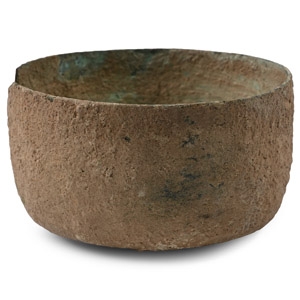
Graeco-Roman Bronze Cup
2nd century B.C.-1st century A.D.Sold for (Inc. bp): £221
Drum-shaped body with a slightly convex base. 143 grams, 93 mm
Ex London, UK, collections, 1990s-2000s. This lot is accompanied by an illustrated lot declaration signed by the Head of the Antiquities Department, Dr Raffaele D'Amato.
The small cup could belong to the typology of drinking vessels called mastos or cymbè. This denomination seems to have been derived from the inhabitants of the island of Paphos, with reference to the simple spherical vessels. Pollux mentions these vessels together with other cups, the phiale and the kumbion. -
.jpg)
Etruscan Silver Ring with Amethyst Scarab Seal
4th century B.C.Sold for (Inc. bp): £546
Wire hoop with ends wound round the shank at each shoulder with one end detached, swivel-mounted amethyst scarab seal with flat underside, segmented border around a dolphin with putto mounted on its back. 5.44 grams, 30.77 mm overall, 25.27 mm internal diameter (approximate size British W, USA 11, Europe 25, Japan 24)
From the private collection of Mr K.A., acquired in the 1990s-early 2000s. This lot is accompanied by an illustrated lot declaration signed by the Head of the Antiquities Department, Dr Raffaele D'Amato.
Egyptian-style scarabs and scaraboids were characteristic of Etruscan art from the 8th century B.C. Originally made in Phoenicia, Cyprus or Rhodes, these objects were made of faience, blue paste, glass paste and bone, or semi-precious stones of varying hardness, from steatite to quartz, onyx and jasper. Mounted in settings on revolving pendants of precious metal, which were later imitated by Etruscan goldsmiths, these Egyptianising items performed prophylactic-religious functions, through the use of sacred or magical imagery taken from hieroglyphic language: royal names or titles, theonyms, sacred symbols, and auspicious formulas.
