
Loading, please wait...
LOT 0319
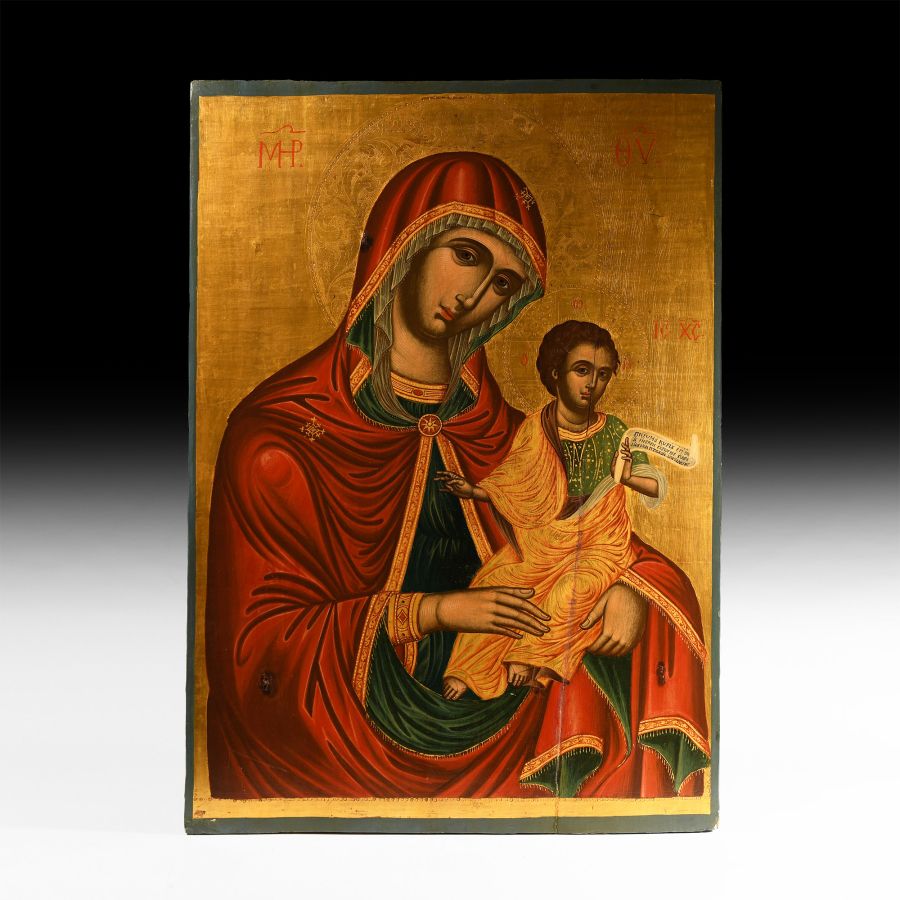
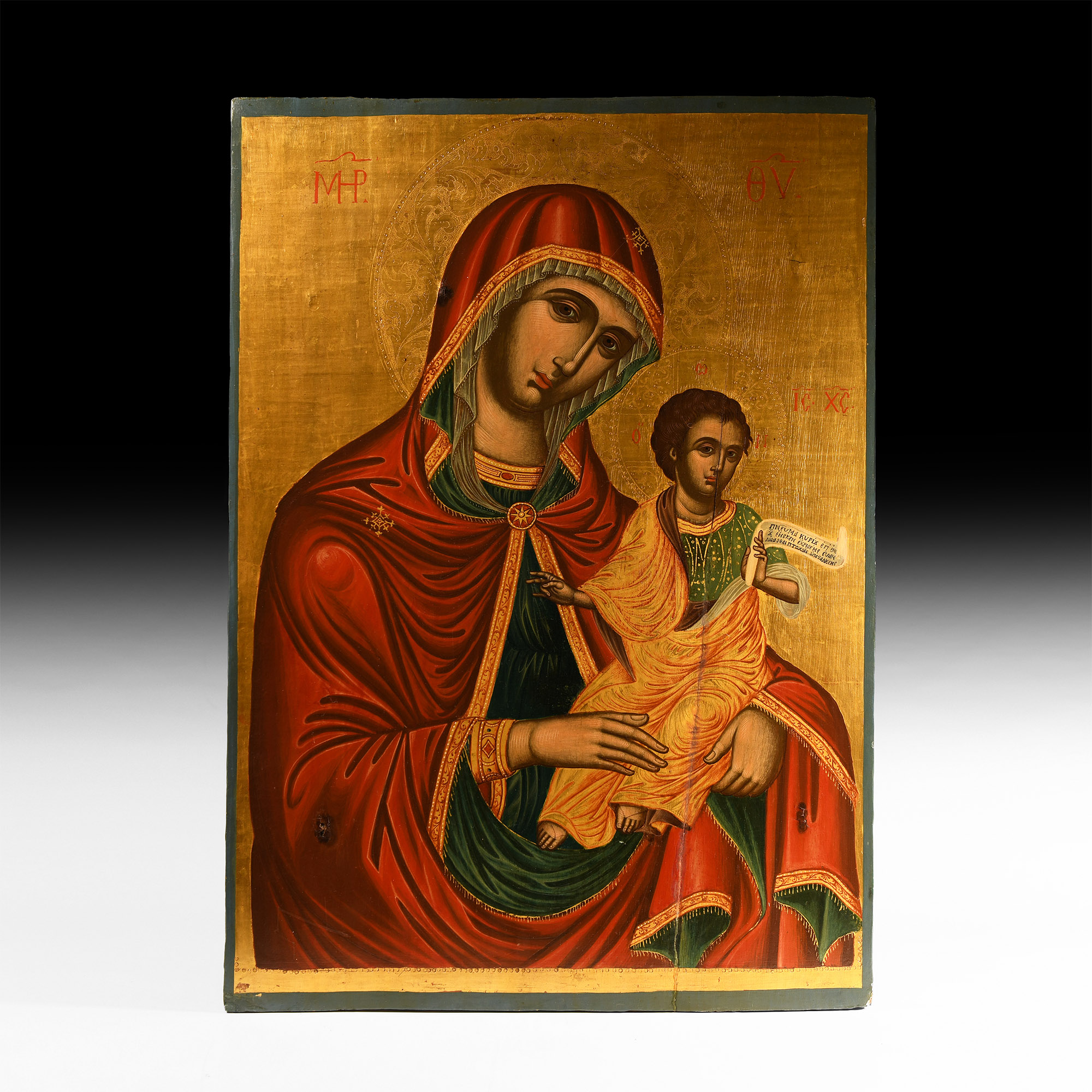
Large Veneto-Cretan Icon of Virgin and Child
17TH CENTURY A.D. OR LATER
23 5/8 x 16 3/4 in. (4.3 kg, 60 x 42.5 cm).
A large icon depicting the Virgin holding the Christ on her lap on a gilt background, both nimbate, the haloes with punched foliate decoration; the Virgin wearing a carmine red maphorion embellished with golden embroidery and fringes, elaborate cuffs and neckline to the himation; the Christ seated on the lap, holding his right arm out and making the blessing sign with his hand, left hand holding an open scroll inscribed in Greek πνευμα κυριου επ εμε ου ενεκεν εχρισεν με ευαγγελιζεσθαι πτωχοις απεσταλκεν με for 'The Spirit of the Lord is on me, because he has anointed me to proclaim good news to the poor' (Luke 4:18-21), the green chiton and orange himation embellished with red folds; Greek inscription 'ΜΡ ΘΥ' for 'Mother of God' flanking the Virgin's halo, 'IC XC' for 'Jesus Christ' to the right of the Child and inside his nimbus 'O Ѿ N' for 'The Only One who always exists'; some restoration.
ProvenanceProperty of a London lady, part of her family's collection.
Accompanied by an academic report by Dr Raffaele D’Amato.
This lot has been checked against the Interpol Database of stolen works of art and is accompanied by searcher certificate no.11572-198599.
See Weizmann, K. et al., The Icon, New York, 1982; Psilakis, N., Byzantine Churches and Monasteries of Crete, Heraklion, 1998; Popescu, G.A., Cristiani d'Oriente, spiritualità, arte e potere nell'Europa Post-Bizantina, Milano, 1999; Evans, H.C., The Arts of Byzantium, New York, 2001; Geelmuyden Bulgurlu, V., Ulf, A., Lindgren, N., Bodin, H., Balicka-Witakowska, E., Five essays on icons, Stockholm & Istanbul, 2005; the icon with the Virgin in the attitude of Mother of the Consolation, or in that of Hodegetria, shows similarity with other two icons of the same Cretan Guild, published by Popescu (1999, cat. nn. 144-145); Weizmann (1982, pp.310-315, 318) published a Veneto-Cretan Ritzos icon with stylistic similarities.
FootnotesIn the Orthodox church, the spaces between the columns close to the central doors of the Iconostasis (Holy Doors) are occupied by two proskynesis icons, representing Christ giving his blessings to the right and to the left the Virgin Mary, with or without the infant, or in interceding position known as Virgin Chalkoprateia type.
CONDITIONTimeLine Auctions follows a vetting process to ensure the authenticity and legality of all items, reinforcing our commitment to integrity and responsible trading. Each antiquity, antique, and coin lot undergoes thorough examination by a vetting committee of at least ten external specialists, professional trade association members, scientists, and archaeologists: Our Vetting Process
AUCTIONS:
TimeLine is a leading auction house specialising in antiquities, ancient art, collectables, natural history, coins, medals, and books. Our auctions offer museums, collectors, historians, and enthusiasts the opportunity to acquire unique and historically significant pieces.
LOT 0319
Large Veneto-Cretan Icon of Virgin and Child
Estimate £5,000 - 7,000€5,800 - 8,120 (for guidance only)$6,750 - 9,450 (for guidance only)
-
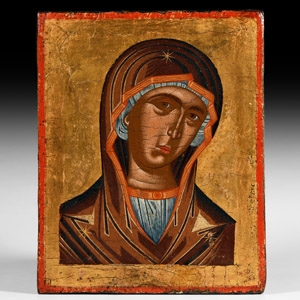
Veneto-Cretan Bust of the Virgin from a Deesis
17th century A.D.Estimate: £3,000 - 4,000 (+bp*)
Opening Bid: £1,350
A small icon from a Deesis, tempera on wood, depicting Mary on a gilt background inclining her head to the right, wearing a maphorion embroidered with gold stars, blue veil and a chiton of same colour; the reverse with a painted red cross with Greek lettering 'IC XI N K' for 'Jesus Christ is winner'. 554 grams, 20.2 x 16.5 cm
Gilding minimally worn, the border minimally restored; very fine condition.
Property of a London lady, part of her family's collection. Accompanied by an academic report by Dr Raffaele D’Amato. This lot has been checked against the Interpol Database of stolen works of art and is accompanied by searcher certificate no.11571-198600.
This splendid specimen comes most probably from a large icon, where it was part of a Deesis. The image implies that the original icon represented Christ flanked by the Mother of God and John the Baptist, all three usually represented as a full figure. The Deisis or Deesis (Деисус, Gk. for “supplication”) was the depiction of the Virgin, John the Baptist and possibly many more saints interceding with Christ on behalf of mankind. -
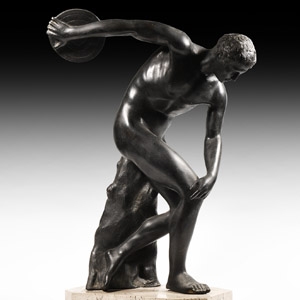
Diskobolos of Myron Statue
19th century A.D.Sold for (Inc. bp): £1,430
A copper-alloy copy of the original Greek bronze Diskobolos of Myron, portraying a youthful nude male athlete poised to spin to release his discus; naturalistically modelled; on a tiered octagonal stone display base. 27 kg, 65 cm high
French collection, 1960s-early 2000s. From an important Paris gallery, France. with Hampel Fine Art Auctions GmbH & Co KG, Munich, Germany, 12 December 2014, lot 1912.
The original Greek bronze (now lost) dated to circa 460–450 B.C., but the work is known through numerous Roman copies in marble. -
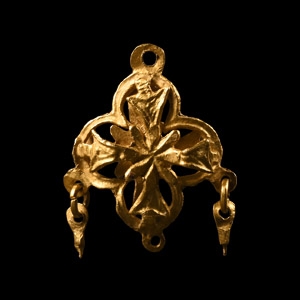
Elizabethan Gold Cross Pendant
16th-early 17th century A.D.Sold for (Inc. bp): £910
A gold bifacial cruciform pendant comprising: outer frame of four lobes confining a cross moline with saltire to the centre, pierced lug to three arms each with a gold dangle, fourth with larger pierced tab for suspension. 1.59 grams, 21 mm
Acquired 1980-2015. Ex Abelita family collection.
