
Loading, please wait...
_900x900.jpg "Large Stone Age Orange Jasper Knife Blade")
_200x200.jpg "Large Stone Age Orange Jasper Knife Blade")
_900x900.jpg "Large Stone Age Orange Jasper Knife Blade")
_200x200.jpg "Large Stone Age Orange Jasper Knife Blade")
.jpg "Large Stone Age Orange Jasper Knife Blade")
.jpg "Large Stone Age Orange Jasper Knife Blade")
LOT 1651
Large Stone Age Orange Jasper Knife Blade
ORANIAN PERIOD, CIRCA 15,000-9,000 B.P.
6 3/4 in. (156 grams, 17.2 cm).
Scaphoid in plan with facets to the upper face; old paper label 'Oranian' to obverse and inked legend to reverse 'Oranian 15k to 9k BC'.
ProvenanceFound North East Africa.
Acquired from a London gentleman in the 2020s.
TimeLine Auctions follows a vetting process to ensure the authenticity and legality of all items, reinforcing our commitment to integrity and responsible trading. Each antiquity, antique, and coin lot undergoes thorough examination by a vetting committee of at least ten external specialists, professional trade association members, scientists, and archaeologists: Our Vetting Process
AUCTIONS:
TimeLine is a leading auction house specialising in antiquities, ancient art, collectables, natural history, coins, medals, and books. Our auctions offer museums, collectors, historians, and enthusiasts the opportunity to acquire unique and historically significant pieces.
-
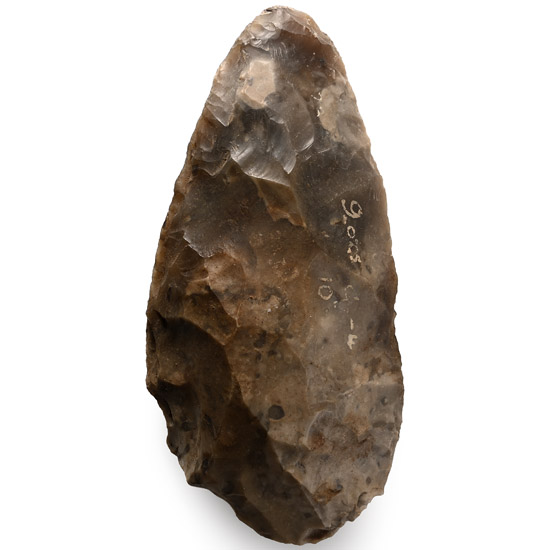
Farnham Stone Age Knapped Flint Axe
Neolithic Period, circa 6,000 B.P.Sold for (Inc. bp): £1,820
Leaf-shaped in profile with broad cutting edge and narrow butt; old inked legend '9 OCS' and others mostly effaced. 241 grams, 12.6 cm
Found during the original official excavations in the Farnham area, Surrey, UK, which were conducted by Harold Faulker (1875-1963), and William Francis Rankine (c.1877-1962), who were instrumental with the excavation works and pit dwellings at sites including Six Bells, Frensham, Tilford, Thursley and Bagshot, and Waverley, amongst others at and near Farnham in the 1930s and 1940s. Much of the material is now in the prestigious Farnham museum. The present part of the collection having been gifted to their good friend and Haselmere Parish Priest, Charles Borelli (c.1914-2000) of Farnham; who was part of the Borelli family from Italy who emigrated from Lake Como in 1828 to set up the Borelli family watch and jewellery business; thence by family descent to his nephew.
Farnham district is one of the most interesting prehistoric regions in England, and has been visited by a succession of prehistoric peoples from Palaeolithic times onwards. Along the southern slope of the Farnham valley are three gravel terraces, which are famous prehistorically and have yielded large quantities of flint implements and bones of prehistoric animals, notably the mammoth. In prehistoric times, the chalk deposits played an important role in attracting settlers, as they contained rich layers of flint nodules used to make implements. The Farnham Gravels have been an abundant source of Palaeolithic finds, most prominent being hand axes. The axes differ in type, and each type is associated with a cultural phase of the Palaeolithic period. Types similar to these are found in similar deposits in the Somme valley and in many English valley gravels. Neolithic people are known to have engaged in flint mining. Polished axes and leaf forms, arrowheads and knives, or possibly lance heads, are characteristic of Neolithic flint work. -
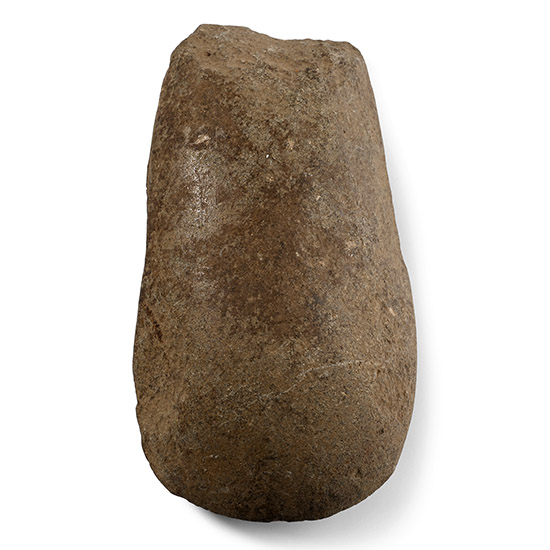
Published East Danish 'Limited Culture 4' Ertebolle Groundstone Limhamn Axe
South Scandinavian Mesolithic Period, circa 6300-5900 B.P.Estimate: £200 - 300 (+bp*)
Current Winning Bid: £100
Finely produced from local diabase/amphibolite and characteristic of the restricted Limhamn-Nivå tradition of North Sjælland and Scania; unusually well-polished for the type, with intact form and clear Mesolithic workmanship, possibly ceremonial. 406 grams, 11.5 cm
Found Aatoften Settlement, Nive Mill South, Nivaa, Denmark, 1970. From the private collection of amateur archaeologist Jorgen Faxholm, UK. Accompanied by copies of the relevant book pages where this axe is published.
This type represents a distinctive South Scandinavian Mesolithic tradition. Limhamn axes illustrate the indigenous technological development from the earlier Nøstvet and Lihult tools. While Limhamn axes are typically heavily scarred from knapping and crushing, this specimen appears unused and shows unusually fine grinding and surface finish, suggesting a piece of elevated status, adding limited practical use. The type is found exclusively in North Sjælland (Denmark) and Scania (Sweden), indicating a localised craft tradition with minimal external influence. A rare and representative example of Scandinavian Mesolithic stone craftsmanship, unbroken from Maglemose to Ertebølle. -
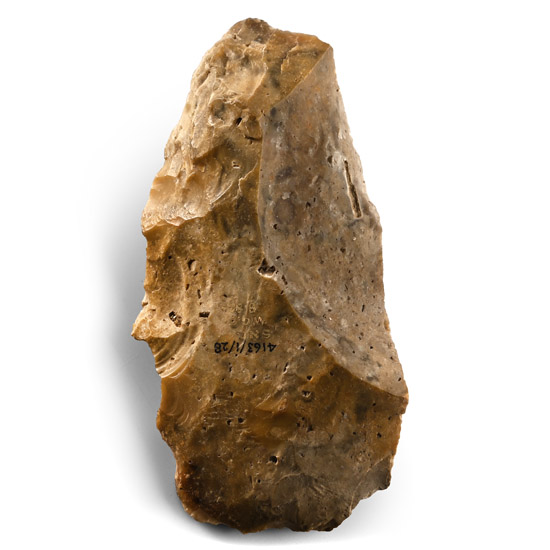
Stone Age Clactonian Flint Axehead
Lower Palaeolithic Period, circa 700,000-300,000 B.P.Sold for (Inc. bp): £46
Slender body with a rounded blade, inked collection number '4163/1/28'. 179 grams, 11.3 cm
Previously in an old Stone Age tool collection, having been annotated with an accession number. Acquired from an Oxfordshire, UK, auction house. From the private collection of a West Midlands lady collector.
