
Loading, please wait...
_900x900.jpg "Large Stone Age Knapped Axe Blade")
_200x200.jpg "Large Stone Age Knapped Axe Blade")
_900x900.jpg "Large Stone Age Knapped Axe Blade")
_200x200.jpg "Large Stone Age Knapped Axe Blade")
.jpg "Large Stone Age Knapped Axe Blade")
.jpg "Large Stone Age Knapped Axe Blade")
LOT 0311
Large Stone Age Knapped Axe Blade
NEOLITHIC PERIOD, CIRCA 5500-2200 B.P.
13 5/8 in. (1.29 kg, 34.5 cm).
Worked on all sides into an almost symmetrical shape; lanceolate cross-section; beige flint (silex) with cream-coloured spots and dots; waxy surface sheen.
ProvenanceFindspot 'Reuilly sur C.1927', France.
Ex M.M., Paris.
French art market, 2019.
This lot has been checked against the Interpol Database of stolen works of art and is accompanied by search certificate number no.12473-228700.
This lot has been cleared against the Art Loss Register database, and is accompanied by an illustrated lot declaration signed by the Head of the Antiquities Department, Dr Raffaele D'Amato.
TimeLine Auctions follows a vetting process to ensure the authenticity and legality of all items, reinforcing our commitment to integrity and responsible trading. Each antiquity, antique, and coin lot undergoes thorough examination by a vetting committee of at least ten external specialists, professional trade association members, scientists, and archaeologists: Our Vetting Process
AUCTIONS:
TimeLine is a leading auction house specialising in antiquities, ancient art, collectables, natural history, coins, medals, and books. Our auctions offer museums, collectors, historians, and enthusiasts the opportunity to acquire unique and historically significant pieces.
-
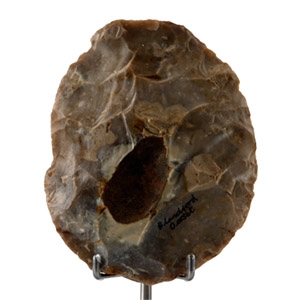
Large Stone Age Flint Ovate Handaxe
Palaeolithic Period, circa 450,000-300,000 B.P.Sold for (Inc. bp): £1,040
With silky cream and pale blue patina; small oval darker area forming part of the original cortex, potentially left to aid grip; inked notation 'Blandford / Dorset'; mounted on a custom-made display stand. 535 grams total including stand, axe: 13.3 cm
Found Blanford, Dorset, UK. From the collection of John Sharp, former well known archaeologist. Acquired on the UK art market. From the private collection of an East Anglian, UK, specialist collector. This lot is accompanied by an illustrated lot declaration signed by the Head of the Antiquities Department, Dr Raffaele D'Amato.
The Ovate form is uncommon. Attributed to Homo Heidelbergensis. -
.jpg)
Stone Age Published French Polished Handaxe
Neolithic Period, circa 4500 B.P.Sold for (Inc. bp): £104
Teardrop-shaped with narrow butt, rounded sides and deep curved edge with polished blade, remains of an inscription, 'purpaN'? to one side. 173 grams, 11.1 cm
From an old large French collection. Acquired on the European art market. From the private collection of an East Anglian, UK, specialist collector. Accompanied by a copy of the relevant book pages where this handaxe is published. This lot is accompanied by an illustrated lot declaration signed by the Head of the Antiquities Department, Dr Raffaele D’Amato. This lot is accompanied by an illustrated lot declaration signed by the Head of the Antiquities Department, Dr Raffaele D'Amato. -
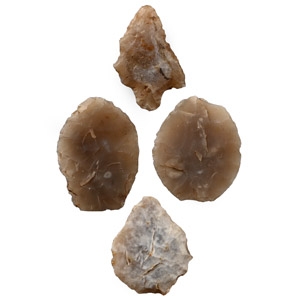
Stone Age Flint Arrowhead Group
Neolithic Period, circa 5000 B.P.Sold for (Inc. bp): £20
Four paper-thin ovate arrowheads. 5.6 grams total, 22-26 mm
Found Thames Valley in the 19th century. From an antiquarian Palaeolithic study collection, Shropshire, UK. This lot is accompanied by an illustrated lot declaration signed by the Head of the Antiquities Department, Dr Raffaele D'Amato.
