
Loading, please wait...
LOT 0249
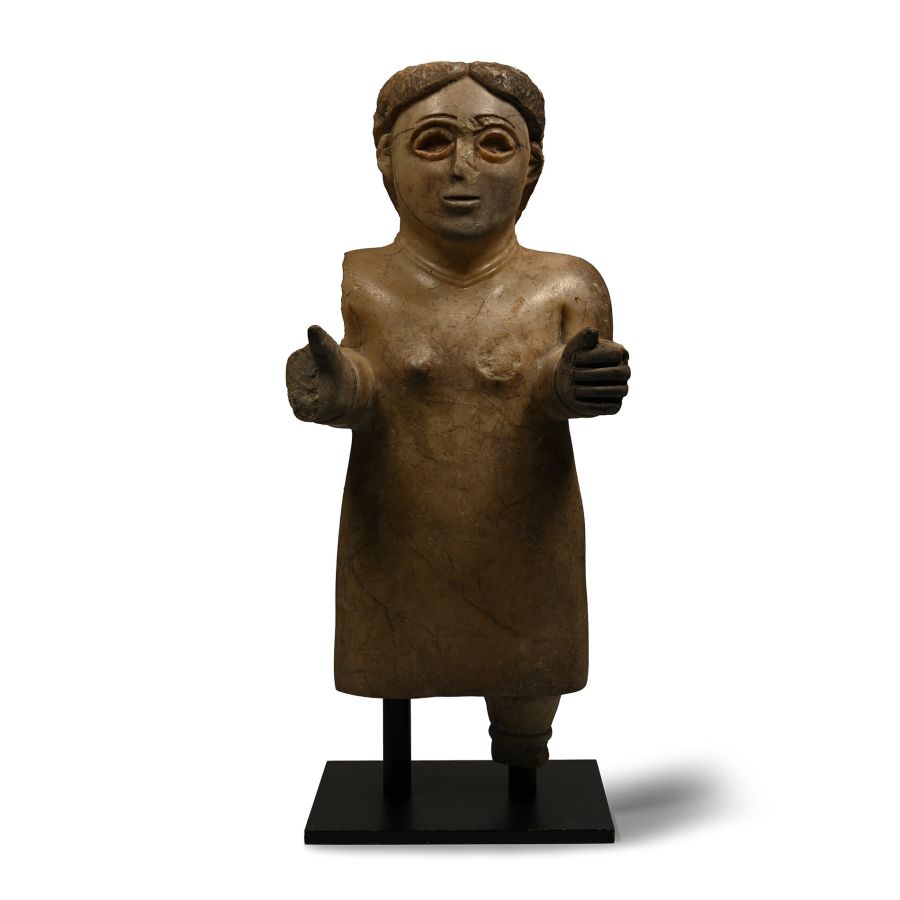
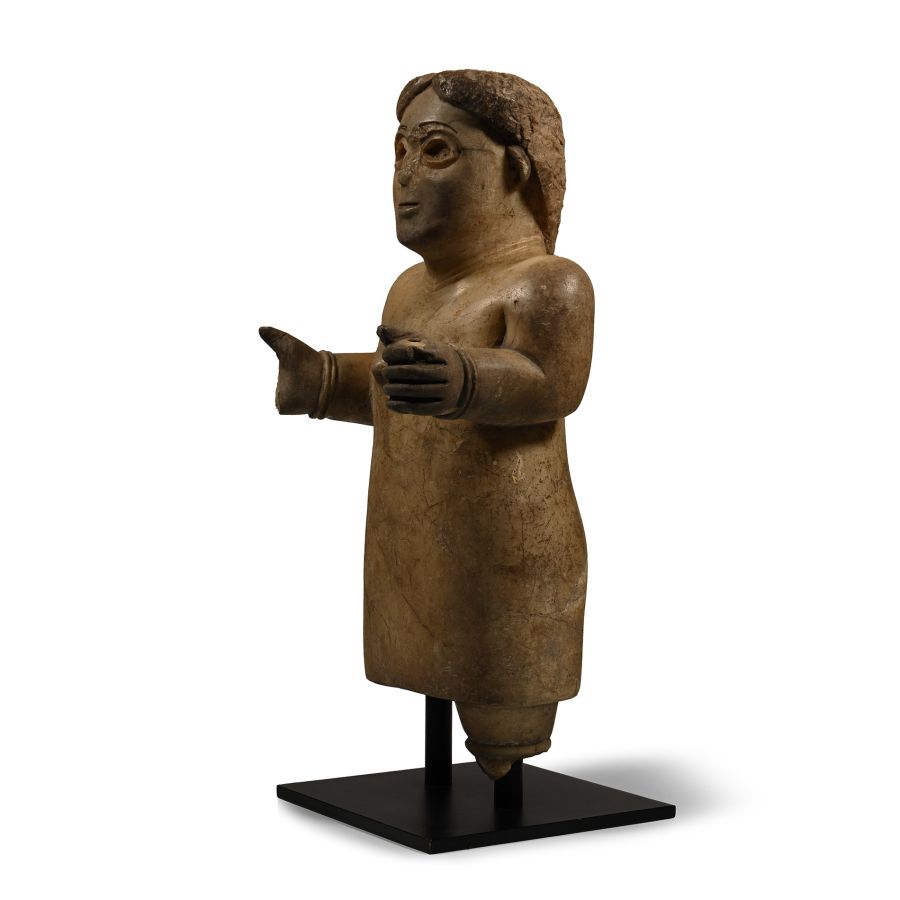
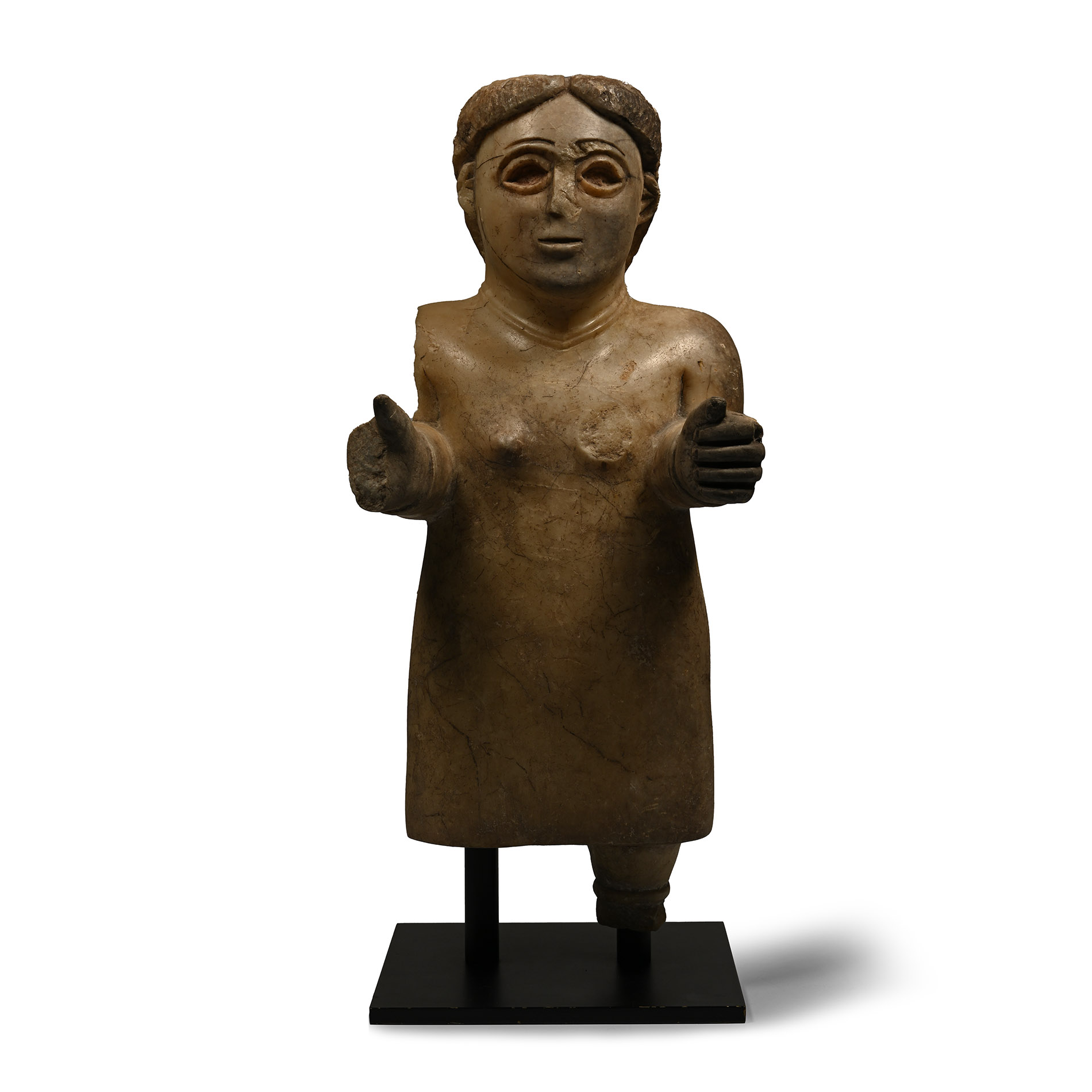
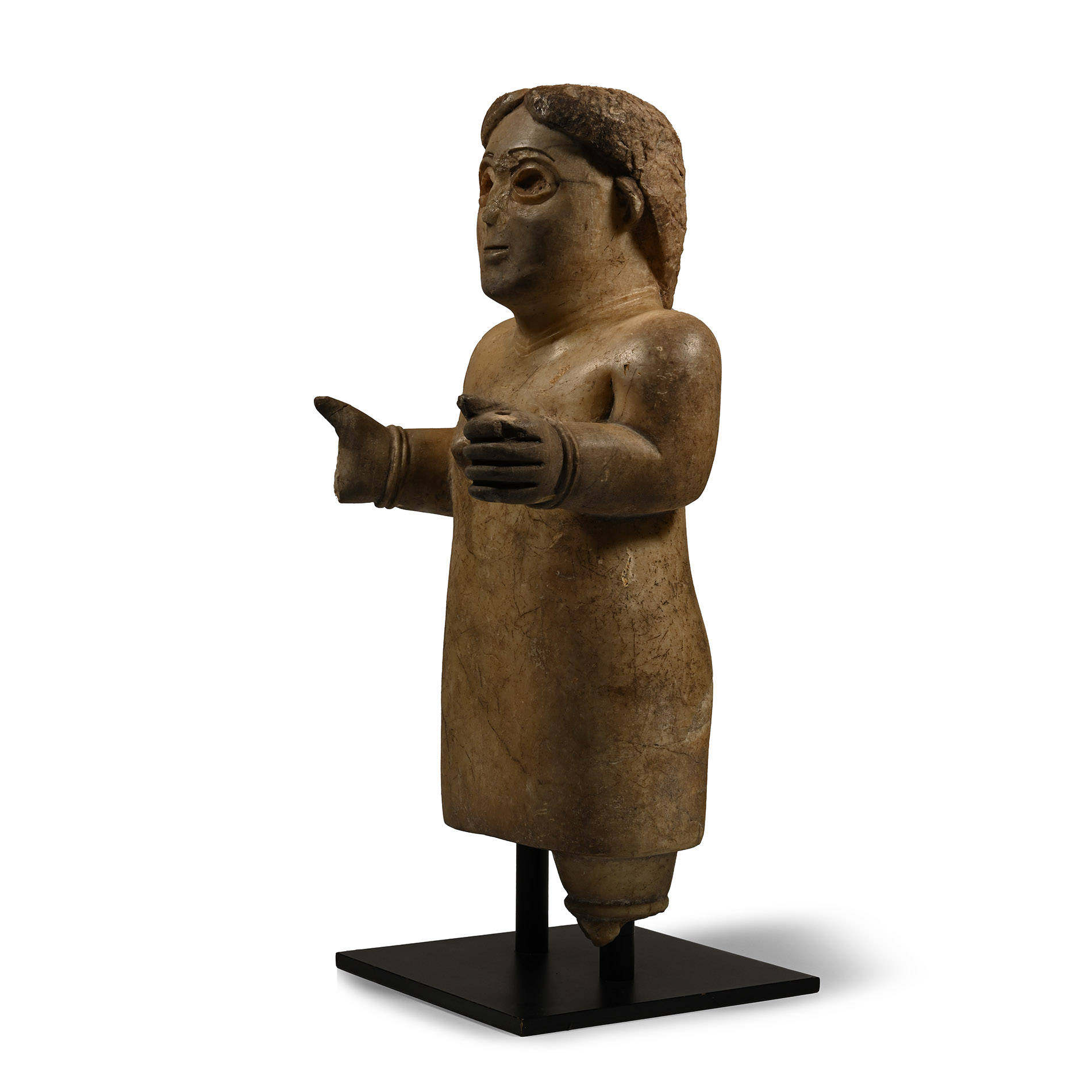
Large South Arabian Alabaster Standing Figure of a Goddess
1ST CENTURY B.C.-1ST CENTURY A.D.
18 3/4 in. (15.55 kg total, 47.5 cm high including stand).
Modelled in the round figure of a standing deity with textural detailing to the hair, naïve facial features with exaggerated eyes to accept inserts (absent) and slit mouth, gripping hands held out at the chest and one pierced to accept an attribute, knee-length garment, collar or necklace below the throat; mounted on a custom-made stand.
ProvenanceEx Hans G. collection, Belgium, 1967-1983.
Belgian art market, 1983.
Private German collection of Mrs H., 1985-1993.
with Pierre Bergé & Associés, Paris, 26 November 2013, no.198 (€40,000-45,000).
Accompanied by an academic report by Dr Raffaele D’Amato.
Accompanied by a copy of the relevant Pierre Bergé & Associés printed catalogue pages (double page spread).
Accompanied by a copy of an Art Loss Register certificate no.S00119290.
This lot has been checked against the Interpol Database of stolen works of art and is accompanied by search certificate number no.12468-230327.
This lot has been cleared against the Art Loss Register database, and is accompanied by an illustrated lot declaration signed by the Head of the Antiquities Department, Dr Raffaele D'Amato.
Cf. for sculptures of the same type and size, see the Louvre, Qatabanian funerary statuette of Ammalay of the Dharah’il clan, inventory no. AO20282, in Calvet, Y., Robin, C., Arabie heureuse, Arabie déserte: les Antiquités arabiques du Musée du Louvre, Paris, 1997, pp.114-115, no. 25; Simpson, S., Queen of Sheba. Treasures from Ancient Yemen, London, 2002, pp.64-65, nos.34-36, statues from Aswan; British Museum, sculpture of a woman from Marib, accession no.1966.0725.1., p.194, no.369; cf. also BM, museum numbers 122005 and 122008, for further similar statuettes.
FootnotesSimilar free-standing statues have been found in the royal cemetery in Aswan (probably Khazinet ed-Darb in the Wādī Markha), and at Hayd ibn Aqil (Timna), in Yemen. They are mainly statuettes from the Yemeni kingdoms of Awsan and Qataban, which developed in the Beihan Valley. They represent rulers or important dignitaries of both reigns.
The statue is remarkable for the detailed treatment of the facial features, hair and dress: the woman is portrayed wearing a long plain dress, similar to the modern futah of Yemenite people. The eyes were originally inlaid with shell set with polished obsidian pupils, giving a life-like effect to the static statuettes.
TimeLine Auctions follows a vetting process to ensure the authenticity and legality of all items, reinforcing our commitment to integrity and responsible trading. Each antiquity, antique, and coin lot undergoes thorough examination by a vetting committee of at least ten external specialists, professional trade association members, scientists, and archaeologists: Our Vetting Process
AUCTIONS:
TimeLine is a leading auction house specialising in antiquities, ancient art, collectables, natural history, coins, medals, and books. Our auctions offer museums, collectors, historians, and enthusiasts the opportunity to acquire unique and historically significant pieces.
LOT 0249
Large South Arabian Alabaster Standing Figure of a Goddess
Sold for (Inc. bp): £54,600
-
Western Asiatic Alabaster Circular Palette
1st millennium B.C.Sold for (Inc. bp): £26
Featuring attractive striations, circular in shape with a slightly convex base, concave top with a rounded recess off-centre. 47 grams, 45 mm
Ex London and Geneva collection, pre-1988. Accompanied by an old dealer's information label. This lot has been cleared against the Art Loss Register database, and is accompanied by an illustrated lot declaration signed by the Head of the Antiquities Department, Dr Raffaele D'Amato. -
Sasanian Gemstone in Silver Ring
5th-7th century A.D. and laterSold for (Inc. bp): £650
Ellipsoid lapis lazuli cloison with intaglio horse; set in a later stepped silver cell, D-shaped hoop with filigree to each outer edge; supplied with a museum-quality impression. 7.32 grams, 28.62 mm overall, 19.63 mm internal diameter (approximate size British T, USA 9 1/2, Europe 21.26, Japan 20)
with a London, UK gallery 1971-early 2000s. Private collection, London, UK. This lot has been cleared against the Art Loss Register database, and is accompanied by an illustrated lot declaration signed by the Head of the Antiquities Department, Dr Raffaele D'Amato. -
.jpg)
Akkadian Cylinder Seal with Contest Scene
Circa 2000-2300 B.C.Sold for (Inc. bp): £520
With frieze depicting rearing ibexes and lions in combat; supplied with a museum-quality impression. 9.21 grams, 24 mm
UK private collection before 2000. Acquired on the UK art market. Property of a London gentleman. This lot has been cleared against the Art Loss Register database, and is accompanied by an illustrated lot declaration signed by the Head of the Antiquities Department, Dr Raffaele D'Amato.
