
Loading, please wait...

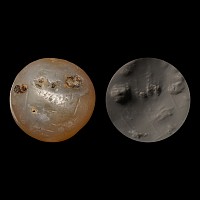

LOT 1653
Large Sasanian Agate Stamp Seal
CIRCA 4TH-5TH CENTURY A.D.
1 in. (18.52 grams, 27.58 mm).
Plano-convex in section with lightly incised geometric motif to underside. [No Reserve]
ProvenanceFrom the private collection of a European gentleman (1942-2024), formed since the 1970s.
CONDITIONTimeLine Auctions follows a vetting process to ensure the authenticity and legality of all items, reinforcing our commitment to integrity and responsible trading. Each antiquity, antique, and coin lot undergoes thorough examination by a vetting committee of at least ten external specialists, professional trade association members, scientists, and archaeologists: Our Vetting Process
AUCTIONS:
TimeLine is a leading auction house specialising in antiquities, ancient art, collectables, natural history, coins, medals, and books. Our auctions offer museums, collectors, historians, and enthusiasts the opportunity to acquire unique and historically significant pieces.
-
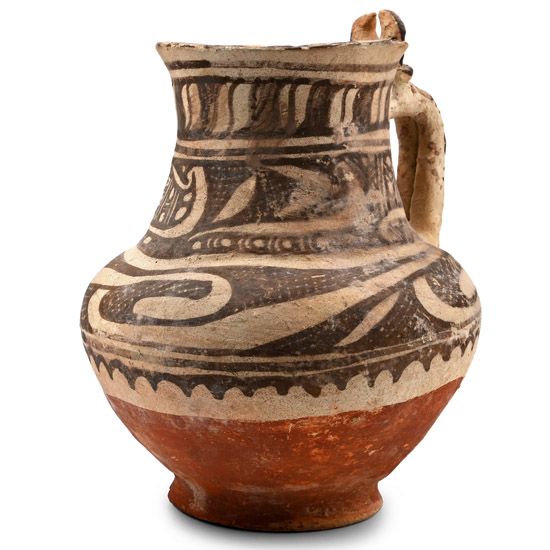
Large Western Asiatic Terracotta Painted Jug
8th-9th century A.D.Estimate: £300 - 400 (+bp*)
Opening Bid: £150
With squat profile, broad shoulder, wide neck and flared rim; strap handle with thumb-pad to the rim; bands of reserved tendrils on a hatched field. 818 grams, 18.5 cm
UK collection, 1990s. Acquired on the UK art market, before 2000. Private collection, Mr M.V., a London-based businessman. -
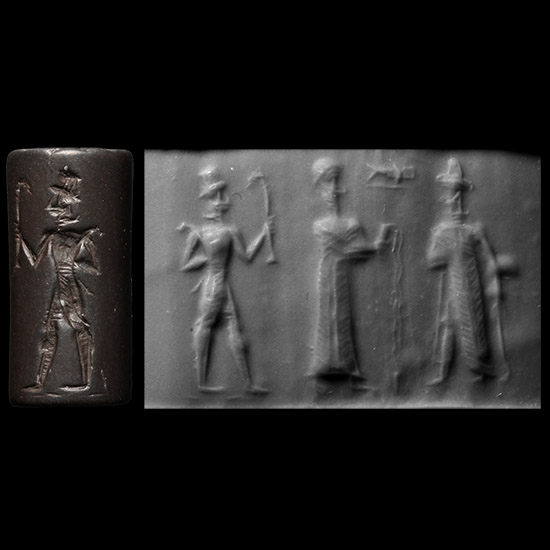
Old Babylonian Hematite Cylinder Seal with the Moon God Sin
Mesopotamia, 1900-1700 B.C.Sold for (Inc. bp): £416
With incuse frieze; accompanied by an old scholarly note, typed and signed by W.G. Lambert, late Professor of Assyriology, University of Birmingham, 1970-1993, which states: 'Cylinder seal of hematite, 19 x 9.5 mm., condition good. Three standing figures: to the right a standing god with horned tiara, holding a scimitar in the left hand, the right clasped at the waist; facing him a standing goddess holding a spouting jar, above her a fish perhaps with lion's face; to the left a god with short dress holding up a shepherd's crook. Old Babylonian, c. 1800-1600 B.C., but probably from northern Mesopotamia. The god with the crook is Amurru, god of shepherding. The other two cannot be identified.'; supplied with a museum-quality impression. 5.9 grams, 18 mm
Mr K. Kobayashi, Osaka, Japan, prior to 1992. Accompanied by a copy of an old scholarly note, typed and signed by W.G. Lambert, late Professor of Assyriology, University of Birmingham, 1992. -
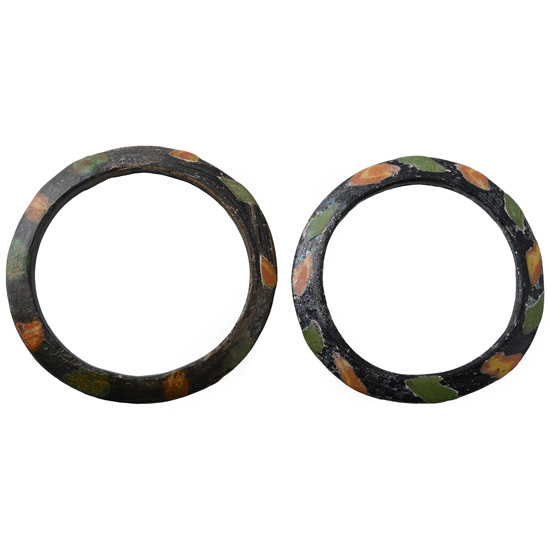
Western Asiatic Multi-Coloured Glass Bangle Pair
Circa 8th-9th century A.D.Sold for (Inc. bp): £39
A matching pair of large black bangles with polychrome highlights. 84 grams total, 94-98 mm
Acquired in the late 1980s-early 1990s. From an important North West London, UK, collection. Property of a West Northamptonshire, UK, gentleman.
