Loading, please wait...

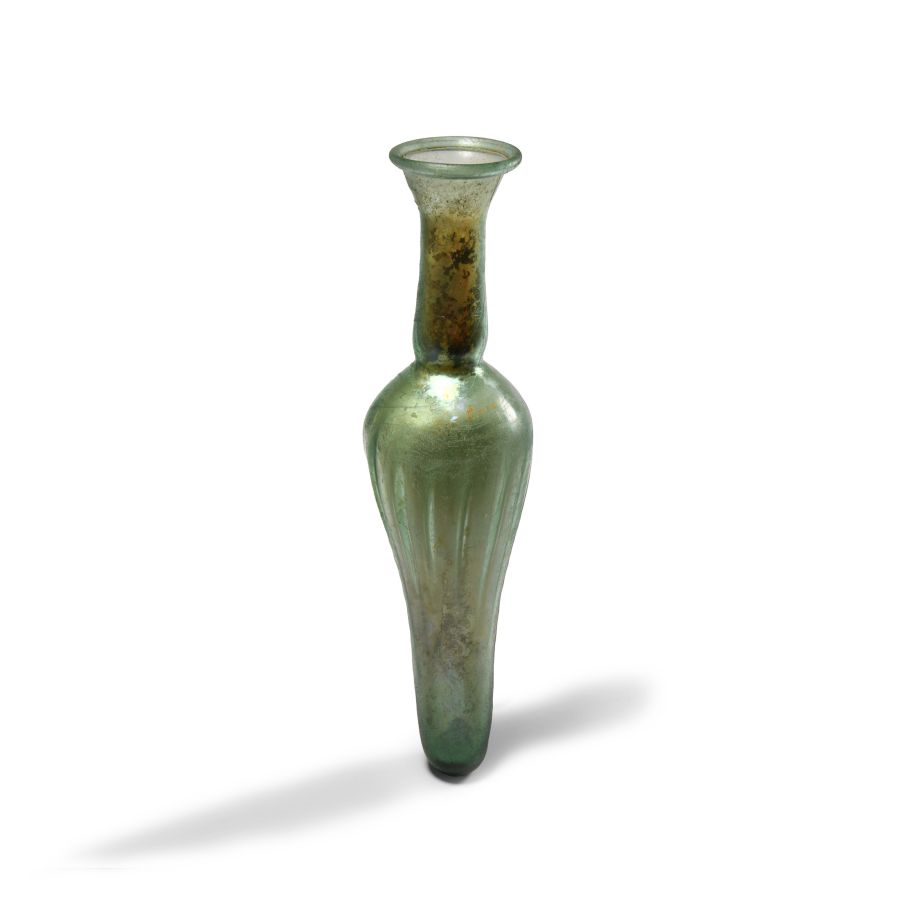
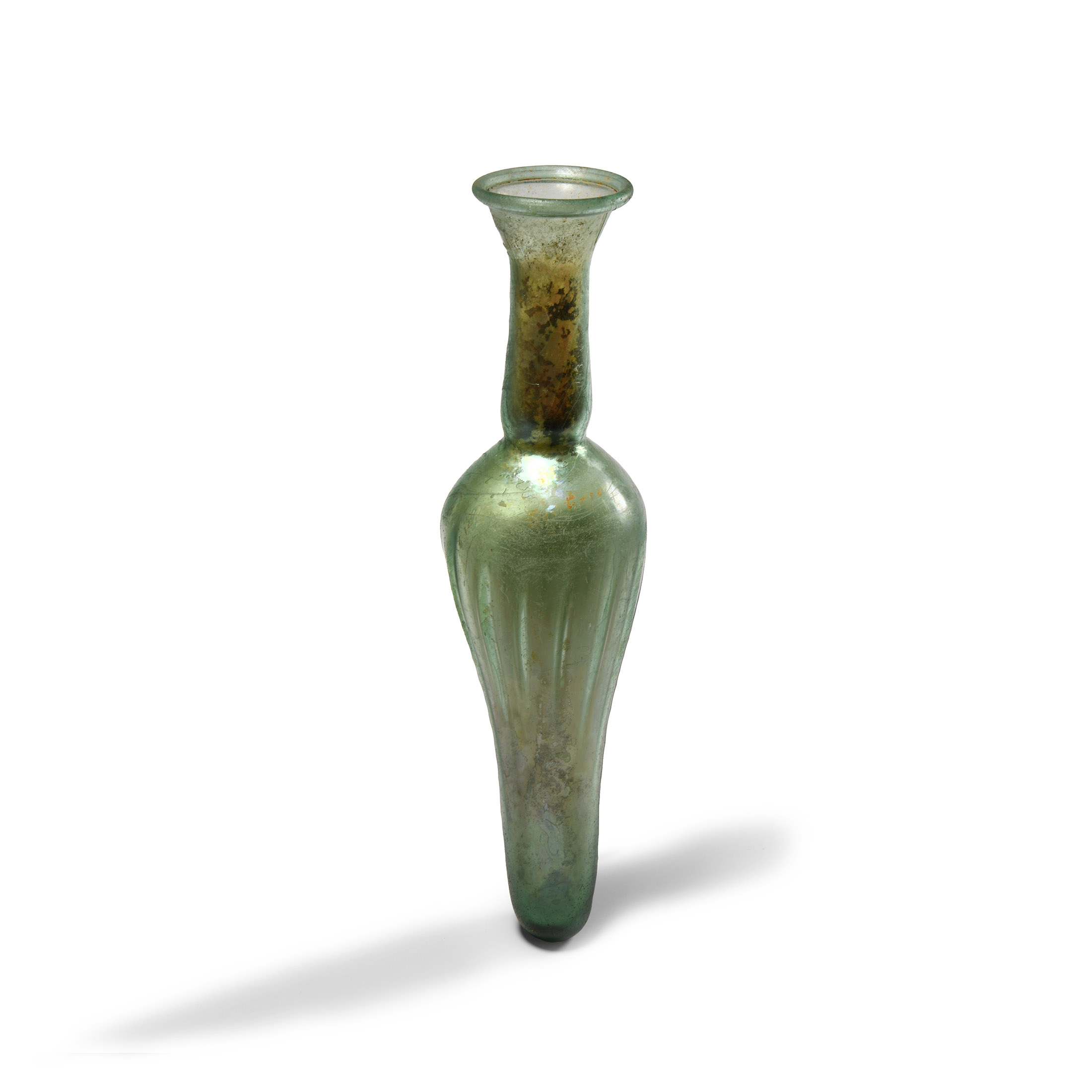
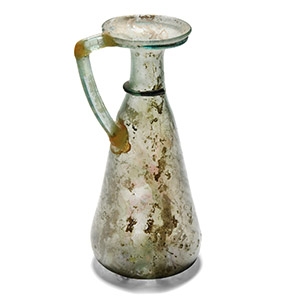
Large Roman Ribbed Glass Wine Vessel Large Roman Ribbed Glass Wine Vessel Large Roman Ribbed Glass Wine Vessel
Use mousewheel to zoom in and out, click to enlarge
Details

LOT 0147

Large Roman Ribbed Glass Wine Vessel

1ST-3RD CENTURY A.D.

12 1/4 in. (235 grams, 31 cm).

A large aqua glass vessel of fusiform shape, raised vertical ribs to the upper body, cylindrical neck with flared top, rolled rim; iridescent surfaces.

Provenance

French collection, 1960s-early 2000s.
From an important Paris gallery, France.

Literature

Cf. Lightfoot, C.S., Ancient Glass in the National Museums of Scotland, Edinburgh, 2007, item 335, for type.

CONDITION
VETTING:

TimeLine Auctions follows a vetting process to ensure the authenticity and legality of all items, reinforcing our commitment to integrity and responsible trading. Each antiquity, antique, and coin lot undergoes thorough examination by a vetting committee of at least ten external specialists, professional trade association members, scientists, and archaeologists: Our Vetting Process


AUCTIONS:

TimeLine is a leading auction house specialising in antiquities, ancient art, collectables, natural history, coins, medals, and books. Our auctions offer museums, collectors, historians, and enthusiasts the opportunity to acquire unique and historically significant pieces.

LOT 0147

Large Roman Ribbed Glass Wine Vessel

Estimate £1,800 - 2,400€2,090 - 2,780 (for guidance only)$2,430 - 3,240 (for guidance only)

Print page

RELATED LOTS
  • Gnostic Epigraphic Gemstone
    Gnostic Epigraphic Gemstone
    3rd-5th century A.D.

    Sold for (Inc. bp): £468

    An engraved gemstone with a stylised image of Harpocrates, depicted as a naked child with a finger raised on his mouth, seated on a lotus flower in a boat, groups of wild animals arranged in threes surrounding; the other side with a magic inscription in Greek letters 'I, E, A, P, Φ, K, Ο, Γ'. 1.25 grams, 14 mm


    Acquired before 1988. Ex family collection, by descent, Geneva.

    Egyptian deities are often represented on magical gems. One of the most interesting figures is the image of Harpocrates seated on a lotus flower, called ‘the young sun’. This figure had a solar nature and a protective function.

    Lot Details

  • Roman Military Eagle Staff Terminal
    Roman Military Eagle Staff Terminal
    2nd-3rd century A.D.

    Sold for (Inc. bp): £11,050

    A free-standing bronze imperial or military eagle terminal from a staff or a sceptre, modelled in the round in a dynamic pose standing on a globe, wings spread, head turned to the right, semi-naturalistic anatomical and feather detailing; the globe bearing an incised eight-armed stylised Macedonian star; sub-triangular lug to back of the neck; collar to globe with hollow underside. 166 grams, 88 mm high


    with Bonham's, London, Knightsbridge, UK, 16 May 2002, lot 301. Accompanied by a copy of the relevant Bonhams catalogue pages. Accompanied by an academic report by Dr Raffaele D'Amato. This lot has been checked against the Interpol Database of stolen works of art and is accompanied by search certificate number no.11582-198947

    In the Roman world, the eagle was associated with the god Jupiter or Zeus, king of the Olympian gods, and was seen as ‘the symbol and agent of apotheosis after death’. An eagle was released from the top of an emperor’s funeral pyre to signal the journey of the soul towards heaven. A sacred attribute of Jupiter, this eagle terminal may have been attached to a sceptre of the statue of the god. Eagles were also the principal standard of the legions, and became the military symbol for excellence.

    Lot Details

  • Roman Nude Crouching Woman Gaming Piece
    Roman Nude Crouching Woman Gaming Piece
    3rd century A.D.

    Sold for (Inc. bp): £1,755

    A bronze figure or gaming piece of a nude female in crouching pose with hands placed on the hips, possibly giving birth; the hair shown drawn up in a bun, segmented armband to each upper arm. 30.4 grams, 28 mm high


    Private Swiss collection, acquired 2002.

    The dice features six attitudes on which it could land when rolled, one of which includes the figure's head. The earliest concrete historical evidence of games played with dice originated from ancient Egypt, circa 3000 B.C., although it is generally believed by historians that dice pre-dated the ancient Egyptian civilisation. The Romans played two games using dice: Tali and Tesserae. The former originated in Greece and features four animal bones. The aim was to roll in such a way that each die displayed a different number-the higher the combined number, the greater the score. The latter was played using three dice, the goal being to roll triple six, or to achieve the highest combined numbers out of the contestants; it was a game of chance and the most common street and tavern gambling game in ancient Rome. ‘Dogs’ referred to poor scores and ‘Venus’ to high ones. Roman players rolled dice from a special cup called a fritillium onto wood, bronze, or marble boards, depending on their class and wealth. Roman elites boasted ornate boards inscribed with their names. The gambling which ensued from dice games caused extreme social issues in Roman society, leading the government to eventually outlaw dice games, although these laws were largely ignored.

    Lot Details

Stay up-to-date with the latest from TimeLine Auctions by joining our mailing list